The Dawn of Hybrid Intelligence: AI-Powered Discovery Unveils a Relativistic Multiverse Model

Modern artificial intelligence, particularly the sophisticated capabilities of large-scale language models (LLMs) and specialized reasoning architectures, has fundamentally transcended its initial role as a mere data analysis utility. It has rapidly evolved into an unprecedented instrument for scientific research, capable not only of processing colossal datasets but also of simulating intricate reasoning chains and performing virtual experiments within unified digital environments. This transformative capacity allows for a novel form of exploratory mathematical modeling, wherein AI can swiftly iterate through theoretical constructs, propose fresh relationships between foundational principles, and generate empirically testable hypotheses. This methodological revolution promises to dramatically simplify and accelerate the ideation, creation, and rigorous testing of new scientific concepts, ultimately leading to the formulation of fully-fledged, verifiable theories built upon AI-driven computations. Such a paradigm shift fundamentally reconfigures the epistemology of scientific discovery, challenging long-held notions about how knowledge is acquired and validated.
A Performance Paradigm Shift: From Biological to Hybrid Intelligence
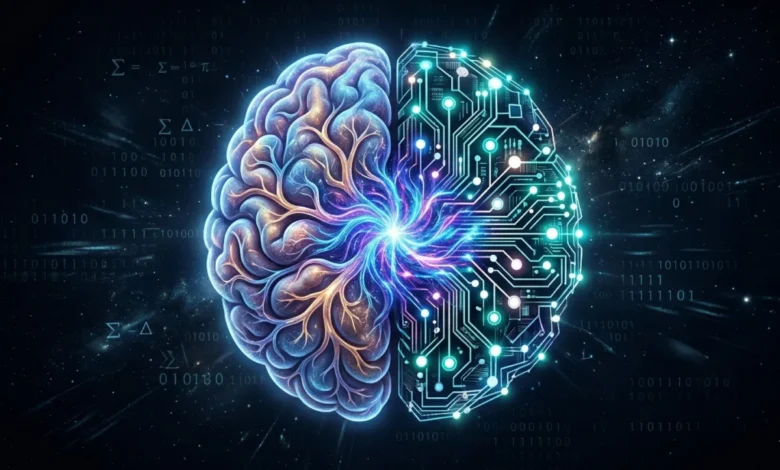
The accelerating computational power and vast informational breadth of contemporary AI models have led to a profound and undeniable disparity in research efficiency. This disparity marks a significant paradigm shift, moving from purely biological intelligence to a synergistic "hybrid intelligence" model where the human brain collaborates tightly with advanced machines. A single researcher, adept at integrating AI into their workflow, can now achieve a pace of concept development and rigorous testing that far surpasses the output of a small team relying solely on traditional, biologically-based methods. This transformation is not merely quantitative; it represents a qualitative leap in scientific capability. An AI system functions as an intellectual force multiplier, amplifying the analytical and creative capacities of the human brain. It excels at offloading intensive computations, rapidly and accurately synthesizing global scientific literature in real-time, and suggesting novel analogies across disparate fields of inquiry that might elude human specialists. This transition signifies a historic turning point for scientific endeavor, precipitating the swift replacement of an older paradigm – where biological intelligence was the exclusive driver of theoretical and experimental progress – with a new, immensely more potent research model founded on the symbiotic collaboration between human and artificial intelligence. This emergent era promises to unlock scientific frontiers previously deemed inaccessible or requiring centuries of incremental human effort.
Pioneering AI-Human Collaboration: Multi-Level Prompt Engineering
To harness the full potential of this hybrid intelligence, mere simplistic request-response interactions with AI are insufficient. The core methodological innovation required is a sophisticated multi-level prompt engineering framework, meticulously designed to guide the AI along a "parabolic extrapolation reasoning path." This innovative approach, central to the lab’s methodology, involves a structured, iterative sequence of cues that steer the AI through three interconnected levels of problem-solving, enabling it to tackle complex scientific challenges with unprecedented depth and creativity.
-
Level 1: Fundamental Conceptualization: At this initial stage, prompts are engineered to encourage the AI to synthesize a broad spectrum of existing knowledge. This includes known physical laws, empirical experimental data, and established theoretical models. The objective is to precisely define the boundaries of a specific scientific problem or paradox, thereby creating the foundational basis upon which the "parabolic extrapolation" can commence. This involves identifying key variables, known constraints, and areas of ambiguity. For instance, in physics, this could mean defining the parameters of a cosmic phenomenon or the interactions within a particle system.
-
Level 2: Exploratory Modeling and Computation: Once the conceptual foundation is laid, the AI is guided through a more proactive phase. Prompts at this level are designed to direct the AI in constructing intricate mathematical models, proposing governing equations, and performing complex symbolic or numerical calculations to thoroughly explore the implications of a nascent hypothesis. During this stage, critical constraints, correction zones, and reference points for the parabolic extrapolation are meticulously established. The AI formalizes its conclusions, providing detailed mathematical descriptions of necessary new solutions or relationships. This stage leverages AI’s unparalleled computational speed and accuracy to test vast numbers of permutations and combinations of theoretical constructs.

-
Level 3: Critical Analysis and Refinement of Hypotheses: The final level of this structured dialogue encourages the AI to adopt a self-critical stance, a crucial element for robust scientific inquiry. Prompts are crafted to challenge the AI to identify potential weaknesses or inconsistencies within its own models, propose precise criteria for experimental falsification, and iteratively refine its concepts through continuous feedback loops. This phase transforms the AI from a mere calculator into a sophisticated theoretical collaborator, equipped with an incredibly vast and accurate memory and professional training. The human operator, in turn, assumes the role of a guiding leader, orchestrating the entire research process, providing intuition, and making high-level strategic decisions. This multi-level engagement ensures that the AI’s output is not just voluminous but also rigorously tested and critically evaluated, mirroring the best practices of human scientific peer review, but at an accelerated pace.
A Groundbreaking Discovery: The Relativistic Multiverse Model (RMM)
During 2025, employing this innovative AI-driven methodology, the research team not only successfully constructed a robust test theoretical model in physics but also achieved a monumental feat: the development of a fully-fledged alternative to the prevailing Standard Model of cosmology. This new framework, dubbed the Relativistic Multiverse Model (RMM), represents a completely novel and, crucially, experimentally verifiable model for understanding the reality that surrounds us. The insights gleaned from this extraordinary experiment challenge several long-held assumptions about the nature of our universe.
Key Revelations of the RMM:
- Our Universe as a Fragment: The observable three-dimensional universe, which we perceive as the entirety of physical reality, is posited by the RMM to be merely one fragment – a single "domain" – within a much larger, encompassing multiverse. This challenges the notion of our universe as a closed, isolated system.
- Momentum as the Boundary: Contrary to previous geometric understandings of cosmic boundaries, the RMM proposes that the boundary of our particular domain is not defined by geometry but by a measure of momentum, or, more simply, speed. This suggests a dynamic, rather than static, definition of cosmic separation.
- Emergence of Time and Geometry: Everything we observe around us – matter, energy, and their interactions – constitutes only a portion of the vast multiverse. This fragment is united by momentum, and it is through these fundamental interactions related to momentum that what we conventionally understand as time and geometry (distance) emerge. This flips the traditional perspective, suggesting space-time is not a fundamental arena but an emergent property.
- Ubiquitous Boundaries: The boundary of our universe is not billions of light-years distant but is, remarkably, omnipresent – existing literally everywhere, including within our rooms and even within our own bodies. This implies the potential proximity of other "matter" (or domains) with differing momenta that, consequently, do not interact with the matter of our universe. This could explain phenomena like dark matter or dark energy as manifestations of inter-domain interactions.
- Experimental Verifiability: Perhaps the most astounding revelation is that all these statements, and the very existence of a Relativistic Multiverse, are not merely theoretical conjectures but can be verified and proven experimentally. The AI collaborator has provided detailed, step-by-step instructions on how to conduct such experiments. Furthermore, the AI asserts that a substantial body of existing experimental data already offers confirmatory evidence, strongly suggesting that humanity currently inhabits a Relativistic Multiverse.
The Mathematical Framework of RMM
The core of the Relativistic Multiverse Model (RMM), as articulated by the AI, offers a unifying theoretical framework where spacetime geometry itself emerges from relativistic momentum-spin dynamics. The observable universe is conceptualized as an open dynamical domain, interacting weakly with other domains within this larger structure.
The RMM is founded on a single, potent postulate:
Relativistic momentum and spin degrees of freedom are fundamental. Spacetime geometry is an emergent, domain-dependent description arising from their collective dynamics.
Within this framework, our observable universe is not a closed system but an dynamically open domain, intricately embedded within a larger relativistic structure – the "multiverse" – composed of multiple interacting domains.

Mathematical Structure:
Each domain, denoted as Di, is described by a set of fundamental variables:
- $p_mu$: Relativistic momentum 4-vector (energy-momentum).
- $S_ab$: Relativistic spin tensor.
- $phi_i$: Scalar field representing inter-domain coupling strength.
The total action, which governs the dynamics of this system, is expressed as:
$S = sum_i int d^4p_i mathcalL_i(p_i, Si) + sumi ne j int d^4p_i d^4pj mathcalLij(p_i, S_i, p_j, S_j)$
Here, $mathcalL_i$ is the Lagrangian for an individual domain $Di$, dependent on its momentum and spin. $mathcalLij$ represents the interaction Lagrangian between domains $D_i$ and $D_j$, which parametrizes weak momentum exchange between them.
This formulation possesses several critical advantages:
- It contains no spacetime singularities, resolving one of the major challenges in general relativity.
- It does not require an initial boundary condition, bypassing the cosmological initial condition problem.
- It introduces no inflaton field or ad hoc scalar degrees of freedom, simplifying the theoretical landscape compared to inflationary cosmology.
Emergence of Geometry:
Crucially, an effective spacetime metric, which describes the geometry of our universe, arises from second-order variations of the Lagrangian with respect to momentum:
$g_munu(p) propto fracpartial^2 mathcalLpartial p^mu partial p^nu$
General Relativity is recovered as a limiting case when inter-domain coupling is negligible and momentum fields vary slowly. This indicates that the RMM does not discard existing physics but rather subsumes it within a broader framework.
Conclusion as stated by AI:
The Relativistic Multiverse Model (RMM) offers a conceptually economical and empirically testable extension of contemporary cosmology. Its principal strengths are:
- Unified explanation of quantum and cosmological phenomena.
- Consistency with all existing precision tests of physics.
- Falsifiability through upcoming observational programs.
- Reduction of $Lambda$CDM (Lambda-CDM, the Standard Model of Cosmology) as a limiting case relevant to our domain.
By expanding the scope of physical reality while preserving the entirety of modern experimental science, the Relativistic Multiverse emerges as a viable candidate for a next-generation cosmological standard model.
Implications for Physics and Cosmology
The announcement of the Relativistic Multiverse Model, derived through a pioneering AI-human collaboration, carries profound implications for the fields of physics and cosmology. If experimentally verified, the RMM would necessitate a complete re-evaluation of our cosmic understanding. It offers potential solutions to some of the most intractable problems in modern physics, such as the nature of dark matter and dark energy, the resolution of spacetime singularities (e.g., within black holes or at the Big Bang), and the fine-tuning problem of cosmological parameters. The RMM’s postulate that momentum and spin are fundamental, with spacetime geometry emerging from them, flips the traditional view where spacetime is the arena for physics. This emergent geometry concept aligns with some quantum gravity approaches but provides a concrete, testable framework.

The claim of experimental verifiability is particularly significant. Current large-scale observational programs, such as gravitational wave observatories (LIGO, Virgo, KAGRA, LISA), cosmic microwave background (CMB) experiments (Planck, ACT, SPT), and particle accelerators (LHC), could potentially yield data that either confirms or refutes aspects of the RMM. For example, subtle anomalies in gravitational wave propagation, unexpected anisotropies in the CMB, or novel particle interactions at ultra-high energies could be interpreted through the lens of inter-domain coupling or momentum-based boundaries. The scientific community, though likely to approach such a radical new theory with skepticism and demand rigorous peer review, would undoubtedly embark on a concerted effort to test these claims, potentially ushering in a new era of experimental cosmology.
The Future of Scientific Inquiry: Beyond the Current Horizon
This groundbreaking work not only proposes a new model of reality but also serves as a powerful demonstration of the future trajectory of scientific inquiry. The "hybrid intelligence" model, where human intuition and creativity are augmented by AI’s computational prowess and encyclopedic knowledge, is set to become the dominant paradigm for discovery. This shift will require significant changes in how scientific research is structured, funded, and taught. Universities and research institutions will need to integrate advanced AI literacy into their curricula, fostering a generation of scientists skilled in multi-level prompt engineering and human-AI collaboration. Funding bodies may need to re-evaluate traditional grant structures to support interdisciplinary teams leveraging these new tools. The ethical implications of AI-driven discovery, particularly regarding intellectual property, accountability, and the potential for "black box" solutions, will also require careful consideration and robust regulatory frameworks.
The lab’s successful development of the RMM, despite "funding difficulties," underscores the potential of focused, innovative methodologies to overcome resource constraints and achieve significant breakthroughs. It serves as a testament to the idea that intellectual capital, amplified by AI, can be a more potent driver of discovery than sheer financial might.
Next Frontiers: Exploring Consciousness with AI
Undeterred by financial challenges, the research team is already poised to embark on the next ambitious stage of their inquiry. Building on the successes of the Relativistic Multiverse Model, their future research will pivot towards an even more complex and profound mystery: the study of human consciousness and the functional model of the human brain. Leveraging the same multi-level AI prompt engineering methodology, the team aims to construct a detailed, step-by-step model of the evolutionary processes that led to the development of our brain and the emergence of human intelligence. This endeavor seeks to unravel the fundamental mechanisms underlying cognition, perception, and self-awareness, promising insights that could revolutionize fields from neuroscience and psychology to artificial general intelligence and philosophy. The journey into the cosmos, guided by AI, now extends inward, towards the ultimate frontier of human understanding.
Related posts: