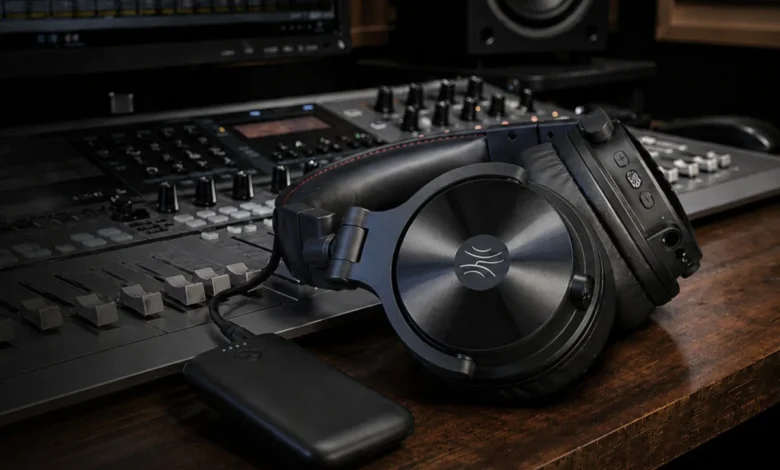
The OneOdio Studio Max 2 are closed-back, over-ear wireless headphones engineered to deliver a seamless audio experience across diverse professional and entertainment applications. Positioned strategically to bridge the functional gap often found between dedicated studio monitoring headphones and high-performance gaming headsets, these headphones are specifically tailored for developers, competitive gamers, and a broader spectrum of gadget enthusiasts who prioritize ultra-low latency and versatile connectivity in their daily routines. Their design philosophy integrates multiple wireless and wired modes, effectively mitigating the pervasive audio delay that frequently compromises the experience with standard Bluetooth headsets. The pivotal inclusion of a dedicated 2.4GHz transmitter, leveraging advanced RapidWill+ 3.0 technology, transforms the Studio Max 2 into a highly practical and indispensable tool for precision-critical tasks such as video editing, intensive coding sessions, and fast-paced gaming environments where synchronization is paramount.
The Evolving Landscape of Audio Technology: Demand for Low Latency
The contemporary digital landscape has significantly escalated the demand for high-fidelity, low-latency audio solutions. In an era dominated by remote work, collaborative content creation, and increasingly immersive gaming experiences, the traditional limitations of standard Bluetooth codecs, often introducing noticeable audio lag, have become a significant bottleneck. This delay, typically ranging from 100ms to 300ms, can be particularly detrimental in scenarios where immediate audio feedback is crucial. For professional video editors, even a slight delay can throw off precise cuts and synchronization. Similarly, for software developers debugging audio-centric applications or musicians monitoring their input, latency can severely impede workflow and accuracy. In the realm of competitive gaming, a millisecond’s difference in hearing footsteps or an enemy’s ability cue can be the decisive factor between victory and defeat.
This burgeoning demand has spurred innovation in wireless audio transmission technologies. While Bluetooth has evolved with codecs like aptX Low Latency, its ubiquity often means a compromise on either quality or latency. The emergence and refinement of dedicated 2.4GHz wireless solutions, often powered by proprietary protocols, have provided a robust alternative, offering significantly reduced latency figures that approach or even surpass wired connections. The OneOdio Studio Max 2 enters this market precisely at this intersection, aiming to offer a comprehensive solution that combines the convenience of wireless with the performance demanded by professionals and serious enthusiasts, thereby addressing a critical need that many general-purpose headphones fail to meet adequately. The product’s timing aligns with a broader industry trend towards hybrid devices that can adapt to multiple use cases without sacrificing core performance attributes.
Design Philosophy and Ergonomics: A Fusion of Heritage and Modernity
The aesthetic and structural design of the OneOdio Studio Max 2 reflects a conscious effort to blend robust functionality with subtle nods to the brand’s professional audio heritage. The headset predominantly features a matte black plastic body, which contributes to its overall lightweight profile while maintaining a sleek, professional appearance. This choice of material also aids in resisting fingerprints and minor scuffs, essential for a device intended for frequent handling and varied environments.
-
Aesthetic and Durability: Complementing the plastic housing, a numbered metal headband ensures precise and consistent size adjustments, providing both durability and a premium feel in a critical structural component. The numbered indicators are a thoughtful addition, allowing users to quickly recall and reset their preferred fit, enhancing user convenience, particularly in shared or multi-user settings. A distinctive design element is the exterior earcups, which proudly display a subtle yet sophisticated vinyl record groove pattern. This detail is not merely decorative; it serves as a direct homage to OneOdio’s foundational roots in DJ hardware, appealing to audiophiles and those who appreciate a touch of classic audio culture. The earcups themselves boast a highly practical design, capable of rotating a full 180 degrees and folding inward. This articulation significantly enhances portability and storage efficiency, making the headphones compact enough for travel. Furthermore, the ability to rotate the earcups facilitates single-ear monitoring, a feature indispensable for DJs, audio engineers, or anyone needing to maintain situational awareness while monitoring audio.
-
Comfort and Wearability: For sustained comfort during prolonged use, OneOdio has equipped the Studio Max 2 with memory foam earpads encased in high-quality protein leather. Memory foam is renowned for its ability to conform to the unique contours of the ear, distributing pressure evenly and creating an effective acoustic seal. The protein leather adds a soft, luxurious feel while being durable and easy to clean. The clamping force of the headset is calibrated to keep it securely in place without feeling overly tight, an important consideration for active users or those who move frequently while wearing them. However, it has been observed that after approximately two hours of continuous wear, the weight distribution can lead to a localized pressure point on the crown of the head. This necessitates occasional readjustment to alleviate discomfort, suggesting that while the headband padding is present, its efficacy for very long sessions could be further optimized.
-
Portability and Practicality: The physical footprint of the Studio Max 2 is notable due to its over-ear design, meaning it occupies a considerable amount of desk space when not in use. Recognizing the potential inconvenience this might pose for users on the go, the manufacturer includes a rigid EVA carrying case. This robust case is custom-fitted to securely hold the headphones when folded, along with all accompanying cables and accessories. The inclusion of such a high-quality protective case underscores OneOdio’s understanding of its target demographic’s mobility needs, offering solid protection against impacts and environmental elements during daily commutes, travel, or storage. This comprehensive approach to design, combining professional aesthetics, ergonomic considerations, and practical portability, positions the Studio Max 2 as a well-thought-out accessory for its intended users.
Advanced Connectivity: Bridging Wired and Wireless Performance
The OneOdio Studio Max 2 distinguishes itself with an impressive array of four distinct connection methods, offering unparalleled flexibility to adapt to virtually any audio source or usage scenario. This multi-faceted approach to connectivity is central to its appeal for tech enthusiasts and professionals.

-
The Promise of Ultra-Low Latency (2.4GHz): At the core of its performance claims for critical applications is the inclusion of the M2 USB transmitter. This compact dongle utilizes a dedicated 2.4GHz wireless connection, powered by OneOdio’s proprietary RapidWill+ 3.0 technology. This advanced protocol is engineered to deliver an astonishingly low audio latency of just 9 milliseconds (ms). To put this into perspective, standard Bluetooth connections typically exhibit latency in the range of 100-300ms, making them unsuitable for real-time monitoring or competitive gaming. Even specialized low-latency Bluetooth codecs rarely dip below 40ms. The 9ms latency of the Studio Max 2 rivals, and in some cases surpasses, that of many wired connections, effectively eliminating any perceptible delay between action and audio feedback. This feature is a game-changer for professional tasks such as video editing, where precise audio-visual synchronization is non-negotiable, and for competitive gaming, where immediate auditory cues can mean the difference between winning and losing. The 2.4GHz connection provides a robust and stable link, minimizing interference in busy wireless environments.
-
Versatile Wireless and High-Res Audio (Bluetooth 6.0 & LDAC): For general wireless convenience, the headset supports Bluetooth 6.0. This modern Bluetooth standard offers improved efficiency, greater range, and enhanced stability compared to older versions. Crucially, it incorporates multipoint pairing capabilities, allowing the headphones to connect simultaneously to two different devices, such as a smartphone and a laptop. This feature enables seamless transitions between listening to music on a computer and answering a call on a phone without manual re-pairing, greatly enhancing productivity and user experience. Furthermore, the Studio Max 2 supports the Sony LDAC codec for high-resolution wireless streaming. LDAC can transmit up to 990 kbps of data, significantly higher than standard Bluetooth codecs (like SBC at around 320 kbps), allowing for a more faithful reproduction of high-resolution audio files and providing a richer, more detailed listening experience for audiophiles when connected to compatible devices.
-
Professional Wired Integration: A testament to its professional aspirations, the headphones provide dual wired input jacks: a standard 3.5mm and a larger 6.35mm. These inputs are located directly on the earcups, allowing users to connect two different audio sources simultaneously. This unique "daisy-chaining" or "dual-source" capability is particularly valuable for audio professionals, such as DJs or studio engineers, who might need to monitor multiple audio feeds concurrently without switching headphones or using external mixers. It also offers a reliable fallback for zero-latency audio when battery power is depleted or when connecting to legacy equipment that lacks wireless capabilities. The inclusion of both common jack sizes eliminates the need for adapters, streamlining the setup process.
-
Software Ecosystem and Customization: To further enhance the user experience, OneOdio offers a dedicated companion app. This application allows users to customize various settings, including EQ profiles, to tailor the audio output to their specific preferences or listening tasks. The ability to set maximum volume limits through the app is a thoughtful addition for hearing protection, particularly useful for younger users or those prone to listening at excessively high volumes. This level of software control underscores the modern approach to audio device management, providing users with the tools to personalize their listening environment.
Limitations and Considerations:
Despite its robust feature set, the Studio Max 2 does present a few limitations. Notably, the headphones carry no official IP rating for water or dust resistance. This omission suggests that caution should be exercised in environments where the device might be exposed to moisture, such as during intense workouts or in rainy conditions. Users are advised to avoid using them in locations where water splashes are a possibility to ensure longevity. Another significant limitation pertains to the built-in microphone. While functional for Bluetooth calls, the microphone is disabled when the headphones are connected via the 2.4GHz transmitter or any of the wired audio cables. This restriction means that voice chat capabilities are strictly confined to Bluetooth mode, which could be an inconvenience for gamers or professionals who rely on the ultra-low latency 2.4GHz connection for audio but still require integrated communication. This design choice necessitates switching to Bluetooth for voice communications, potentially introducing latency back into the vocal channel, which might impact coordinated gameplay or professional conferences.
Sonic Performance: From Studio to Gaming Arena
The audio fidelity of the OneOdio Studio Max 2 is delivered through its 45mm High-Flux drivers, components chosen for their ability to reproduce a wide frequency range with considerable power. However, the initial out-of-the-box sound signature, particularly with the default "Music" EQ profile, leans towards a consumer-friendly tuning.
-
Driver Technology and Frequency Response: The 45mm drivers are engineered to move a significant volume of air, contributing to a robust bass response. In the default "Music" EQ setting, these headphones exhibit a pronounced emphasis on bass frequencies, often described as a V-shaped sound signature. While this can be enjoyable for casual listening of genres like pop, hip-hop, and electronic music, it simultaneously recesses the midrange frequencies. This recession can lead to a "muddy" sound, where bass elements overshadow vocals and instrumental nuances, making it challenging to discern individual elements within complex mixes. This particular tuning, while popular, may not be ideal for critical listening or tasks requiring analytical audio reproduction.
-
Tailored Sound Profiles: Recognizing the diverse needs of its target audience, OneOdio has addressed the default EQ balance through its companion mobile app. By applying the "Monitoring" preset or the custom DJ KSHMR profile, users can significantly flatten the frequency response. This adjustment is crucial for transforming the headphones from a bass-heavy consumer profile to a more neutral, analytical sound. A flatter frequency response tightens the low-end frequencies, making bass notes more defined and less boomy. Simultaneously, it brings the midrange forward, dramatically improving clarity and presence for vocals, guitars, and other crucial instruments. For audio engineers, this "Monitoring" profile is essential for accurate mixing and mastering, allowing them to hear the audio as faithfully as possible without artificial coloration. For competitive gamers, this improved midrange clarity and tightened low-end response are invaluable for isolating distinct directional audio cues, such as footsteps, gunshots, or environmental sounds, providing a significant tactical advantage.
-
Passive Isolation vs. Active Noise Cancellation: The Studio Max 2 does not incorporate Active Noise Cancellation (ANC) or transparency modes. Consequently, its ability to reduce external noise relies entirely on the passive isolation provided by its physical design, specifically the memory foam earpads and the closed-back earcups. The memory foam, by conforming to the shape around the ear, creates a decent seal that effectively blocks out a significant portion of standard ambient room noise, such as computer fan hums, low-level office chatter, and the sound of keyboard typing. This level of passive isolation is generally sufficient for focused work in relatively quiet environments. However, in louder, more dynamic settings like bustling coffee shops, public transport, or open-plan offices with significant background noise, the passive isolation will inevitably be overcome, allowing considerable external sounds to bleed through. Users seeking complete immersion in noisy environments or those requiring active noise cancellation for travel may find this a notable limitation compared to headphones equipped with ANC technology.
-
Microphone Clarity for Communication: For communication purposes, the built-in microphone, when used in Bluetooth mode, captures clear voice audio. This makes the Studio Max 2 suitable for standard phone conversations, video conferencing, and general online meetings. The clarity is sufficient for professional communication, ensuring that the user’s voice is understood without significant distortion or muffling. However, as noted earlier, the microphone’s limitation to Bluetooth mode means that users relying on the ultra-low latency 2.4GHz connection for gaming or professional audio work will need to either switch to Bluetooth for communication or utilize an external microphone solution, which could complicate setups for some users.

Endurance and Value Proposition: Powering Through Extended Sessions
A standout feature of the OneOdio Studio Max 2 is its exceptional battery performance, positioning it as a leading contender in its category for endurance. This robust battery life is a critical factor for professionals and enthusiasts who require reliable, long-duration audio playback without constant recharging interruptions.
-
Unrivaled Battery Life: On a single charge, the headphones deliver an impressive maximum of 120 hours of continuous audio playback when connected via Bluetooth. This figure far exceeds the industry average for wireless headphones, many of which offer between 20 to 60 hours of battery life. Such extensive endurance makes the Studio Max 2 ideal for extended work trips, long gaming sessions, or weeks of casual listening without needing to worry about daily recharging. When utilizing the higher-performance 2.4GHz transmitter for ultra-low latency audio, the total runtime, while reduced, remains highly competitive at 50 hours. This still represents several days of intensive use, a testament to the efficient power management of the device. Recharging is facilitated via a modern USB-C port, offering convenience and compatibility with ubiquitous charging standards. Furthermore, the inclusion of a rapid charging feature is particularly beneficial: a mere five-minute fast charge can restore an impressive nine hours of listening time, effectively providing quick top-ups for urgent needs.
-
Market Positioning and Affordability: The OneOdio Studio Max 2 retails for $199.99 (USD). This price point places it firmly in the mid-range segment of the headphone market, where it competes with both general-purpose premium wireless headphones and more specialized gaming or studio-focused alternatives. Considering its versatile connectivity options, ultra-low latency performance, high-resolution audio support (LDAC), and remarkable battery life, the Studio Max 2 presents a compelling value proposition. It offers a feature set often found in more expensive professional or gaming headsets, making it an attractive option for users seeking high performance without an exorbitant price tag. The headphones are available for purchase directly through the OneOdio official website and major e-commerce platforms like Amazon, indicating a broad distribution strategy. Additionally, the availability of promotional discounts, such as a 15% reduction with a specific code, further enhances its affordability and market competitiveness, appealing to budget-conscious consumers looking for premium features.
Implications for the Modern Tech User
The introduction of the OneOdio Studio Max 2 has significant implications for how tech enthusiasts, professionals, and gamers approach their audio needs, particularly in an increasingly hybrid and interconnected world.
-
Empowering Content Creation: For video editors, music producers, and podcast creators, the ultra-low latency 2.4GHz connection is transformative. It virtually eliminates the frustration of audio-visual desynchronization, allowing for more precise editing and monitoring. The ability to switch to wired connections for critical studio work, or use Bluetooth with LDAC for high-fidelity playback of reference tracks, offers an adaptable toolkit that streamlines workflow. This device simplifies the audio chain, reducing the need for multiple specialized headphones and potential latency-introducing interfaces.
-
Enhancing Competitive Gaming: The 9ms latency through the 2.4GHz transmitter provides a genuine competitive edge for gamers. In fast-paced titles, the ability to hear and react to audio cues in near real-time can significantly improve performance and immersion. While the microphone limitation to Bluetooth is a consideration, many serious gamers already utilize dedicated external microphones, making this less of a drawback for the core competitive gaming demographic. The comfort and passive isolation further contribute to a focused gaming experience.
-
A Tool for the Hybrid Work Environment: The multipoint Bluetooth connectivity and clear microphone for calls make the Studio Max 2 highly effective for the hybrid worker. Seamlessly switching between a work laptop for video conferences and a personal phone for notifications or music is a practical advantage. The impressive battery life means fewer interruptions for charging during a busy workday or long travel. This adaptability caters directly to the modern professional who often juggles multiple devices and demands consistent performance across various tasks.
-
Consolidating Audio Gear: The OneOdio Studio Max 2 stands as an example of the convergence of different audio device categories. By offering a robust solution for both professional monitoring and high-performance gaming, alongside everyday wireless convenience, it reduces the need for users to invest in and manage multiple sets of headphones. This consolidation simplifies tech setups and offers a unified, high-quality audio experience across all facets of a tech-centric lifestyle.
In conclusion, the OneOdio Studio Max 2 carves out a distinct niche in the highly competitive audio market. Its core strength lies in its exceptional low-latency performance via the 2.4GHz RapidWill+ 3.0 transmitter, complemented by versatile connectivity options including Bluetooth 6.0 with LDAC and dual wired inputs. While minor considerations such as the microphone’s mode limitations and the lack of an IP rating exist, these are largely overshadowed by its professional-grade features, adaptable sound profiles, and industry-leading battery life. For developers, gamers, and tech enthusiasts who demand precision, flexibility, and endurance from their audio equipment, the Studio Max 2 presents itself as a thoughtfully designed and highly capable solution, poised to become an indispensable tool in their digital arsenal. Its strategic pricing further cements its position as a compelling option for those seeking high performance without compromise.