Nvidia’s ASPIRE Framework Introduces Self-Improving Robotics Through Autonomous Code Generation and Continual Learning

The field of artificial intelligence and robotics has long grappled with a fundamental bottleneck: the rigidity of software pipelines when deployed in messy, unpredictable physical environments. Traditional robotic programming relies on brittle control sequences that struggle to dynamically manage shifting physical dynamics, cluttered object configurations, and real-time execution failures. To address these systemic limitations, researchers from Nvidia and various partner universities have introduced ASPIRE, a novel framework designed to enable AI systems to autonomously write, execute, debug, and refine robot control programs through continual learning.
Unveiled as a major leap forward in AI research, ASPIRE—which stands for Agentic Skill Programming through Iterative Robot Exploration—operates much like a veteran robotics engineer. Rather than treating every new operational task as an isolated challenge, the framework uses closed-loop execution and evolutionary search to diagnose errors, isolate root causes, and distill successful repairs into a reusable skill library. This capability marks a decisive shift in the robotics industry, moving away from static, human-intensive programming paradigms and toward self-improving, agentic systems capable of accumulating transferable knowledge across diverse hardware configurations.
The Background and Evolution of Robotic Coding Agents
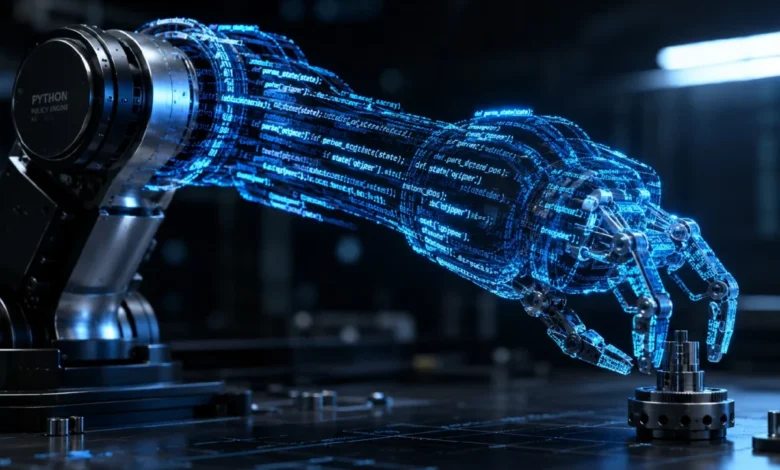
For decades, programming a robot required tedious, manual scriptwriting or complex teleoperation. However, recent breakthroughs in artificial intelligence coding agents have demonstrated that large language models (LLMs) can review execution traces, pinpoint coding errors, and iteratively refine scripts. This progress catalyzed the emergence of the "code-as-policy" paradigm, a methodology that translates high-level robot behaviors into executable Python programs that interface directly with perception tools, application programming interfaces (APIs), and motor control actions.

Instead of forcing an AI model to output raw motor torques—a notoriously difficult task prone to catastrophic physical errors—the code-as-policy approach has models generate readable scripts. Because these actions are written as code, they can be scrutinized, debugged, and optimized using direct interaction feedback from the robot’s sensors.
Despite these advances, existing robotic coding agents have faced severe operational hurdles. Historically, these systems have operated in naive environments that provide only coarse, task-level feedback—such as a binary pass-or-fail signal. Debugging a complex robotic program is inherently difficult because failures stem from a multitude of interacting subsystems, including multimodal perception pipelines, contact dynamics, grasp generation routines, and motion planning constraints.
If a robot fails to pick up an object, a basic failure signal does not reveal whether the root cause was faulty computer vision, an unstable physical grasp, or a collision-avoidance error triggered by the motion planner. Without fine-grained diagnostic traces to isolate the exact point of failure, prior agents lacked the ability to determine which evidence to inspect or how to construct an effective repair strategy. Furthermore, existing systems suffered from a lack of cumulative memory. When a standard AI agent successfully resolved a problem, it discarded the fix, meaning an agent attempting its hundredth task was conceptually no more experienced than an agent attempting its very first.
Mechanics of the ASPIRE Framework
To overcome these structural limitations, the development team behind ASPIRE designed an architecture that mimics the cumulative experience of human engineering teams. When human roboticists encounter a program failure, they systematically replay the execution logs, analyze perception outputs and motion trajectories, isolate the failing subsystem, and rewrite the underlying code. More importantly, they internalize these solutions, compounding their debugging experience into transferable heuristics that generalize across different operational tasks.

ASPIRE automates this exact human workflow through an integrated, three-component architecture:
-
The Closed-Loop Robot Execution Engine: Acting as an aviation-style "black box," this component records comprehensive multimodal traces whenever a task is executed. It logs what the robot saw, what the code outputted, where the motion planner threw an error, and the exact visual keyframes recorded right before and after a failure. This granular data allows the AI agent to accurately trace a failure back to a specific line of code or physical interaction.
-
The Compounding Skill Library: When the agent validates a successful repair, a central coordinator distills the solution into a reusable rule, heuristic, or debugging workflow. These insights—ranging from localization tricks and grasping constraints to navigation strategies—are permanently stored. Future agents can retrieve these skills as in-context guidance to drastically accelerate the resolution of subsequent, complex assignments.
-
The Evolutionary Search Procedure: Machine learning agents frequently fall into local minima, repeatedly tweaking the exact same flawed logic without making meaningful progress. To prevent this, ASPIRE employs evolutionary search to generate a diverse population of alternative control programs and task strategies simultaneously. By testing multiple code mutations in parallel, the framework explores fundamentally different pathways to solve a problem rather than getting trapped in a single failed trajectory.
Practical Applications and Real-World Scenarios

To understand the practical impact of ASPIRE, consider an enterprise warehouse deploying a mobile manipulator to retrieve a specific object from a crowded workbench. If the robot detects the object but halts its approach due to a motion-planning error—triggered because the target was mathematically too close to the table’s edge and violated a safety buffer—a traditional robot would require manual human intervention.
Under the ASPIRE framework, the execution engine pulls the logs, and the agent diagnoses that the perception system functioned correctly, but the motion planner threw a collision-avoidance error. Utilizing evolutionary search, the agent proposes and tests multiple code patches in parallel. Instead of altering the perception prompt, it writes a script instructing the robot to sample alternative approach angles (such as 45-degree, 90-degree, and 180-degree vectors) to discover a valid, collision-free path. Once validated, the successful multi-angle approach routine is extracted and permanently cataloged in the skill library.
Crucially, ASPIRE bridges the traditional gap between simulation and real-world deployment. Because the framework learns fundamental physical heuristics rather than memorizing environment-specific simulation code, skills discovered in high-speed virtual environments can be imported directly into physical robots. Even if the physical hardware features a different mechanical embodiment or a proprietary programming interface, retrieving these pre-learned skills significantly reduces the engineering effort required for real-world enterprise deployments.
Empirical Performance and Quantitative Results
To rigorously evaluate the framework, the research team powered ASPIRE’s core coding agent using advanced large language models, testing the system across multiple simulated benchmark families that assessed short- and long-horizon robotic navigation and manipulation tasks. For real-world transfer evaluations, the team deployed the framework to control a physical bimanual robot with a completely distinct mechanical structure and API interface.

The quantitative results demonstrated massive performance improvements across all tested environments:
- On the LIBERO-Pro benchmark, ASPIRE outperformed all state-of-the-art baselines, improving success rates by up to 77 percentage points on object perturbation tasks.
- On the Robosuite benchmark, the framework elevated a complex bimanual handover task from a mere 20 percent success rate to an impressive 92 percent.
- On long-horizon BEHAVIOR-1K tasks, ASPIRE surpassed both leading AI baselines and human experts in navigation and execution. Furthermore, when applying its accumulated skill library to unseen long-horizon tasks, the system achieved a 31 percent zero-shot success rate, drastically eclipsing prior methods which plateaued at just 4 percent.
In real-world deployment experiments, the efficiency gains were equally dramatic. When a physical robot was tasked with lifting a soda can, providing the agent with a previously learned simulation skill reduced the total reasoning tokens required for debugging by nearly an order of magnitude—dropping from approximately 61.94 million tokens down to 6.58 million—while boosting the final success rate from 65 percent to 95 percent. On a far more complex drawer-manipulation task, an unassisted agent burned through an exhaustive budget of nearly 335 million tokens without achieving a single successful execution. Conversely, when equipped with the transferred simulation skill, the system achieved an 11 out of 20 success rate while consuming only 81.67 million tokens.
Broader Implications and Future Outlook
The introduction of frameworks like ASPIRE highlights a broader industry pivot toward "loop engineering" and agentic artificial intelligence. As foundational reasoning models continue to advance, the integration of autonomous self-debugging and cross-domain skill transference addresses one of the most stubborn economic barriers in automation: the immense cost and labor of custom robotic programming.
By enabling robotic systems to diagnose their own operational failures, learn from accumulated experience, and seamlessly transfer physical heuristics from virtual simulations to real-world hardware, Nvidia and its academic collaborators have laid the groundwork for scalable, adaptive robotic fleets. As the research team prepares to open-source the underlying code, developers and enterprises alike gain a powerful toolset to accelerate the deployment of intelligent robotics into complex, open-world environments.
Related posts: