For decades, search engine optimization (SEO) professionals have relied on a foundational set of tools to verify whether a specific web page has been successfully indexed by search engines. The most prominent among these has been the site: operator, a command that forces Google or Bing to return all indexed URLs from a specific domain. Additionally, searching for a unique, verbatim snippet of text enclosed in quotation marks has served as the industry standard for confirming that a specific piece of content has been ingested and cataloged by a search engine’s crawlers. These methods, while rudimentary, have provided essential visibility for webmasters lacking direct access to proprietary diagnostic tools like Google Search Console (GSC) or Bing Webmaster Tools (BWT).
However, the rise of Generative AI and Large Language Model (LLM)-powered search experiences has introduced a layer of complexity to the discovery and retrieval process. As AI-native search engines shift from traditional link-based results to answer-driven interfaces, understanding how and why content is retrieved—or ignored—has become an urgent priority for digital marketers. While GSC and BWT remain the gold standards for granular diagnostic data, the current landscape necessitates a hybrid approach to verifying content visibility in the era of artificial intelligence.
The Shift from Traditional Search to AI Retrieval
The traditional methodology for verifying indexing—utilizing site: queries and verbatim snippet matching—is rooted in the early architecture of the World Wide Web. By using a query such as "exact text snippet," a webmaster could determine if a search engine had parsed their page and deemed it relevant enough to include in its database. This remains a highly effective, low-barrier diagnostic test. If a search engine returns the exact URL when a unique block of text from that page is queried, it serves as empirical evidence that the page has been discovered, crawled, and indexed.
In the contemporary search ecosystem, however, platforms like ChatGPT, Perplexity, and Google’s AI Overviews utilize different retrieval mechanisms. These models do not always display a linear list of results; instead, they perform semantic searches to identify information relevant to a user’s prompt. Consequently, if a page is not appearing in these AI-driven environments, the reasons may extend beyond simple indexing failures. It may be that the content lacks the necessary authority, topical relevance, or structural clarity to be selected by the LLM’s retrieval-augmented generation (RAG) system.
A New Diagnostic Workflow for AI Environments
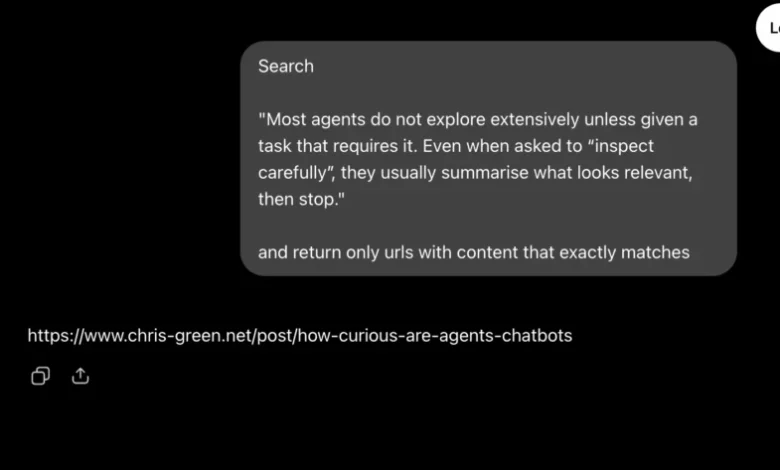
In the absence of direct analytics for how an LLM retrieves a specific page, SEO practitioners have begun adapting traditional search techniques into AI-specific prompts. By inputting a specific snippet of text into a chatbot and instructing it to return only the source containing that exact text, users can simulate a retrieval test. This process helps determine whether a search engine’s AI layer has ingested the content and, crucially, whether it can associate that content with the correct URL.
The utility of this method is twofold. First, it confirms the existence of the page within the AI’s current index. Second, it provides a baseline for troubleshooting. If a page fails to appear, the diagnostic steps remain similar to traditional SEO: checking for crawl blocks in robots.txt, ensuring the site is not suffering from canonicalization issues, or verifying that the page’s content is sufficiently unique to be indexed as an authoritative source.
Timeline of Search Indexing Evolution
The evolution of these verification methods can be categorized into three distinct eras:

- The Indexing Era (1998–2010): The introduction of the site: operator and the refinement of boolean search queries allowed webmasters to manually verify if their URLs existed within a search engine’s database.
- The Analytics Era (2010–2022): With the launch of Google Search Console and Bing Webmaster Tools, the industry shifted away from "guessing" via search operators toward data-driven insights. These tools provided direct logs of crawl errors, index status, and traffic data.
- The Retrieval Era (2023–Present): The integration of LLMs into search has prioritized "retrieval" over "ranking." Today, the primary challenge is not just being indexed, but being retrieved by an AI model that synthesizes information from multiple sources to answer a user’s query.
Data-Driven Implications for Content Strategy
Recent data suggests that AI search engines are increasingly selective about the sources they cite. A page may be indexed—meaning it exists in the search engine’s database—but fail to be retrieved for relevant queries. This "retrieval gap" is often a function of content quality and topical authority.
When a page is successfully retrieved via an AI chat prompt, it indicates that the search index has established a strong connection between the query and the content. If a page fails this test repeatedly, it may indicate one of three technical hurdles:
- Discovery Failure: The search engine has not yet crawled the URL. This is common for new sites or pages without internal linking.
- Indexing Delay: The page has been crawled but is held in a "pending" status due to quality thresholds or crawl budget limitations.
- Retrieval Exclusion: The page is indexed, but the AI model deems it irrelevant or of insufficient value compared to competing pages for the specific intent of the query.
Technological Solutions and Future Workflows
As the complexity of AI-driven search grows, manual testing—copying and pasting snippets into various chatbots—has become an inefficient workflow. To address this, developers are beginning to experiment with automation tools designed to bridge the gap. For instance, open-source browser extensions, such as the experimental "Exactly Matchy" project, have been developed to automate the process of querying AI chatbots for specific text strings. These tools allow users to verify indexing across multiple AI platforms simultaneously, significantly reducing the time required to perform manual audits.
However, the adoption of such tools carries inherent risks. Just as with any third-party browser extension, users must exercise caution regarding data privacy and code integrity. Reviewing the source code of any extension before installation is considered a best practice in the professional SEO community, as these tools often interact with user sessions on secure platforms.
Fact-Based Analysis of AI Search Challenges
The central challenge for modern webmasters is that AI responses are not "truth"—they are probabilistic outputs based on the data the model has retrieved. Therefore, a successful retrieval test in a chatbot does not guarantee that the page will rank or generate traffic. It only confirms the first, most fundamental hurdle: the page is reachable and recognized by the AI’s index.
If a page is discoverable through these tests but fails to drive traffic or feature in AI-generated answers, the solution lies outside of technical SEO. It requires a shift toward "Authority Optimization." This involves ensuring that the content provides unique, high-value insights that exceed the depth of the current consensus in the search index. As AI models prioritize information density and expert consensus, pages that rely on thin or redundant content are increasingly likely to be ignored, even if they are technically "indexed."
Conclusion
The transition from traditional link-based search to AI-driven retrieval has not rendered the old methods of SEO obsolete, but it has fundamentally changed how they are applied. While the site: operator remains a staple for technical verification, the modern SEO must now treat LLM retrieval as a critical, distinct phase of the content lifecycle. By combining traditional technical audits with new, snippet-based AI retrieval tests, professionals can maintain visibility in an increasingly opaque search environment. As the industry continues to iterate on these verification workflows, the focus will likely remain on ensuring that content is not only indexed but consistently available to the models that are increasingly defining the user experience of the modern web.