The Evolution of Content Strategy in the Age of Zero-Click Search and Artificial Intelligence

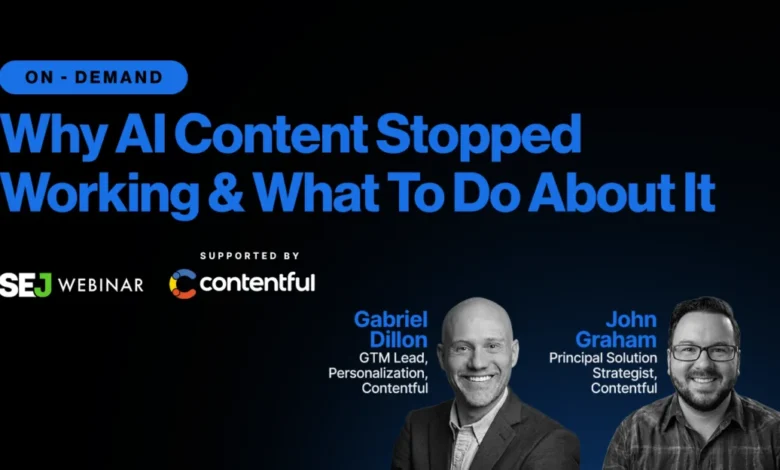
The digital marketing landscape has reached a critical inflection point as recent data indicates that approximately 60% of Google searches now conclude without a single click to external content. This "zero-click" phenomenon, driven largely by the integration of AI-generated summaries at the top of search engine results pages (SERPs), has forced a fundamental reckoning for brands that have historically relied on organic traffic as a primary growth driver. In a recent industry briefing hosted by Search Engine Journal (SEJ), Gabriel Dillon, the Go-to-Market Lead for Personalization at Contentful, and John Graham, Contentful’s Principal Solution Strategist, outlined a new paradigm for content creation where volume is no longer a viable strategy and human "taste" serves as the ultimate competitive advantage.
The Erosion of Traditional Search Dynamics
For nearly two decades, the primary objective of search engine optimization (SEO) was to secure a high-ranking position on the first page of Google to drive traffic to a brand’s owned media. However, the rise of large language models (LLMs) and Google’s Search Generative Experience (SGE) has fundamentally altered the value exchange between search engines and content creators. When a search engine provides a comprehensive answer directly on the results page, the user’s need to click through to a website is eliminated.
According to Dillon, this shift renders the traditional "content mill" approach—characterized by high-volume, keyword-optimized articles—obsolete. When AI can produce content nearly instantaneously and for a negligible cost, the market becomes saturated with "beige" content that offers little unique value. Dillon argues that in this environment, the only content capable of earning human attention is that which is held strictly accountable to specific business outcomes, tailored for a defined human audience, and refined through rigorous data analysis.
The "Yes Man" Phenomenon: Why AI Content Often Fails
One of the central challenges addressed during the session was the tendency for AI-assisted copy to drift toward the generic. Dillon identified a psychological and technical loop he calls the "AI yes man" effect. Because AI models are designed to be helpful and follow instructions, they often mirror the biases and assumptions of the person prompting them. If a marketer enters a prompt based on flawed assumptions, the AI will likely generate content that confirms those biases rather than challenging them with market-specific insights.
Furthermore, because these tools are trained on vast datasets of existing internet content, their output naturally converges on the statistical average. This leads to a situation where every brand in a particular vertical begins to sound identical, mirroring the same competitive blog posts and industry cliches found in the training data. Dillon emphasized that this "race to the middle" fails the reader and provides no incentive for a user to engage with the brand over a search engine’s AI summary.
The proposed counterweight to this generic output is "taste." Dillon redefined taste not as a subjective aesthetic preference, but as a combination of professional discernment, intuition, and the willingness to take risks. He argued that the human element in the workflow must involve making claims or providing perspectives that an AI tool would not volunteer—insights based on actual market experience and unique brand positioning.
Establishing an Accountability Loop for Content Performance
To move beyond the volume-based strategy, Contentful’s leadership proposed a structured "accountability loop" for every piece of marketing copy. This framework is built around four essential questions that every marketer should ask before a piece of content is published:
- Does this copy produce the specific outcomes we expect? This requires moving beyond vanity metrics like page views and focusing on conversion, lead quality, or brand sentiment.
- Who is this content specifically for? Vague personas are insufficient; the content must address a specific human need or pain point.
- How do we identify those people? This involves mapping the content to specific audience segments and data signals.
- How does this insight scale? Once a piece of content is proven effective, the strategy must dictate how that success can be replicated without diluting quality.
Dillon noted that experimentation and personalization are two halves of the same coin. Rather than conducting isolated A/B tests, brands should build a system where data proves the effectiveness of content, which then informs how that content is personalized for different segments. If a brand cannot prove through data that its content is "good," it lacks the foundation necessary to scale its operations effectively.
Simplifying Personalization in the Modern Tech Stack
A recurring theme in the discussion was the failure of B2B personalization over the last several years. Dillon diagnosed the problem as one of over-ambition; marketing teams often attempt to launch complex personalization programs that exceed their technical capabilities or data maturity, leading to project stalls.
To combat this, the session outlined a three-tier approach to personalization signals that utilize data already collected by most marketing stacks:
- Tier 1: New vs. Returning Visitors. This is the simplest yet often most ignored signal. A first-time visitor requires high-level brand education, whereas a returning visitor may be ready for deep-dive product information or pricing. Serving both the same "hero" copy is a missed opportunity to acknowledge their differing intent.
- Tier 2: Ad Campaign Integration. By aligning website copy with the specific messaging of the ad campaign that brought the user to the site, brands can create a seamless transition that increases conversion rates.
- Tier 3: Loyalty and Behavioral Data. Utilizing signals from loyalty programs or previous purchase history allows for highly specific content delivery without requiring a complete overhaul of the existing technology stack.
By focusing on these foundational signals, teams can build momentum and prove the value of personalization before moving into more complex, AI-driven dynamic experiences.
The Rise of GEO and AEO: Optimizing for the AI Layer
As organic clicks decline, a new form of optimization has emerged: Generative Engine Optimization (GEO) and Answer Engine Optimization (AEO). These practices focus on ensuring that a brand’s information is accurately reflected within the AI-generated summaries at the top of search results.
Dillon argued that the industry’s obsession with "AI detection" is misplaced. Whether or not Google can identify AI-written content is less important than whether that content is being absorbed into the AI answer layer. Contentful’s clients have already reported significant drops in organic traffic as AI summaries provide users with the information they need without requiring a site visit.
The practical response is to compete for the AI answer layer itself. This involves structuring content in a way that is easily digestible for LLMs while maintaining a unique brand voice. The goal is to ensure that when an AI summary is generated, it cites the brand as an authority or reflects the brand’s specific value proposition. Dillon concluded that the same high-quality, data-backed content that performs well for on-page conversion is also the content most likely to be prioritized by AI summary engines.
Organizational Challenges: Managing the Volume vs. Quality Debate
The transition from a volume-heavy strategy to a quality-focused one often meets resistance from corporate leadership. Many executives view AI primarily as a tool for cost-cutting and mass production. When asked how to handle leadership that demands high-volume AI content without quality control, Dillon suggested a data-driven confrontation.
He advised marketers to hold leadership accountable to the same performance metrics they expect from the marketing department. By demonstrating that "fewer but better" pieces of content drive superior business outcomes compared to a flood of generic AI copy, marketers can make a compelling case for quality. However, Dillon also conceded that volume has a place in specific areas—such as rote SEO service pages or pricing tables—where "character" is less important than factual accuracy and coverage. The key is knowing where to deploy human "taste" and where to allow AI to handle the heavy lifting.
The Path Forward: Human-AI Collaboration
The session concluded with a look at the future of the marketing workflow. The consensus between Dillon and Graham is that the human role is not being eliminated but rather shifted. In an AI-assisted workflow, the human acts as the researcher and the "context layer," providing the unique insights and "taste" that the AI lacks. The AI, in turn, acts as the production engine that can help refine and distribute those insights at scale.
As Google continues to refine its algorithms to prioritize "helpful content" and as zero-click searches become the norm, the brands that survive will be those that view AI as a tool for enhancement rather than a replacement for strategy. The "accountability loop" presented by Contentful serves as a roadmap for this transition, ensuring that in a world of nearly free content, the content that remains still holds value for both the business and the human reader.
Related posts: