Building Tactile UX Honoring Intentional Design with Lottie and Programmatic Control

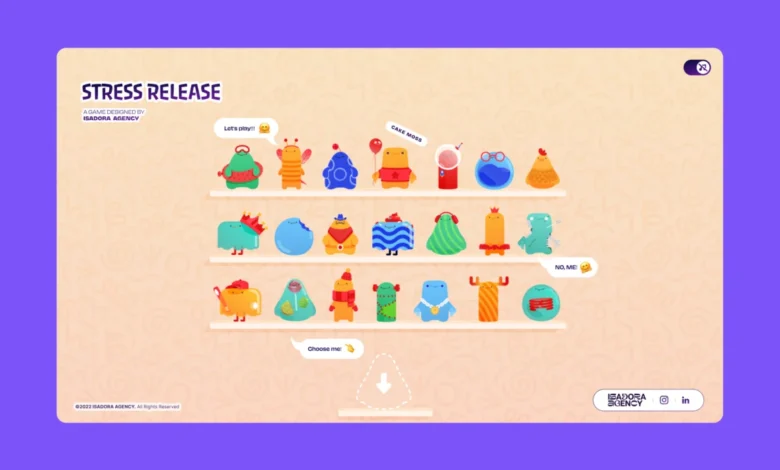
When front-end developers and user experience engineers are tasked with creating web interfaces that prioritize tactile, bouncy, or destructive physical responses, the industry standard has long been the immediate integration of physics engines. Libraries such as Matter.js and Cannon.js, or complex WebGL-based simulations, have historically served as the default toolkit for developers aiming to gamify the digital experience. However, a recent project by the Isadora Agency—a digital stress-relief game titled Stress Release—has challenged this reliance, demonstrating that absolute control over motion often requires a shift away from simulation and toward programmatic precision.
The objective of the Stress Release project was to create a highly tactile interface for burnt-out creative professionals, allowing users to interact with animated characters through clicking, dragging, and distorting digital assets. As the development team began the prototyping phase, a conflict arose between the capabilities of traditional physics engines and the specific requirements of the project’s art direction. While physics engines excel at simulating realistic gravity, friction, and inertia, they frequently produce erratic, unpredictable motion. The animators at Isadora Agency, conversely, had crafted bespoke, frame-accurate animations that required specific, deterministic responses to user input.
This necessitated a fundamental architectural pivot: the team abandoned the physics engine approach entirely. Instead, they developed a system that relies on programmatic Lottie state controls, standard DOM manipulation, and distance-based mathematics. By utilizing this method, the team successfully maintained the integrity of the animators’ creative vision while delivering a fluid, responsive experience without the overhead of WebGL.
The Philosophy of Intentional Motion
In the realm of interactive design, "intentional motion" refers to the precise orchestration of visual elements where every frame serves a narrative or emotional purpose. For the Stress Release project, the animators utilized custom JSON-based Lottie files, where specific reactions—such as a "mega squeeze"—were mapped to exact frame counts. For instance, a complex reaction sequence was designed as a 181-frame build-up followed by a specific release.
If a physics engine were applied to such a sequence, the procedural nature of the engine would likely override the handcrafted keyframes, resulting in motion that, while physically plausible, lacked the artistic intent behind the character design. The Isadora Agency’s decision to move toward a deterministic architecture ensured that the interaction layer acted as a flawless trigger for the animation layer. By mapping clicks to specific Lottie segments, the team ensured that the user’s input always resulted in the exact visual reaction intended by the animators, thereby preserving the emotional "squish" and "bounce" required for a stress-relief tool.

Technical Implementation: Mapping Clicks to Geometry
The technical execution of this project relied on a sophisticated coordinate mapping system that converted page coordinates into local character coordinates. By calculating the distance from the center of a character to the user’s click point using the Pythagorean theorem (specifically the Math.hypot function), the development team created a concentric zone system, effectively treating the characters like interactive dartboards.
This system categorized clicks based on distance from the center point, allowing for varying degrees of "feedback intensity." A click near the center of the character yielded a higher point value and a more dramatic animation reaction, while clicks toward the periphery resulted in more subdued responses. This spatial accuracy, achieved entirely through standard DOM positioning and JavaScript calculations, created a "tactile" sensation of physical contact. When a user interacts with the character, the explosion Lottie animation is dynamically repositioned to the exact X and Y coordinates of the click, reinforcing the user’s perception that they have physically impacted the character.
Performance and Responsive Design
A common critique of DOM-based animation frameworks is their performance overhead when compared to WebGL, particularly on mobile devices. To mitigate these concerns, the Isadora Agency team implemented several optimization strategies. By leveraging CSS variables for responsive resizing, the interface adapts to different screen sizes without the need for complex, resource-heavy collision detection or bounding box re-calculations.

Furthermore, the team employed a tiered quality-control system for Lottie animations. During the "shelf" view, where multiple characters are displayed simultaneously, the team reduced the playback quality and speed to conserve CPU cycles. Conversely, when the user focuses on a single character for the interaction phase, the animation runs at full quality. This balance of performance and visual fidelity allowed the application to remain accessible on mobile browsers, where computational resources are significantly more constrained than on desktop platforms.
Chronology of Development
The development cycle of Stress Release followed a standard agile progression:
- Initial Prototyping (Weeks 1-2): Exploration of Matter.js and other physics libraries to handle character reactions.
- Design Audit (Week 3): Determination that simulation-based physics conflicted with the highly specific, frame-accurate character animations provided by the art team.
- Architectural Shift (Week 4): Development of the programmatic state control system, mapping DOM events directly to Lottie segments.
- Integration (Weeks 5-6): Implementation of distance-based math for hit detection and score calculation.
- Optimization (Week 7): Fine-tuning of Lottie quality settings and CSS variable-based responsive design to ensure mobile performance.
Implications for Future Web UX
The success of the Stress Release project offers a compelling case study for UX engineers and creative developers. It highlights a recurring theme in modern web development: the most "advanced" technology is not always the most effective for a given design requirement. While WebGL and physics simulations are powerful, they are often overkill for experiences that prioritize artistic direction over physical accuracy.

By mapping animation timelines directly to user input via the DOM, developers can create experiences that feel significantly more handcrafted and intentional. This approach not only provides the "tactile" feedback users crave in modern, gamified UI, but it also creates a more predictable and easier-to-debug system for the engineering team.
The industry response to this project has been largely positive, with many in the UX community pointing to the shift as a move toward "human-centric" rather than "engine-centric" design. As web browsers continue to increase in power, the ability to rely on native browser features—like the Lottie runtime—rather than heavy external dependencies, is likely to become a preferred strategy for developers aiming to maintain high frame rates and precise visual control.
Broader Impact and Industry Context
The rise of "highly interactive" web experiences is part of a larger trend toward making the web feel more like a native application. As brands look to differentiate themselves through unique digital experiences, the demand for "tactile" UI—interfaces that respond to the user with physical logic—is growing. The Isadora Agency’s work demonstrates that these experiences do not require a compromise in performance or design control.

Looking forward, the architectural pattern used here—a combination of programmatic state triggers and vector-based animations—may prove to be a foundational template for future gamified marketing campaigns, educational tools, and creative interfaces. By choosing the right tool for the design, rather than the most advanced tool for the stack, developers can ensure that the user experience remains consistent, performant, and, most importantly, faithful to the original creative vision. This project stands as a reminder that the most compelling web interactions are often born from a marriage of precise mathematics and artistic intent, rather than a reliance on black-box simulation engines.