Navigating the New EU AI Transparency Mandates and the Future of Digital Labeling

The European Union’s implementation of comprehensive artificial intelligence regulations, effective as of August 2, 2026, marks a pivotal shift in the global digital landscape, mandating strict transparency and labeling requirements for AI-generated content. Far from the catastrophic "doomsday" scenarios predicted by some industry alarmists, these guidelines represent a calculated, pragmatic approach to digital literacy. The primary objective is to ensure that when citizens interact with AI-generated text, imagery, or audio, they are equipped with the information necessary to distinguish synthetic content from human-authored material. This regulation does not solely apply to entities headquartered within the EU; it encompasses any organization worldwide that serves EU citizens, effectively creating a "Brussels Effect" that will likely standardize AI transparency practices across international borders.
The Chronology and Scope of Compliance
The journey toward this regulatory milestone began years ago as generative AI tools transitioned from niche research projects to ubiquitous consumer products. By 2024, the European Commission identified a growing "trust gap" regarding automated content. The subsequent drafting of the EU AI Act culminated in the finalization of transparency obligations under Article 50. By mid-2025, industry leaders and legal experts were already preparing for the August 2026 enforcement date, recognizing that the rules—much like the GDPR (General Data Protection Regulation) or the European Accessibility Act—carry significant penalties for non-compliance.
Under these mandates, both "providers"—the developers who build and supply AI models—and "deployers"—the organizations that integrate these models into products or services—bear legal responsibility. The law is explicit: licensing a third-party AI model does not absolve a company of its duty to disclose its use. If a business utilizes an LLM (Large Language Model) or a generative image tool to interact with or inform EU users, the burden of transparency remains with the deployer.

Distinguishing Between Assistance and Generation
A critical component of the legislation is the nuance between "AI-assisted" tasks and "AI-generated" content. The European Commission has provided guidance to clarify this distinction, which is essential for businesses attempting to integrate AI into their workflows without triggering excessive labeling requirements.
Routine administrative tasks that involve minor, assistive AI functions—such as spell-check, grammar correction, automated formatting, or basic language translation—are generally exempt from the mandatory disclosure labels. These are categorized as assistive technologies that enhance existing human work rather than replacing it. Conversely, content that is substantively created by an AI, such as automated summaries, composite or manipulated imagery, or full-length articles, requires clear disclosure.

The threshold for "editorial responsibility" is high. It is insufficient to have a human employee "skim" an AI-generated document before publication. To avoid the mandatory labeling requirement, a named entity or individual must take explicit, documented editorial responsibility for the output, implying a level of review and modification that transforms the AI’s draft into a human-controlled product. In instances where the output is fully automated or constitutes a substantial rewrite of an initial prompt, the disclosure is non-negotiable, with the exception of specific, closed-loop B2B environments where such disclosures might be governed by separate, private contractual agreements.
Beyond the Sparkle: The Necessity of Clear Communication
One of the most significant challenges for UI/UX designers has been the industry-wide reliance on the "sparkle" icon to denote AI features. Research, including studies from the Nielsen Norman Group, indicates that the sparkle symbol has become overly ambiguous. In many contemporary interfaces, it is used indiscriminately to signal anything from a "magic" cleanup tool to a chatbot interface, leading to "icon fatigue" and user confusion.

The European Commission’s new guidelines explicitly state that a generic sparkle icon is insufficient to satisfy the transparency mandate. To achieve compliance, organizations must move toward standardized, descriptive labeling. The Commission has released an official set of AI-related icons that are intended to be used in conjunction with clear, plain-language text, such as "AI-generated" or "AI-modified." The regulation mandates that these labels must be "clear, distinguishable, and accessible." Furthermore, the disclosure must persist; if a user downloads or shares the content, the AI label must remain attached to the file or the data, preventing the stripping of metadata that identifies the synthetic origin of the work.
The Global Regulatory Pattern
While the EU is currently at the forefront of this specific transparency legislation, it is part of a broader, global trend toward AI regulation. Similar, albeit varying, requirements have been surfacing in other jurisdictions. In the United States, several states have already introduced or passed legislation focusing on the transparency of synthetic performers in advertising and the protection of political integrity against deepfakes.

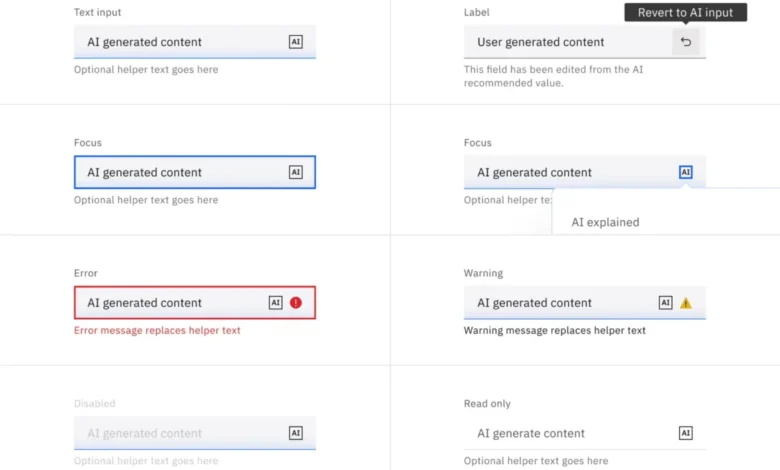
These developments suggest that the era of "unlabeled AI" is rapidly coming to an end. Businesses that treat these requirements as a checkbox exercise are likely to face legal and reputational hurdles. Instead, forward-thinking organizations are treating transparency as a component of "AI ethics by design," integrating these disclosures directly into their design systems, such as the IBM Carbon Design System, which has already begun prototyping comprehensive AI labeling patterns for complex data dashboards and interactive interfaces.
Implications for Future Product Development
For product designers and developers, the immediate implication is a need for a comprehensive audit of all AI-integrated features. Teams must determine which features fall under the "public interest" definition—which covers health, safety, environmental, economic, and political domains—as these are subject to the most rigorous scrutiny. Any AI-generated product claim touching upon these sensitive areas will trigger strict disclosure requirements.

Furthermore, the legal landscape is evolving to ensure that "synthetic reality"—photos or illustrations that realistically mimic people, objects, or locations—is clearly marked. Law firms specializing in digital regulation are advising clients to over-label rather than under-label, particularly in commercial and marketing contexts, to avoid the risk of being found in violation of the EU AI Act.
Conclusion: A Shift Toward Trust
The panic surrounding these new mandates often stems from a misunderstanding of the objective. The intent is not to stifle innovation or penalize companies for using cutting-edge tools. Rather, it is to provide the end-user with the information necessary to evaluate the credibility of the information they consume.

By standardizing how AI-generated content is marked, the EU is attempting to create a more resilient information ecosystem. In a world where synthetic media is increasingly indistinguishable from reality, the ability to confirm the provenance of content is becoming a fundamental requirement for a functioning digital society. As companies continue to integrate generative AI into their products, the focus must shift from simply "deploying" the technology to building interfaces that respect the user’s right to know the origin of the content they see. This regulatory shift, while demanding, ultimately fosters a higher standard of digital integrity, which is a net positive for both creators and consumers in the long term. Organizations that embrace these transparency patterns today will be better positioned to build the trust necessary for the long-term adoption of their AI-powered solutions.