Morphoice Launches EightyTen Virtual Instrument Emulating Classic Roland JX Series Synthesizers

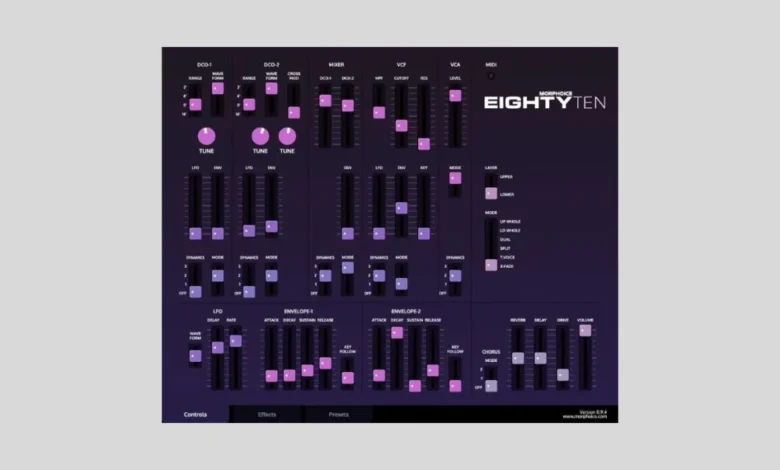
Developer Morphoice has officially announced the release of EightyTen, a new software synthesizer that meticulously emulates two of the most iconic entries in the Roland JX series: the JX-8P and the Super JX-10, including its rack-mount counterpart, the MKS-70. Currently available as a free beta for macOS, Windows, and Linux, EightyTen represents the latest effort by Morphoice to bring the specific harmonic character of 1980s analog-digital hybrid synthesis to modern digital audio workstations (DAWs). The release follows a rapid succession of vintage-inspired plugins from the developer, signaling an aggressive expansion into the competitive market of virtual analog emulation.
Historical Context and the Legacy of the Roland JX Series
To understand the significance of EightyTen, one must look back to the mid-1980s, a period of profound transition in the music technology industry. In 1984, Roland released the JX-8P, a six-voice polyphonic synthesizer designed to compete with the burgeoning popularity of Yamaha’s FM-based DX7. While the industry was moving toward digital precision, Roland opted for a hybrid approach, utilizing Digitally Controlled Oscillators (DCOs) to maintain tuning stability while retaining the warm, organic textures of traditional analog filters.
The JX-8P was followed in 1986 by the Super JX-10, which essentially housed two JX-8P engines within a single chassis. This allowed for twelve-voice polyphony and the ability to "stack" or "split" two different patches, creating the lush, complex pads that became a staple of cinematic scores and pop production in the late 80s. The MKS-70 later provided these same capabilities in a professional rack-mount format.
Despite their sonic capabilities, the original hardware units were often criticized for their interface. Moving away from the "knob-per-function" design of the Juno and Jupiter series, Roland implemented a menu-driven system with a data entry slider. This led to the creation of the PG-800 external programmer, a hardware controller that restored tactile editing to the JX series. EightyTen adopts this streamlined PG-800 aesthetic, offering users immediate access to all synthesis parameters without the need for cumbersome menu diving.
Technical Specifications and Synthesis Architecture
EightyTen replicates the core architecture of its hardware inspirations while introducing modern flexibility. The plugin features two DCOs per voice, providing the stable yet harmonically rich foundation characteristic of the JX line. A defining feature of this architecture is the "Cross Modulation" capability, which allows one oscillator to modulate the pitch of the other. This enables the creation of "metallic" or "bell-like" timbres—often referred to as FM-style sounds—allowing producers to achieve the grit and complexity of frequency modulation within an analog subtractive framework.
The filter section is a critical component of the EightyTen’s sound profile. It employs a 24 dB/octave resonant low-pass filter, modeled after the Roland IR3109 and subsequent filter chips, which provides the smooth, creamy sweep associated with vintage Roland hardware. This is paired with a non-resonant high-pass filter, useful for thinning out low-end frequencies in complex mixes.
For modulation, EightyTen provides two ADSR (Attack, Decay, Sustain, Release) envelope generators per voice. These can be assigned to the filter, the amplifier, or the pitch of the oscillators. The plugin also incorporates the legendary Roland stereo chorus effect. Known for its ability to transform thin sounds into wide, immersive textures, the chorus in EightyTen features the classic "Mode I" and "Mode II" (slow and fast) settings, accurately recreating the bucket-brigade device (BBD) behavior of the original units.
Modern Enhancements and Onboard Effects
While EightyTen remains faithful to the 1984–1986 era of synthesis, Morphoice has integrated several contemporary features to enhance the plugin’s utility in modern production environments. The developer has included a suite of high-quality effects that go beyond the original Roland hardware specifications:
- DarkStar Reverb: This algorithmic reverb is inspired by modern boutique hardware, specifically the Strymon BigSky. It is designed for "infinite" atmospheric washes and cinematic textures, catering to ambient and film-score composers.
- Lo-fi Tape Delay: To add a sense of vintage wear and tear, this effect emulates the wow, flutter, and saturation of analog tape loops, providing a rhythmic depth that complements the synth’s pads.
- HeatBurn Drive: This distortion module allows users to add harmonic saturation or aggressive clipping to the signal, bridging the gap between the clean, polite tones of the JX-8P and the more aggressive requirements of modern electronic music.
Furthermore, EightyTen supports full velocity and aftertouch sensitivity. This is a crucial inclusion, as the original JX-8P was one of the first synthesizers to offer these expressive controls, making it a favorite among keyboardists who required a more "musical" and responsive instrument.
Development Timeline and Morphoice Strategy
The release of EightyTen is part of a broader, high-speed development cycle from Morphoice. Over the past eighteen months, the developer has established a reputation for releasing high-quality emulations of legendary synthesizers in rapid succession:
- February 2025: Release of "Unstable," an emulation of the Yamaha CS-80.
- May 2026: Release of "EightySix," an emulation of the Roland Juno-6.
- June 2026: Release of "EightyEight," an emulation of the Roland Jupiter-8.
- July 2026: Release of "EightyTen," emulating the JX-8P/Super JX-10.
Morphoice utilizes a "public beta" distribution model. This strategy allows the developer to gather real-world performance data across a wide range of hardware configurations and operating systems (macOS, Windows, and Linux). It also serves as a marketing tool, building a user base through free access before transitioning to a paid model. The developer has cautioned that while the current beta is free to download, it may cease to function or require a license once the software reaches its "1.0" stable release.
Pricing Model and Distribution
EightyTen is currently available via Gumroad. The "name your price" model allows users to download the plugin for $0; however, Morphoice offers a lifetime license for any contribution of $10 or more. This approach is increasingly common among independent developers, offering a low barrier to entry while encouraging financial support from the community to fund ongoing development and DSP research.
The plugin is provided in AU, VST, and VST3 formats, ensuring compatibility with major digital audio workstations such as Ableton Live, Logic Pro, FL Studio, and Reaper. The inclusion of a Linux version is particularly noteworthy, as the Linux audio community remains underserved by many of the industry’s larger plugin manufacturers.
Market Impact and Industry Implications
The release of EightyTen enters a market saturated with "vintage" emulations, yet it occupies a specific niche. While there are numerous emulations of the Juno and Jupiter series (most notably from Roland Cloud and Arturia), the JX-8P and Super JX-10 have historically received less attention. By focusing on these later-period analog synths, Morphoice is targeting a demographic of producers looking for the "sophisticated" 80s sound—often associated with the soundtracks of Harold Faltermeyer or the lush pop of Chaka Khan—rather than the raw, buzzy tones of earlier VCO-based (Voltage Controlled Oscillator) synths.
Industry analysts suggest that the rise of high-quality, low-cost emulations like the "Eighty" series poses a challenge to established software giants. When independent developers can offer professional-grade DSP and authentic user interfaces for a fraction of the cost of a subscription service, it shifts the value proposition for the end-user.
Furthermore, the inclusion of modern effects like the DarkStar Reverb indicates a shift in plugin design philosophy. Modern users often prefer "all-in-one" solutions where the sound design and spatial processing occur within a single interface, rather than relying on a chain of external plugins.
Final Summary
EightyTen represents a bridge between the historical legacy of Roland’s synthesis and the requirements of the modern digital studio. By combining the architectures of the JX-8P and the Super JX-10, Morphoice has created a versatile tool capable of producing everything from simple bass lines to complex, twelve-voice layered pads. As the software remains in its beta phase, users are encouraged to test the instrument and contribute to its development through the donation-ware model. With its intuitive interface and expanded effects suite, EightyTen is positioned to become a staple for producers seeking the authentic character of the mid-80s analog-digital hybrid era.