Zebra 3 Beta Unveils Next-Generation Physical Modeling Capabilities with New Modal Synthesis Modules

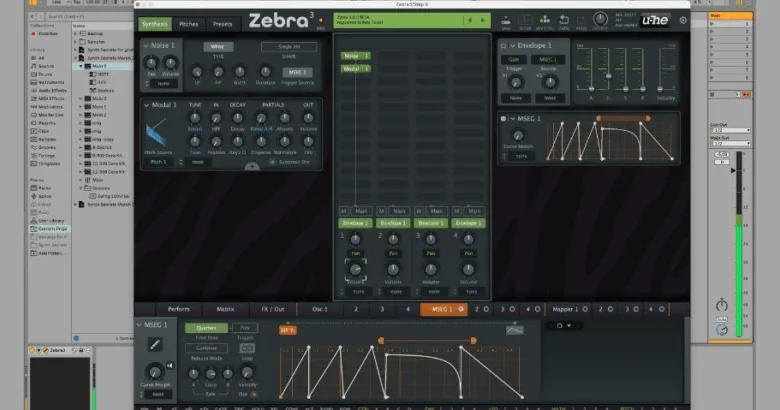
The landscape of digital sound design is undergoing a significant shift as u-he officially moves Zebra 3 into its public beta phase, introducing a suite of features that redefine the boundaries between synthetic and organic sound. Long regarded as the "Swiss Army Knife" of synthesizers, the Zebra series has maintained a dominant position in professional studios for over two decades. With the release of the Zebra 3 beta, the focus has shifted toward the innovative "Modal" modules, which employ advanced physical modeling to bridge the gap between abstract synthesis and real-world acoustic resonances. This development marks a pivotal moment for sound designers, film composers, and electronic music producers who seek the precision of digital control combined with the unpredictable, organic character of physical objects.

The Evolution of Percussive Synthesis: From FM to Physical Modeling
To understand the significance of Zebra 3’s Modal modules, one must look back at the history of percussive sound design. The 1980s marked a turning point in music production with the mainstream adoption of Frequency Modulation (FM) synthesis and digital sampling. Prior to this, the industry was dominated by analog subtractive synthesizers. While these instruments excelled at creating warm pads and aggressive leads, they were notoriously poor at replicating "real-world" sounds, particularly hollow, struck, or plucked objects like marimbas, bells, and tuned percussion.

The sudden explosion of marimba-esque, tuned percussive sounds in the 80s—heard in the works of artists like Madonna and Gloria Estefan, as well as iconic film scores such as Predator and Romancing the Stone—was largely driven by the Yamaha DX7 and early Fairlight samplers. FM synthesis allowed for the creation of complex overtone structures that could mimic the inharmonicities of wood and metal. However, FM synthesis remains notoriously difficult to program, often requiring trial and error to achieve realistic results.

Zebra 3 moves beyond the limitations of both subtractive and FM synthesis by utilizing physical modeling within its Modal modules. Unlike sampling, which plays back a static recording, or FM, which approximates a sound through frequency ratios, physical modeling mathematically recreates the way sound waves interact with a physical structure. When a user hits a metal tube, a glass bell, or a hollowed-out piece of wood, the resulting sound is a product of cascading resonances. Zebra 3’s Modal modules calculate these resonances in real-time, providing a level of organic variation that traditional synthesizers cannot achieve.

Technical Breakdown: The Architecture of the Modal Module
The core innovation in Zebra 3 is the ability to decouple the "exciter" from the "resonator." In this architectural framework, the actual sound source run through the Modal module is often incidental to the final tonality. The module acts as a virtual chamber or object that is "excited" by an incoming signal. This allows for unconventional sound design workflows, such as transforming a simple burst of white noise into a complex, melodic, and dancefloor-ready percussive arpeggio.

The Modal module operates by analyzing the dynamic volume profile of the input signal. By using the "Suppress Dry" function, users can remove the original source signal entirely, leaving only the calculated resonances of the modeled object. This process imparts an organic variation to every hit; because the physics are calculated dynamically, no two notes sound identical, effectively eliminating the "machine-gun effect" common in digital sampling.

Within the module, u-he has implemented modeling slots (A and B), allowing users to load specific physical profiles—such as the "Punched Can" or "Metal Bowl"—and blend between them. This interpolation between different physical states provides a fertile ground for modulation, enabling sounds that morph from wooden textures into metallic resonances over time.

Chronology of the Zebra Legacy and the Road to Zebra 3
The journey to Zebra 3 has been one of the most anticipated timelines in the history of music software. To understand the weight of this release, one must observe the developmental milestones of u-he, the Berlin-based company founded by Urs Heckmann.

- 2003: The Birth of Zebra. Zebra 1.0 was released as a Mac-only plug-in, quickly gaining a cult following for its modular approach.
- 2006: Zebra 2.0. This version became an industry standard. Its inclusion in major Hollywood productions—most notably by Hans Zimmer for The Dark Knight and Inception—cemented its reputation as the premier tool for cinematic sound design.
- 2012–2022: The "Zebra 3" Rumors. For a decade, Zebra 3 became the "vaporware" of the synth world. Urs Heckmann famously stated that he would not release the third iteration until he could offer a significant technological leap rather than a mere incremental update.
- 2023: The Zebra Legacy. u-he consolidated Zebra 2 and all its soundsets into a single "Legacy" product, signaling that the transition to Zebra 3 was imminent.
- 2024–2026: Public Beta Phase. The current beta release represents the culmination of years of research into physical modeling and user interface design. The April 2026 update to the beta includes the refined Modal modules and the Multi-Step Envelope Generator (MSEG) improvements featured in current industry tutorials.
A Practical Application: From Noise to Rhythmic Percussion
The power of the Zebra 3 engine is best demonstrated through its ability to synthesize a "minimal tech" percussive riff from a source as basic as white noise. This workflow highlights the synergy between the synth’s various modules.

Phase 1: The Exciter (Noise Module)
The process begins with a "Noise 1" module set to a "Single Hit" shape. By manipulating the Envelope 1 settings—specifically setting Attack, Sustain, and Release to zero while maintaining a Decay of approximately 400ms—the user creates a tight volume profile. This serves as the "stick" hitting the virtual surface.

Phase 2: The Resonator (Modal 1)
By adding the Modal 1 module immediately after the noise source, the "stick" hits a virtual object. Loading a "Punched Can" model into slot A instantly transforms the characterless noise into a metallic, resonant strike. At this stage, the tuning and decay parameters of the Modal module dictate the pitch and "ring" of the object, rather than the pitch of the original noise.

Phase 3: Rhythmic Complexity (MSEG and Mapper)
To transform a single hit into a dancefloor-ready groove, Zebra 3 utilizes its enhanced MSEG. By linking the trigger source of the noise and envelope to the MSEG, users can draw intricate, "skippy" patterns that sync to the project tempo.

Furthermore, the "Mapper" module is employed to convert a fixed-pitch pattern into a melodic riff. By assigning Mapper 1 to the Modal 1 Tuning parameter, the synthesizer can step through different pitches for each rhythmic hit. This allows for the creation of complex, "clackety" layers that provide both rhythmic drive and melodic interest.

Industry Implications and Market Analysis
The introduction of Zebra 3’s physical modeling capabilities has broader implications for the music production software market. Historically, physical modeling was a niche area of synthesis, occupied by specialized instruments like Applied Acoustics Systems’ Chromaphone or Ableton’s Collision. By integrating these capabilities into a flagship modular synthesizer, u-he is challenging the dominance of wavetable synthesis, which has led the market via plug-ins like Xfer Records’ Serum and Vital.

Industry analysts suggest that the move toward physical modeling reflects a growing "organic" trend in electronic music. As listeners become accustomed to the perfection of digital production, there is an increasing demand for "micro-imperfections" and acoustic-like textures. Zebra 3 addresses this by providing a tool that is fundamentally designed to be non-static.

Furthermore, the beta release strategy through community forums like KVR Audio allows u-he to stress-test the engine across a vast array of hardware configurations. The feedback from this beta phase is expected to refine the "Zebra 3" user interface, which aims to simplify the complexity of modular synthesis through a more intuitive, modern aesthetic.

Broader Impact on Film and Game Scoring
For the film and game scoring communities, Zebra 3 represents a significant workflow optimization. Composers often layer synthetic sounds with organic recordings to create "hybrid" scores. The Modal modules allow for the creation of these hybrid sounds within a single instrument. A composer can now design a "signature" percussion sound that possesses the weight of a synthetic sub-bass and the resonant complexity of a real-world ethnic drum, all while maintaining full MIDI control over the performance.

The ability to modulate the "Position" and "Disperse" parameters within the Modal module also allows for the simulation of different performance techniques—such as where a drum is struck or how tightly a string is held. This level of expressive detail is becoming a requirement in the competitive landscape of modern media composition.

Conclusion: The Future of u-he and Zebra 3
As Zebra 3 moves toward its final release, the consensus among early adopters is that u-he has successfully avoided the trap of "feature bloat." Instead of simply adding more oscillators or filters, the company has introduced a new paradigm of sound generation that honors the legacy of 80s FM synthesis while embracing the future of physical modeling.

The public beta remains open for testers, providing a rare glimpse into the development of a tool that will likely define the sound of the coming decade. With its ability to turn a "tiny little burst of white noise" into a powerful, driving percussive force, Zebra 3 is poised to remain a favorite among sound designers who value depth, flexibility, and unmistakable character. For the modern producer, the message is clear: the balance of nostalgia and forward-thinking design is no longer a goal to be reached, but a standard to be maintained.
Related posts: