X Expands Transparency Reporting to Show Local Law Content Restrictions and Government-Mandated Withholdings

Social media platform X, formerly known as Twitter, has announced a significant expansion of its transparency features, offering users unprecedented visibility into how local laws and government mandates impact the reach of their posts and profiles. This update builds directly upon the recently introduced "Under the Hood" initiative, marking another step in the company’s ongoing efforts to demystify its algorithms, content moderation practices, and visibility restrictions.
Under the newly deployed system, creators, publishers, and everyday users alike will be able to see precise details regarding whether their content has been suppressed, limited, or legally withheld in specific jurisdictions. By pulling back the curtain on regional compliance, X aims to eliminate much of the ambiguity traditionally associated with content moderation and algorithmic visibility penalties, commonly referred to by users as "shadowbanning."
Main Facts and the Mechanics of the New Feature
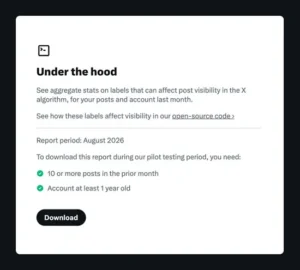
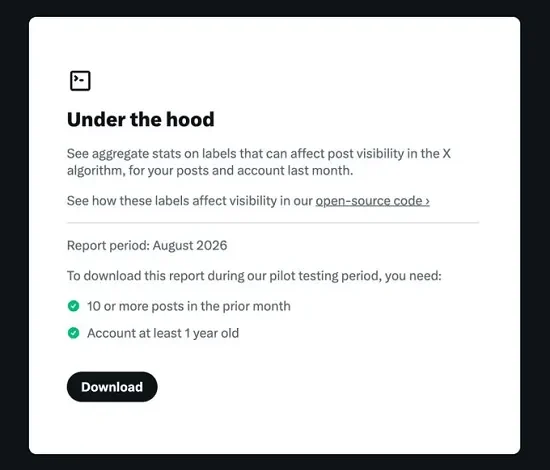
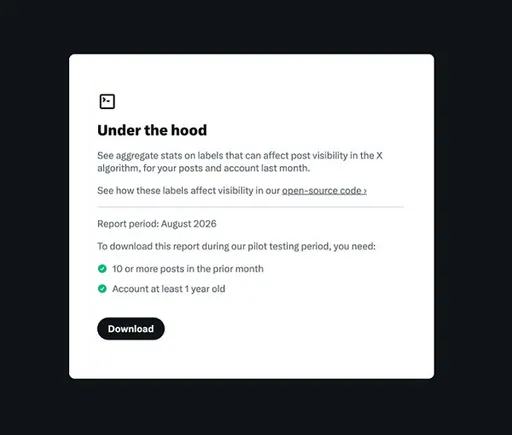
The core of this update lies within the enhanced user performance insights dashboard. Initially rolled out last month, the "Under the Hood" update granted the public a rare look into the operational mechanics of the platform’s source code alongside a simplified reporting mechanism. This mechanism enabled users to identify any penalties or restrictions applied directly to their accounts or individual posts.
With the latest expansion, X is taking transparency a step further. Accounts that meet specific eligibility criteria will now receive detailed, granular breakdowns of regional visibility constraints. Specifically, if a post or profile has its reach curtailed due to required compliance with local laws, the system will explicitly state the nature of the restriction. For instance, users will be able to view if any of their published materials were withheld in a specific country following a formal legal demand, and importantly, they will be informed of the exact country that issued the restriction.
According to official statements released by the company, this feature is designed to empower users with actionable data. "We’ve expanded Under The Hood after seeing people’s appreciation of more transparency into government-required content filtering," X stated. "In addition to showing labels applied to your account and posts in the prior month, Under The Hood now shows if your account or posts had their visibility limited because of required compliance with local law(s). For example, you can see if any of your posts were withheld in a country following a legal demand — and which country."
To qualify for these advanced insights, accounts must meet a two-pronged threshold designed to prevent system abuse and ensure data relevance: the account must be at least one year old, and it must have published more than 10 posts within the previous calendar month. This ensures that active, established contributors receive the diagnostics necessary to evaluate their global reach, while filtering out dormant or burner accounts.
Chronology of X’s Transparency Initiatives
To fully understand the significance of this update, it is essential to examine the recent history and timeline of X’s transparency and algorithm-sharing endeavors. Since the acquisition of the platform by billionaire entrepreneur Elon Musk, the company has repeatedly stated its commitment to open-source principles and radical transparency regarding content moderation.
Early 2023: Open-Sourcing the Algorithm
X took its first major step toward algorithmic transparency by open-sourcing the code responsible for recommending tweets on the platform’s "For You" timeline. This move allowed independent researchers, developers, and users to inspect how posts are prioritized, scored, and distributed across the network.
Mid-2023 to Early 2024: Refining Safety and Visibility Labels
The platform introduced various iterations of visibility filtering labels, attempting to notify users when their content was deemed to violate safety policies, such as the Hateful Conduct policy or Civic Integrity guidelines. However, these early notifications were often opaque, leading to persistent user complaints regarding sudden drops in engagement without clear explanations.
Late 2024: The "Under the Hood" Launch
X officially launched the "Under the Hood" framework. This update provided a dual benefit: it offered deeper insight into the functionality of the platform’s underlying source code and introduced a streamlined reporting function allowing users to check for account-level penalties or restrictions applied over the preceding month.
Current Phase: Local Law and Government Compliance Insights
Building directly upon the foundation laid by the initial "Under the Hood" release, X integrated regional compliance reporting. This current iteration bridges the gap between internal platform moderation and external government demands, explicitly delineating between company-enforced safety penalties and state-enforced legal withholdings.
Supporting Data and the Creator Economy
The introduction of these granular insights arrives at a critical juncture for X, particularly as the platform endeavors to attract and retain top-tier content creators through its monetization programs. In an increasingly competitive landscape populated by platforms like YouTube, TikTok, Meta’s threads, and Substack, predictability and transparency regarding reach are paramount for digital creators who rely on consistent impressions to generate revenue.
Data from digital marketing and social media analytics firms consistently show that content creators view algorithmic unpredictability as one of their primary operational risks. When a creator experiences a sudden plummet in engagement—often dubbed a shadowban—it can drastically reduce their ad-revenue sharing potential and brand sponsorship viability.
By providing exact metrics on whether a drop in reach is driven by a domestic platform penalty or an international legal restriction, X is equipping creators with the data necessary to adjust their strategies. For instance, a geopolitical commentator or investigative journalist who notices their post reach declining in a specific nation will now know with certainty that local legal compliance is the culprit, rather than an arbitrary glitch or a blanket algorithmic suppression by the platform itself.
Furthermore, transparency regarding government-mandated content removal has long been a key metric for civil liberties organizations and digital rights watchdogs. Groups such as the Electronic Frontier Foundation (EFF) and Access Now have historically advocated for detailed transparency reports from all major technology firms. While X previously published periodic transparency reports detailing government requests for user data and content removal, integrating these insights directly into the individual user dashboard represents a democratization of data that was previously accessible only through aggregate, macro-level corporate reports.
Industry Reactions and Comparative Analysis
The broader tech industry has observed X’s evolving transparency policies with mixed reactions. Competitors such as Meta, Google (YouTube), and TikTok have historically relied on comprehensive, periodic transparency reports—often published biannually—to outline government takedown requests and content moderation statistics at scale. However, none of these major platforms currently offer individual users a dedicated, self-service dashboard that details localized, government-mandated content withholding down to the specific post and country level.
Digital rights advocates have cautiously welcomed X’s move, noting that providing users with direct insight into state censorship is a positive step toward accountability. When a government compels a platform to restrict speech within its borders, the visibility of that demand allows the public, press, and international observers to quantify the extent of digital censorship occurring within sovereign jurisdictions.
At the same time, policy analysts point out the complex legal tightrope technology companies must walk. Global platforms operating across international boundaries are legally obligated to comply with local laws in the jurisdictions where they offer services. Failure to comply can result in severe financial penalties, the blocking of the entire platform within a country, or criminal liability for local company representatives. By clearly labeling when and where local laws have forced the suppression of content, X effectively shifts the burden of accountability back onto the requesting governments, demonstrating to users why certain content is missing without necessarily endorsing the censorship itself.
Broader Implications and Future Outlook
The expansion of X’s "Under the Hood" insights carries several profound implications for the future of digital communication, international law enforcement cooperation, and platform governance.
First, it sets a new benchmark for corporate accountability in the social media sector. As governments worldwide increasingly seek to regulate online discourse, combat misinformation, and enforce local speech laws—ranging from the European Union’s Digital Services Act (DSA) to stringent regional internet regulations in Asia and the Middle East—platforms will face mounting pressure to disclose the mechanics of their compliance. X’s granular reporting model may well become a template that other social networks are forced to adopt to maintain user trust.
Second, the feature aids in mitigating misinformation and conspiracy theories regarding platform bias. When users cannot see why their content is underperforming, vacuum effects are created, often filled by speculation that platform executives are intentionally suppressing specific political viewpoints or independent media outlets. By introducing objective data feeds that explicitly state the reason for visibility limitations—whether it is an internal safety violation or an external legal demand—X reduces the psychological friction between the user base and platform administration.
However, challenges remain. The restriction threshold requiring accounts to be at least one year old with more than 10 monthly posts means that new accounts, whistleblowers, or grassroots activist networks created explicitly to report on fast-moving geopolitical events may not immediately have access to these diagnostic tools. Additionally, navigating the delicate balance between corporate transparency and the legal non-disclosure requirements sometimes mandated by specific government subpoenas or secret legal directives could present future hurdles for X’s compliance team.
As X continues to refine its open-source philosophy and expand its diagnostic toolsets, the platform is positioning itself uniquely within the social media ecosystem. By turning visibility metrics into an open book, X is inviting its user base to scrutinize not only its own internal code but also the complex geopolitical pressures that shape the modern internet landscape. For creators, journalists, and global citizens navigating an increasingly fractured digital world, these enhanced insights offer a clearer, more factual understanding of how information flows—and where it is legally halted—across borders.
Related posts: