The digital publishing landscape is undergoing a fundamental transformation as the industry pivots from a traditional search-driven model toward a complex ecosystem dominated by artificial intelligence agents. For over two decades, the relationship between publishers and platforms was defined by a simple exchange: content for referral traffic. However, as 2026 progresses, this paradigm is collapsing. Publishers, who once anxiously debated whether AI answer engines like ChatGPT or Perplexity would provide enough click-through traffic to compensate for the decline of traditional search engine results pages (SERPs), have largely abandoned that hope. Instead, a new strategy is emerging: treating AI answer engines not as sources of human referrals, but as a primary distribution layer where success is measured by visibility, citations, and brand authority within AI-generated responses.
This shift toward the "agentic web"—a term describing an internet where autonomous AI agents perform tasks, aggregate data, and answer queries on behalf of humans—has forced a radical rethinking of search engine optimization (SEO). In its place, Generative Engine Optimization (GEO) and Answer Engine Optimization (AEO) have become the new benchmarks for digital success. The priority is no longer just getting a human to click a link; it is ensuring that an AI agent consumes, understands, and accurately cites a publisher’s content when generating a real-time response.
The Surge of Agentic Traffic and the Rise of RAG
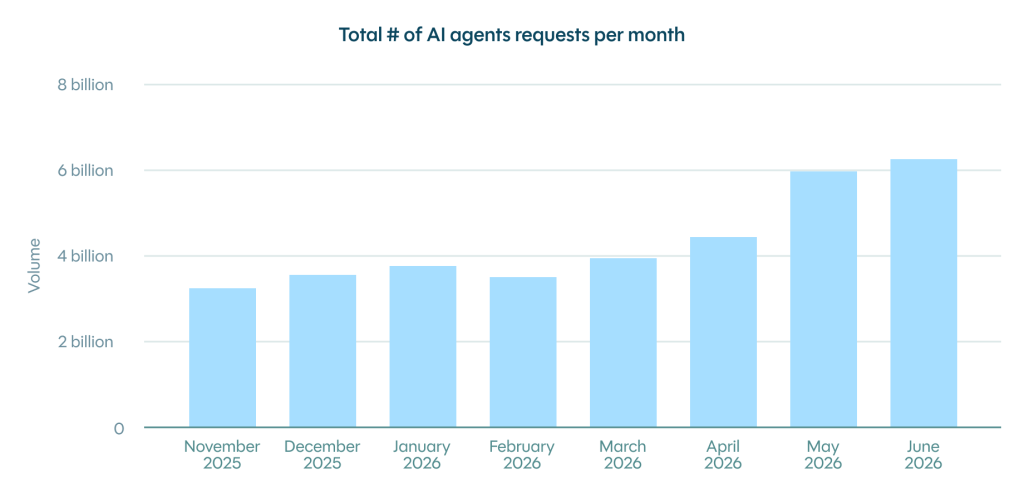
The scale of this transition is reflected in recent telemetry from major cybersecurity and data firms. According to a report from DataDome published in July 2026, AI agent traffic surged by 45% in the second quarter of the year alone. DataDome’s network, which monitors over 400 global companies, recorded a staggering 17.7 billion AI agent requests between April and June 2026. This represents a significant jump from the 12.2 billion requests recorded in the first quarter. In June 2026 alone, requests hit a peak of 6.6 billion, signaling that the "bot-to-human" ratio on the open web is tilting further toward automated systems.

A critical driver of this growth is the evolution of how AI models interact with the live web. In the early stages of the generative AI boom, bots primarily crawled the web to "train" large language models (LLMs) on historical data. Today, the focus has shifted toward Retrieval-Augmented Generation (RAG). RAG allows AI models to query the live internet in real-time to provide up-to-date answers to user prompts.
Meta has emerged as a dominant force in this space. DataDome’s analysis shows that Meta’s training crawlers grew by 74% between Q1 and Q2 2026, but its RAG crawlers grew at more than double that rate, increasing by 163%. Jérôme Segura, Vice President at DataDome, noted that we are entering a "new phase of the AI web" where continuous indexing is the norm. Unlike the "scrape once" methodology of the past, AI agents are now persistent visitors, requiring publishers to develop sophisticated guidelines for crawling and indexing similar to the standards long established for Googlebot.
Chronology of the Shift: From Search to Agents
To understand the current state of AI visibility, it is necessary to look at the timeline of the digital publishing industry’s reaction to generative AI:
- Late 2022 – Mid 2023: The "Panic Phase." The release of ChatGPT and early iterations of Bing AI led to fears of a "zero-click" future. Publishers focused on blocking bots via robots.txt to protect their intellectual property.
- Late 2023 – 2024: The "Negotiation Phase." Major publishers like News Corp, Axel Springer, and Time entered into multi-million dollar licensing deals with OpenAI and Google. These deals allowed AI firms to use content for training in exchange for financial compensation and "brand attribution."
- 2025: The "Infrastructure Phase." Publishers began experimenting with new technical formats like Markdown and LLMs.txt to make their content more "agent-readable." AI-driven traffic grew by 187% this year, outpacing human traffic by a factor of eight.
- 2026: The "Agentic Web Phase." The industry accepts that AI referral traffic is negligible (often staying below 1-2% of total traffic). The strategy shifts toward "Visibility as Currency," where being the cited source in an AI answer is seen as a way to maintain brand relevance and influence the "distribution layer."
Rebuilding the Web for AI Consumption
As publishers move toward an agent-first strategy, they are increasingly stripping away the visual "fluff" of the modern web. Traditional HTML pages are cluttered with JavaScript, CSS, advertisements, and tracking scripts—elements that are useful for humans but burdensome for AI agents.
To solve this, a growing number of websites are adopting "agent-readable" versions of their content. The most prominent standard is the use of Markdown and specialized files like llms.txt. These files provide a text-only, structured version of a website’s content and metadata, allowing an LLM to "read" the site without having to parse complex page designs.
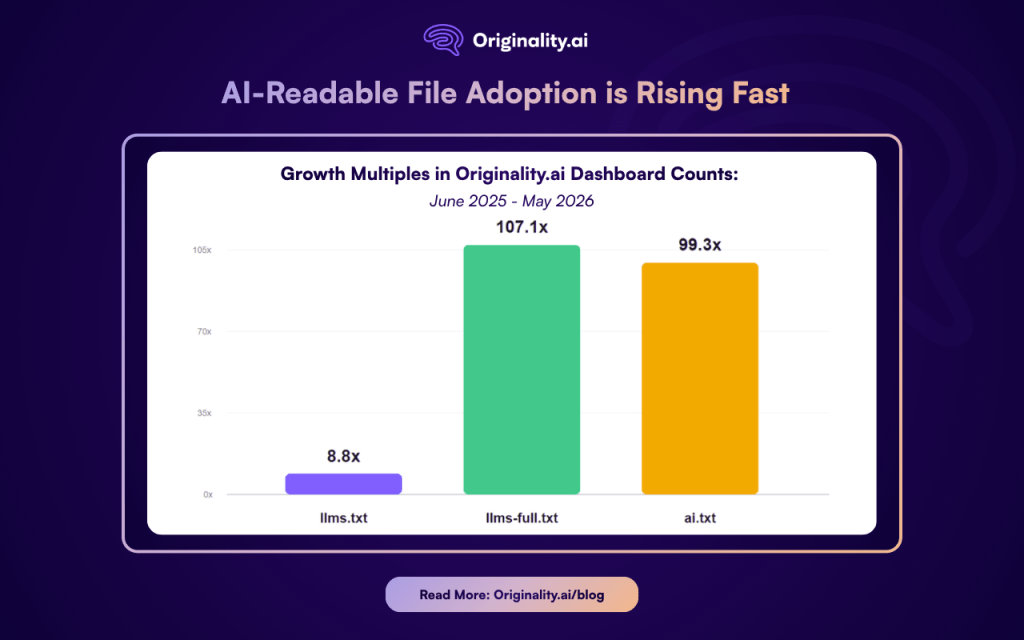
Data from Originality.ai highlights the rapid adoption of these standards. The number of llms.txt instances on the web grew from 4,088 in June 2025 to 36,120 by May 2026—an 8.8-fold increase across a sample of 3 million websites. Despite this surge, adoption among traditional news publishers remains relatively low at 3.2%, compared to 7.9% on the broader open web.
However, the effectiveness of these files remains a point of contention. Research from Ahrefs found that 97% of llms.txt files received zero requests in May 2026. This suggests that while publishers are building the infrastructure for an agentic future, the AI agents themselves—particularly those operated by Google and OpenAI—may not yet be prioritizing these specific files over standard HTML crawling. Jon Gillham, CEO of Originality.ai, characterized this trend as a "low-cost bet" on a future that is not yet fully realized.
The Difficulty of Achieving AI Visibility
Even as publishers optimize for AI, "winning" in the agentic web is proving to be more difficult than traditional SEO. Webflow’s AEO Maturity Index, which analyzed 2,000 websites, found that the median company appeared in only 16% of relevant AI answers. More concerning for publishers seeking traffic is that these companies appeared with a citation and a link only 6% of the time.
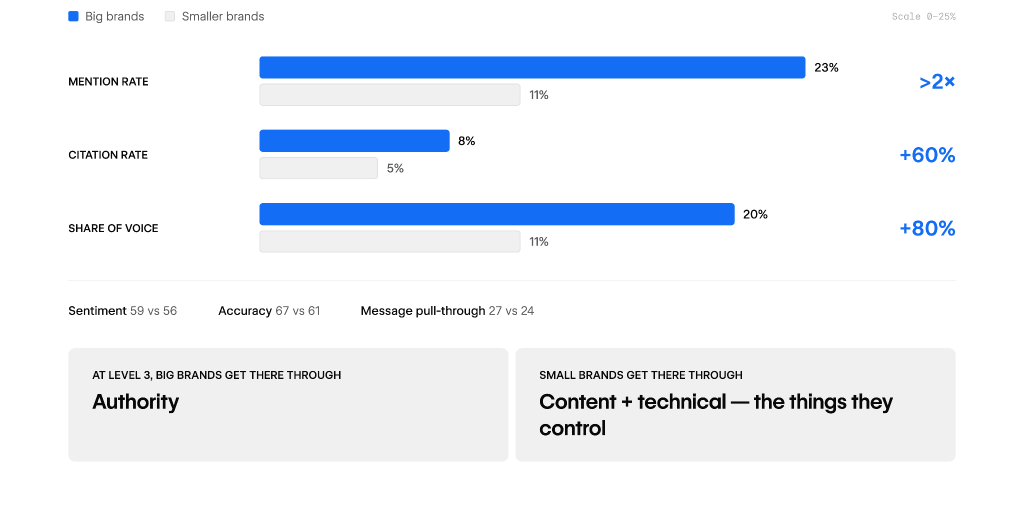
The analysis revealed a "rich get richer" dynamic. Large, high-authority domains performed significantly better, seeing two times higher mention rates and 80% higher share of voice in AI search results compared to smaller competitors. Guy Yalif, chief evangelist at Webflow, pointed out that underperformance in AI visibility is often linked to fundamental SEO failures: broken links, missing metadata, and stale content. In the agentic web, these errors are amplified, as AI agents prioritize accuracy and technical clarity above all else.
The Referral Reality: Why Clicks Are No Longer the Goal
The motivation for this strategic pivot is grounded in the disappointing reality of AI-driven referral traffic. DataDome’s Q2 2026 report found that while human interactions with ChatGPT that resulted in a click-through increased by 17%, the actual volume of traffic remains meager compared to the heyday of Google Search. ChatGPT currently accounts for upwards of 80% of all AI-driven referral traffic, but for most publishers, this represents only a tiny fraction of their total audience.
Furthermore, the "ChatGPT-User" bot, which fetches live pages to answer questions, actually visited websites 6% less in Q2 2026 than it did in the previous quarter. This indicates that as AI models become more efficient and their internal knowledge bases grow, their need to "ping" a publisher’s server for every query may be decreasing.
This has led to a split in publisher tactics. Some, like Reuters and Time, have moved away from blanket bot-blocking. Instead, they have adopted a "whitelist" approach. They block all unknown or "unpolite" bots by default but create specific pathways for approved AI agents that offer business value, such as those that provide clear citations or operate under a licensing agreement.
The Failure of Bot Blocking and the Need for Monetization
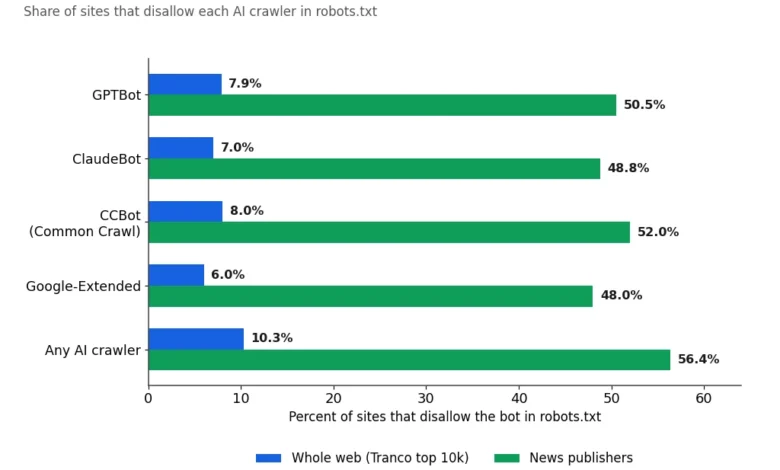
Despite the shift toward visibility, a significant portion of the publishing industry remains in a defensive posture. A report from web data firm HasData found that 56.4% of news publishers currently block at least one AI crawler via robots.txt, a stark contrast to the 10.3% blocking rate on the open web. GPTBot, operated by OpenAI, is the most frequently banned, with over 50% of news publishers attempting to restrict its access.
However, the technical reality is that robots.txt is a "gentleman’s agreement" that many AI crawlers simply ignore. HasData’s testing revealed that 39.5% of sites that declared a ban on GPTBot still served pages to the bot when it crawled them.
Roman Milyushkevich, CEO of HasData, warns that publishers are in a "change-or-die" situation. By attempting to block bots without robust server-side security, they are losing their visibility in AI search results while failing to stop the very data scraping they fear. The consensus among industry analysts is that the era of "simple walls" is over. The future of publishing lies in sophisticated access deals and new monetization models that account for the fact that content is being consumed by machines rather than eyes.
Broad Implications for the Media Ecosystem
The transition to an agentic web carries profound implications for the future of journalism and digital media:

- Brand as the Only Moat: In a world where AI synthesizes information, the "source" matters more than the "site." Publishers must invest in brand authority so that AI agents recognize them as the definitive source for specific topics.
- The Decline of Ad-Supported Models: If users no longer visit a website to consume content, the traditional display advertising model collapses. Publishers will likely pivot toward "licensing-as-a-service" or premium subscription models where AI agents act as the delivery mechanism for paid content.
- The Rise of GEO Services: Just as the 2010s saw the rise of SEO agencies, the late 2020s will be dominated by GEO (Generative Engine Optimization) consultants who specialize in technical markdown formatting and brand sentiment analysis within LLMs.
- Legal and Regulatory Battles: The tension between "fair use" and "automated extraction" will continue to play out in courts globally. The outcome of these cases will determine whether AI companies must pay for the "distribution" of content even if no click occurs.
As the web becomes increasingly populated by bots, the publishers who survive will be those who stop fighting the technology and start mastering the new currency of AI visibility. Success in 2026 and beyond is not about how many people visit a homepage, but how often a publisher’s facts, insights, and brand name are woven into the answers provided by the digital assistants that now mediate the human experience.
Related posts: