
Snap Inc. Reports Stalled User Growth and Surging Revenues in Q3 2026 Earnings Amid Expanding AR Bets and Regulatory Pressures


Snap Inc. released its financial results for the third quarter of 2026 on Wednesday, detailing a complex picture of a mature social media platform navigating stagnant user acquisition in its most lucrative Western markets, alongside a healthy year-over-year climb in overall revenue. While daily active user growth has slowed to a crawl, the parent company of Snapchat managed to increase its top-line intake through improved monetization efficiency, artificial intelligence integration within its advertising infrastructure, and a booming subscription ecosystem that includes Snapchat+ and expanded cloud storage features.
The financial report underscores a pivotal transitional phase for Snap as it attempts to diversify beyond traditional advertising by leaning into short-form video consumption, creator partnerships, business-to-business (B2B) marketing pipelines, and next-generation augmented reality hardware. However, the company continues to face severe external headwinds, including tightening global regulations on youth internet access, regional demographic shifts, and fierce competition from established social media giants such as Meta, ByteDance’s TikTok, and Google-owned YouTube.
Stagnant User Growth and Regional Disparities
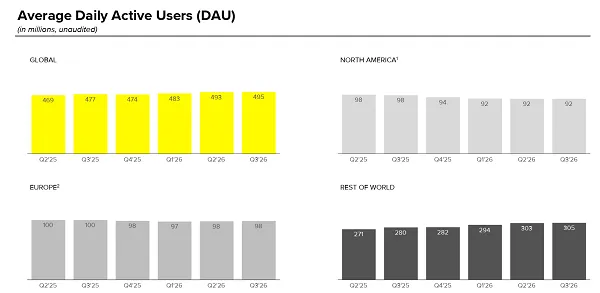
According to the Q3 2026 earnings filings, Snapchat reached 495 million daily active users (DAUs) globally, representing a negligible increase from the 493 million DAUs reported in the second quarter. This net addition of just 2 million users quarter-over-quarter highlights ongoing challenges in expanding the platform’s footprint in mature markets.
A deeper examination of the geographical breakdown reveals a stark geographic polarization. Snapchat experienced zero net user growth across both North America and Europe during the third quarter. Consequently, the entirety of the company’s modest user expansion stemmed from its "Rest of World" segment, which encompasses developing markets across Asia, Latin America, Africa, and parts of Eastern Europe.

This regional divergence carries substantial financial implications for Snap’s business model, given that the platform generates the vast majority of its revenue in North America and Europe. In North America, Snapchat’s Average Revenue Per User (ARPU) reached $11.07 in Q3, marking a healthy increase from $10.26 in the previous quarter. Conversely, the platform generated a mere $1.13 per user in the Rest of World segment. This means that while user acquisition is technically continuing, it is occurring almost exclusively in regions where monetization yields roughly 90% less per user due to lower localized advertising demand and pricing power.
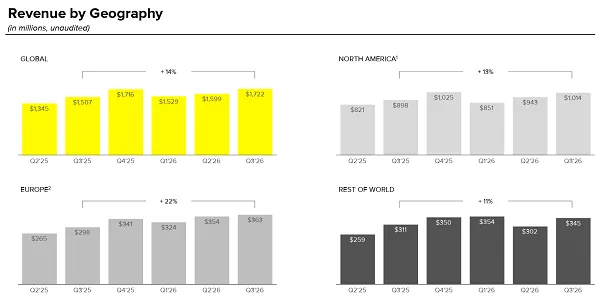
Despite the flatlining user counts in the West, Snap demonstrated a noteworthy ability to extract higher value from existing audiences. Overall third-quarter revenue rose 14% year-over-year to reach $1.72 billion. Regionally, North American revenue climbed 13% to $1.01 billion, European revenue jumped 22% to $363 million, and Rest of World revenue increased 11% to $345 million. The revenue discrepancy between the European and Rest of World markets is particularly striking: Snapchat maintains roughly three times more users in the Rest of World than in the European Union, yet both regions delivered nearly identical financial returns, illustrating the heavy reliance on Western monetization pipelines.
Regulatory Pressures and Youth Demographics
Snapchat’s long-term growth prospects are increasingly intertwined with regulatory developments concerning teen access to social media. According to baseline data published by Pew Research, approximately 55% of U.S. teens aged 13 to 17 use Snapchat regularly, positioning it as the fourth most popular platform among American teenagers behind YouTube, TikTok, and Instagram.
As numerous governments worldwide debate or implement strict social media usage bans and age-verification mandates for minors, platforms heavily utilized by younger demographics face acute risks. Australia serves as a primary case study for these emerging regulatory hurdles. Following the implementation of Australia’s restrictive social media legislation for children under the age of 16 in December 2025, Snap reported that it locked or disabled more than 415,000 user accounts in the country. These accounts were restricted either after users openly declared themselves to be under 16 or because Snap’s proprietary age-detection technology flagged them as underage.
Given that Snap reported having over 8 million users in Australia in August 2023, the enforcement of teen bans appears to have stripped the company of approximately 5% of its total user base in that specific market. While a 5% localized reduction might appear manageable in isolation, a widespread replication of similar bans across North America and Europe could trigger severe structural damage to the platform’s user network. Beyond direct user loss, a decline in youth penetration threatens to degrade Snapchat’s cultural relevance as the primary peer-to-peer connection tool for younger generations, which in turn could depress long-term advertiser interest.
Engagement Metrics and Content Ecosystem
To combat user attrition and maintain user retention, Snap executives have pointed to robust internal engagement metrics as evidence of the platform’s core stickiness. In his prepared remarks accompanying the earnings release, Snap CEO Evan Spiegel highlighted that the average number of daily messages sent within the application increased by 8% year-over-year during the third quarter. Furthermore, the volume of individuals participating in two-way communication grew by 6% over the same timeframe, indicating that core interpersonal messaging habits remain resilient despite plateauing overall user sign-ups.
At the same time, short-form video consumption on the platform has surged. The number of people posting content to Spotlight—Snapchat’s dedicated feed for public, user-submitted video content—surged by 130% year-over-year in Q3. Concurrently, daily active viewers of Spotlight grew by 40% year-over-year, reinforcing the notion that algorithmically curated video continues to capture user attention and compete effectively against rival short-form formats.
Artificial Intelligence, Diversification, and New Revenue Streams
During the earnings call, Spiegel credited artificial intelligence as a transformative catalyst for the company’s internal engineering teams and its advertising machinery. By leveraging machine learning models and generative AI tools, Snap has improved ad targeting efficiency, optimized campaign performance for brand partners, and enhanced user-facing creative capabilities.
In parallel with its core advertising business, Snap has actively pursued revenue diversification through creator partnerships and commercial restructuring. The company recently launched specialized pitch initiatives aimed at securing business-to-business (B2B) advertising budgets, seeking to capture enterprise spending beyond traditional direct-to-consumer brand campaigns.
A significant bright spot in the financial report was the performance of Snap’s "Other Revenue" category, which jumped 84% year-over-year. This division is anchored by digital subscriptions and cloud services, specifically Snapchat+, Lens+, and Memories Storage. During the third quarter, Snap crossed a major milestone by surpassing 30 million combined active subscribers across these paid offerings, proving that a portion of the user base is willing to pay recurring fees for premium features, enhanced personalization, and extended storage capabilities.
The Augmented Reality Bet: AR Specs
Looking toward the future, Snap continues to invest heavily in its hardware ambitions, centered around its augmented reality glasses. The latest iteration of Snap’s AR Specs officially launched for pre-order in September, carrying a premium price tag of $2,200. The device is currently available to consumers in the United States, France, and the United Kingdom, though physical fulfillment and shipping schedules have yet to commence.
Snap envisions these glasses as the cornerstone of its next-generation platform strategy, aiming to pioneer advanced digital connectivity through wearable optical displays that project digital overlays onto the physical world. However, initial financial data from the Q3 report indicates that the AR Specs have not yet contributed meaningfully to the company’s financial bottom line.
Neither Spiegel nor CFO Doug Hott provided specific pre-order unit volumes during their prepared remarks, implying that hardware revenue remains negligible relative to the company’s $1.72 billion quarterly top-line intake. Consequently, analysts note that it is currently impossible to accurately gauge broader consumer demand or the long-term commercial viability of the hardware division.
Fact-Based Analysis of Implications
Snap Inc.’s Q3 2026 performance paints the picture of a technology firm caught between operational resilience and structural vulnerability. On one hand, the company has successfully improved its advertising yield in key Western markets, expanded its high-margin subscription offerings past the 30-million-subscriber threshold, and accelerated video engagement through Spotlight.
On the other hand, the complete stagnation of user growth in North America and Europe—combined with the looming threat of global youth social media bans—poses a fundamental challenge to the company’s valuation model. Because the vast majority of Snap’s revenue depends on Western advertising rates, its heavy reliance on Rest of World markets for net user additions creates a structural imbalance. Unless Snap can reignite domestic user acquisition or successfully monetize its emerging AR ecosystem and enterprise ad initiatives, future quarters may reveal widening fissures in the company’s long-term growth trajectory.