Native Instruments Teams Up with PC Music Founder A.G. Cook to Launch Super*Saw Synthesizer

The landscape of electronic music production has long been defined by the unmistakable acoustic footprint of the stacked sawtooth wave. Originating during the digital and virtual-analog hardware revolution of the mid-to-late 1990s, the "supersaw" waveform quickly established itself as the sonic backbone for everything from underground rave anthems and euphoric Eurodance tracks to modern commercial pop wall-of-sound arrangements.
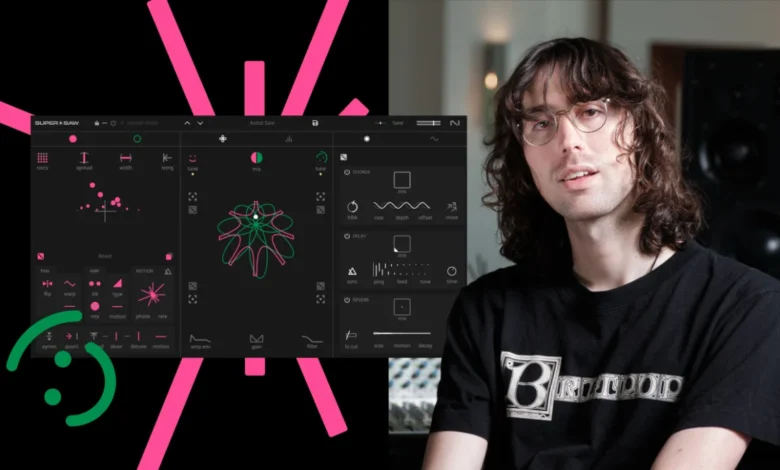
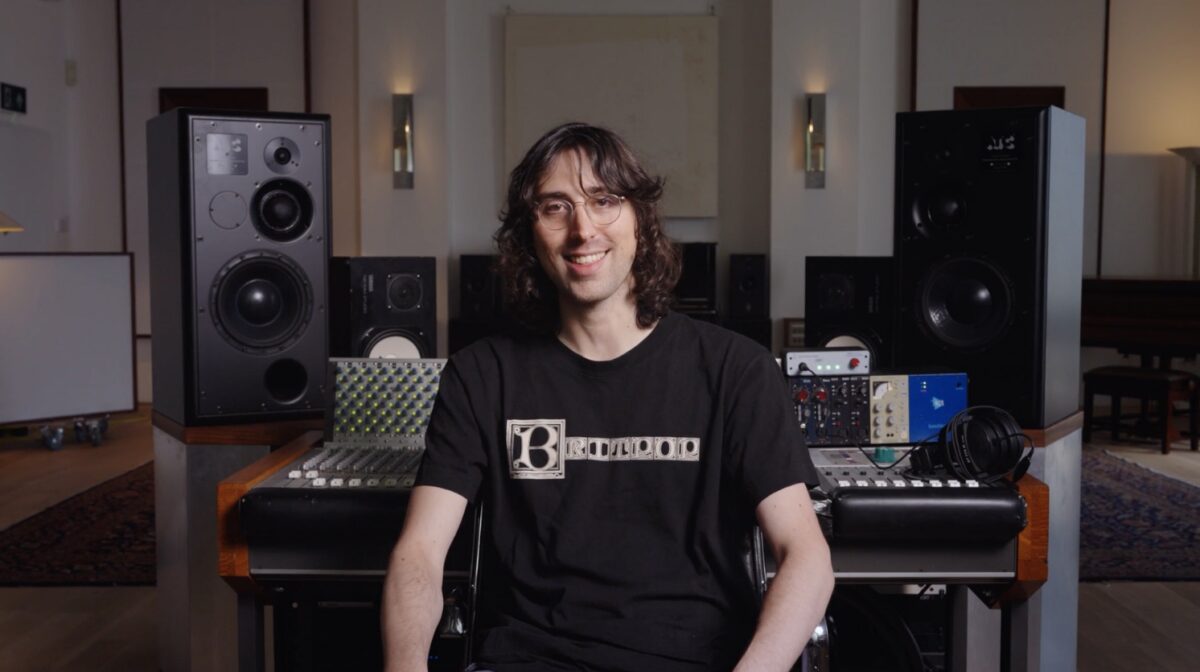
Addressing this enduring legacy, audio technology leader Native Instruments has officially announced the release of SuperSaw—pronounced SuperStarSaw*—a dedicated software synthesizer developed in close collaboration with visionary producer, songwriter, and PC Music founder A.G. Cook. Revealed during an exclusive press event and artist walkthrough at Baltic Studios in London, the instrument represents a significant milestone in software instrument design, specifically engineered to streamline the traditionally complex workflows required to produce hyper-layered, detuned synthesizer textures.
The Evolution of the Supersaw: From 90s Hardware to Modern Software
To understand the engineering and creative philosophy behind Super*Saw, industry analysts and sound designers must look back at the technological limitations and breakthroughs of the 1990s. Prior to the digital emulation boom, electronic music producers were largely restricted by the polyphony and oscillator counts of physical analog hardware. When virtual-analog synthesizers emerged, they introduced the capability to stack multiple oscillators—often seven or more sawtooth waves per voice—detuned slightly against one another to create an immensely thick, wide, and aggressive sonic presence.
Over the ensuing decades, this technique evolved from a hardware trick into a foundational genre-defining element. However, achieving professional-grade results with stacked sawtooth waves historically demanded tedious digital audio workstation (DAW) workarounds. Producers routinely had to duplicate tracks, manually write complex automation for fine-tuning parameters, and run multiple third-party plugins simultaneously to create the illusion of movement and depth within a chord progression.
According to A.G. Cook, whose decade-long career includes landmark production credits for groundbreaking pop artist Charli XCX, critically acclaimed solo projects like 7G and Apple, and his 2024 record Britpop, these cumbersome routing sessions frequently hindered spontaneity. In designing Super*Saw, the objective was to condense these labor-intensive workflows into a single, highly responsive, and expressive software instrument that prioritizes real-time performance over static audio editing.
Architectural Overview and Core Features of Super*Saw
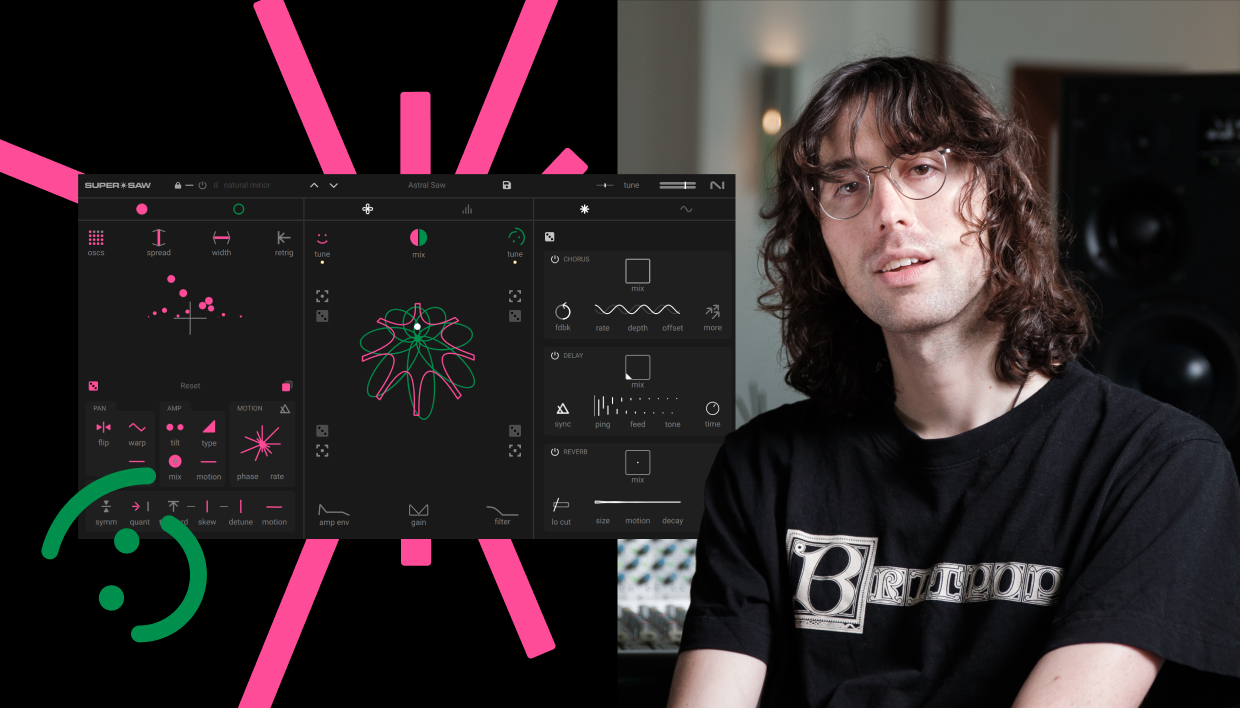
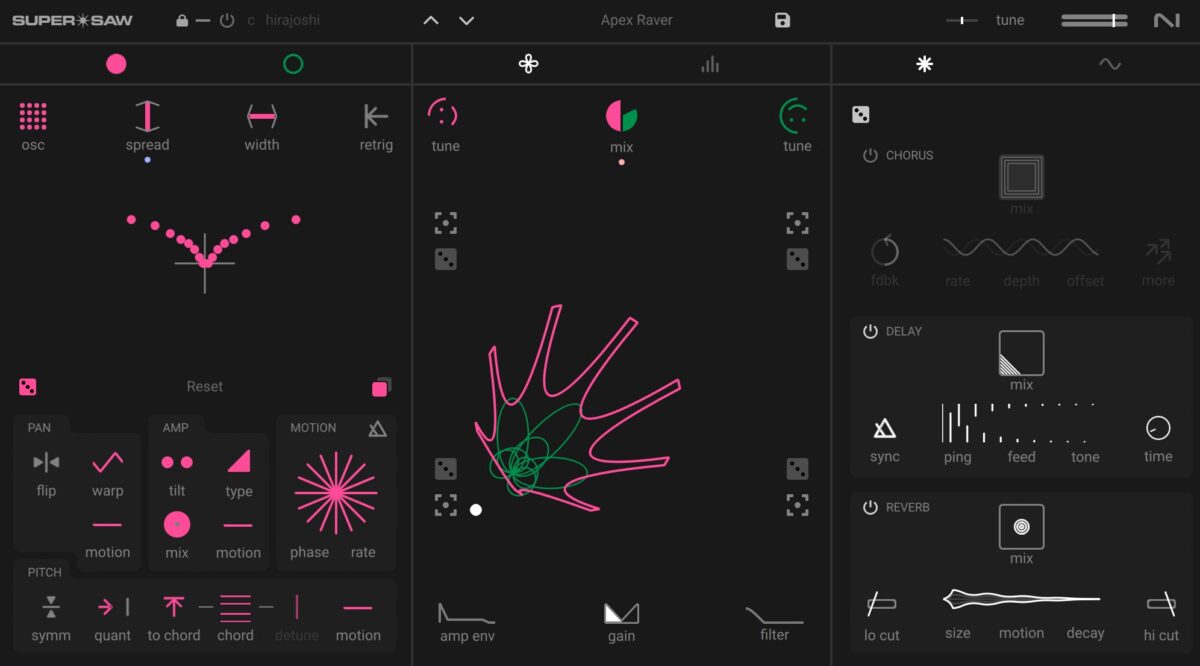
Super*Saw departs from traditional multi-engine wavetable or frequency-modulation synthesizers by narrowing its architectural focus entirely to the purity and potential of the sawtooth wave. At its core, the instrument features a dual 8-voice sawtooth oscillator system. This system is partitioned into two distinct, color-coded visual and sonic layers: a vibrant pink layer and a contrasting green layer.
This dual-layer design mirrors Cook’s personal mixing and sound-design methodologies. By conceptualizing the patch structure as a dialogue between two complementary elements—such as a heavily modulated, wide-spreading chord pattern on one layer anchored by a focused, fundamental bassline on the other—producers can achieve rich harmonic interplay without muddying the low end.
Key functional capabilities built into the Super*Saw interface include:
- The 4-Corner Morpher: A real-time performance controller that allows users to seamlessly transition between varying chord shapes, detuning rates, and modulation states on the fly.
- Star-Shaped Modulator: A flexible modulation source that can be mapped directly to stereo panning, amplitude, or pitch parameters to inject continuous organic motion into static chords.
- Instant Randomization Tools: Integrated "dice" functionality that enables producers to instantly generate unpredictable variations across the pink and green layers, bridging the gap between deliberate sound design and happy accidents.
Artist Collaboration and Industry Implications
The collaboration between Native Instruments and A.G. Cook underscores a broader industry shift toward artist-driven software development. Rather than relying solely on internal engineering teams to design virtual instruments based on historical emulation, leading music software companies are increasingly partnering with contemporary producers who have defined modern subgenres.
Cook’s work with PC Music—a collective and record label he founded in 2013—fundamentally reshaped the boundaries of electronic pop music by embracing maximalism, high-definition digital aesthetics, and hyper-processed vocal and instrumental timbres. By distilling the sonic aesthetics of his personal discography—including tracks like "Superstar" and "Stargon"—into a commercially available plugin, Native Instruments and Cook are providing independent producers and bedroom creators with access to professional-grade sound-shaping tools that were previously accessible only through complex, multi-plugin signal chains.
Industry observers note that the release of Super*Saw arrives at a time when nostalgia for late-90s and early-2000s electronic production techniques is at an all-time high across mainstream pop, hyperpop, and electronic dance music (EDM). By offering an instrument that excels at generating everything from pristine, shimmering pop harmonies to heavily saturated, noise-floor-filling percussive wall-of-sound textures, Native Instruments aims to capture both veteran producers seeking workflow efficiency and a younger generation of creators exploring the outer limits of digital synthesis.
The SuperSaw synthesizer is available now through the official Native Instruments digital store, compatible with standard DAW environments via the company’s established Komplete ecosystem software architecture. As electronic music production continues to evolve at the intersection of nostalgia and futuristic sound design, instruments like SuperSaw demonstrate the enduring power of classic waveforms when reimagined through modern engineering workflows.