Native Instruments and A.G. Cook Launch Super*Saw, Redefining the Iconic 1990s Synthesizer Sound for Modern Producers

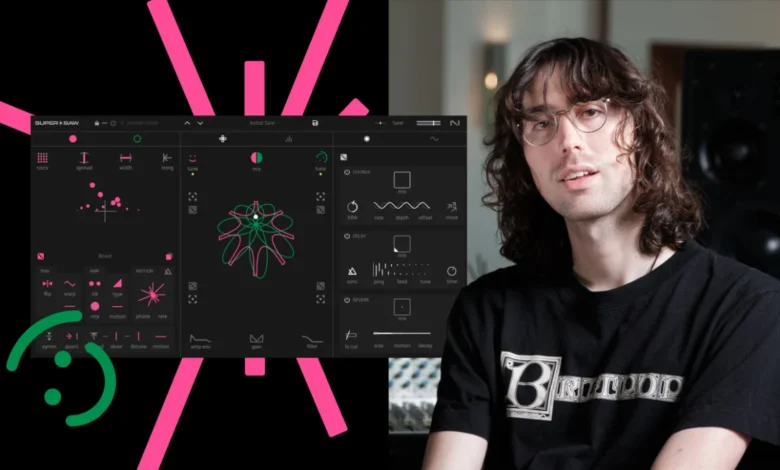
The landscape of electronic music production and modern sound design has long been defined by a distinct, harmonically rich sonic footprint: the stacked sawtooth wave. Originating during the digital and virtual analog synthesis revolution of the mid-to-late 1990s, the "supersaw" quickly became the structural foundation for European rave anthems, euphoric eurodance, and expansive club arrangements.
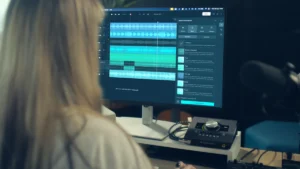
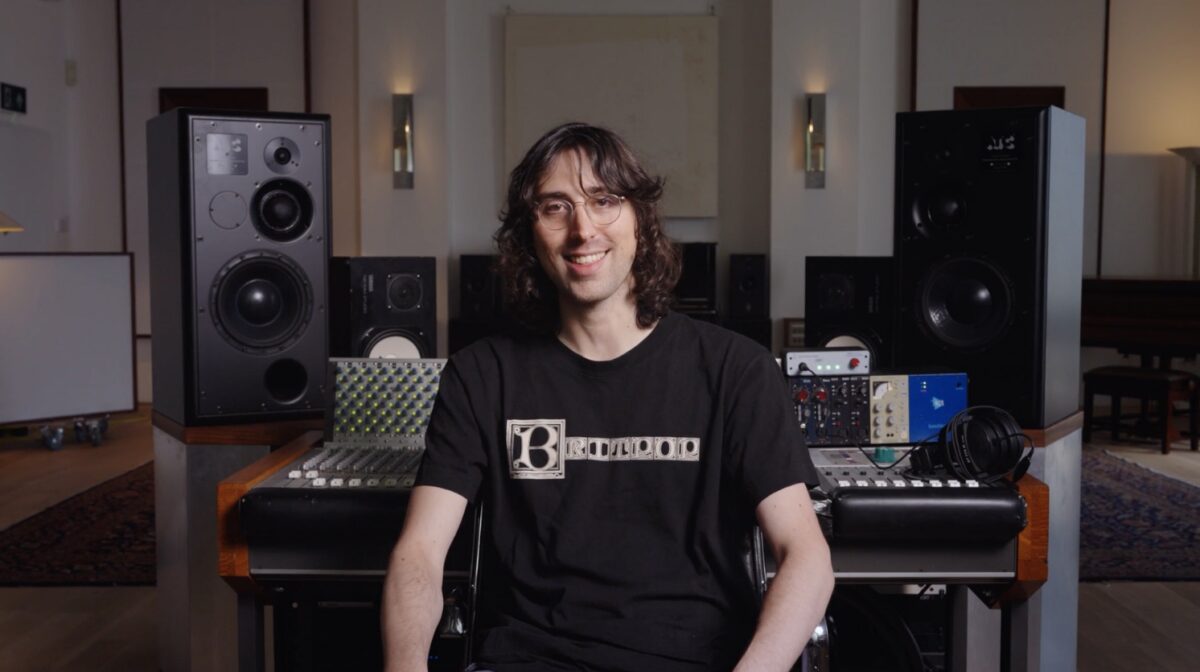
Continuing this lineage, Native Instruments has officially announced the global release of Super*Saw, a dedicated software synthesizer co-designed alongside visionary producer, artist, and PC Music founder A.G. Cook. Pronounced "SuperStarSaw," the instrument translates Cook’s extensive, hyper-detailed production methodology—honed over a decade of shaping contemporary pop and underground club music—into a unified, highly expressive plugin. To mark the product launch, Native Instruments hosted an exclusive production breakdown and interview with Cook at the historic Baltic Studios in London, detailing the technological and philosophical journey behind the instrument.
The Evolution of the Supersaw: From 1990s Hardware to Modern Software
The historical trajectory of the supersaw began as manufacturers sought to overcome the physical and polyphonic limitations of hardware synthesizers. By packing multiple oscillators into a single voice and detuning them against one another, manufacturers created an overwhelmingly thick, wide timbre that cut effortlessly through dense commercial mixes.
Over the decades, this foundational concept was adopted across genres, morphing from underground dance music into the backbone of modern hyperpop and wall-of-sound electronic arrangements. For A.G. Cook, whose discography includes expansive solo bodies of work such as 7G and Apple, his latest full-length record Britpop, and extensive collaborative production with artists like Charli XCX, Oklou, and Caroline Polachek, the supersaw has remained a central creative motif.
Despite its ubiquity, achieving an intricate, evolving supersaw patch traditionally demanded cumbersome Digital Audio Workstation (DAW) routing. Producers routinely relied on manual track duplication, meticulous multi-plugin stacking, and complex automation curves to introduce movement across a chord progression. Cook himself frequently faced these structural hurdles during the creation of tracks like "Stargon" and "Superstar." By encapsulating this complex stacking workflow into a single instrument, Super*Saw removes technical friction, allowing musicians to interact with the synthesizer in a fluid, performance-oriented manner.
Architectural Overview: Dual 8-Voice Oscillators and the Morpher Interface
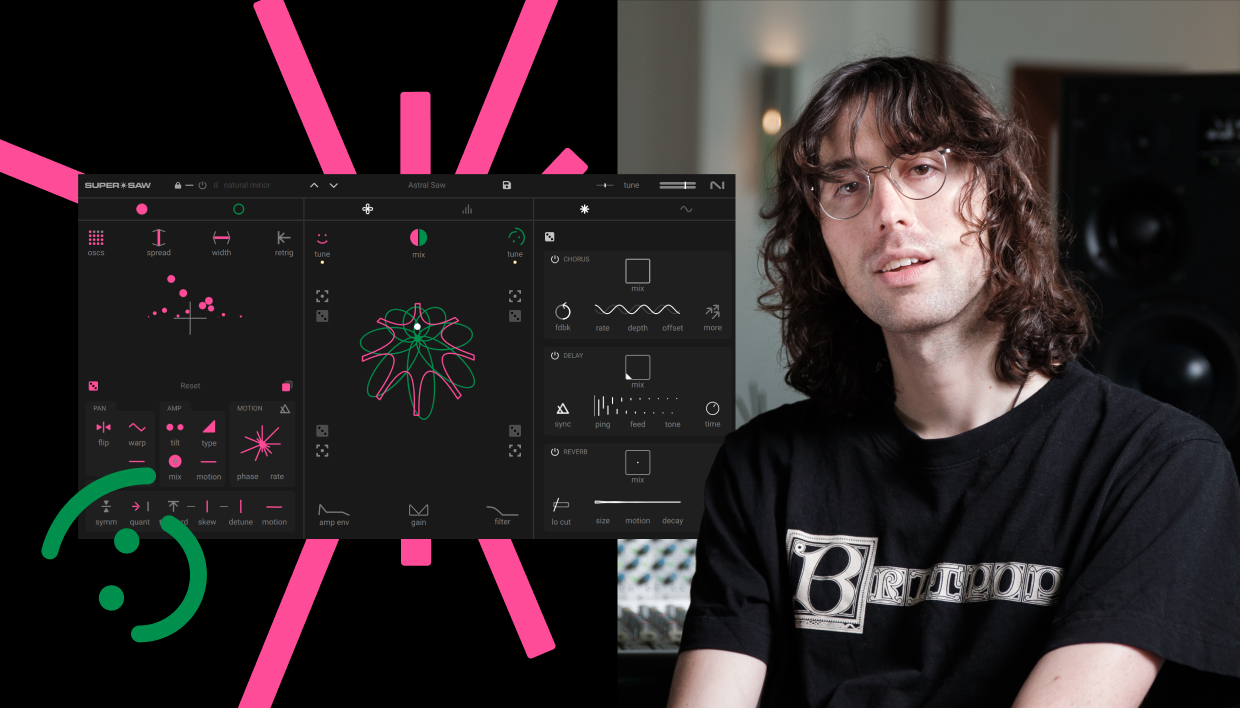
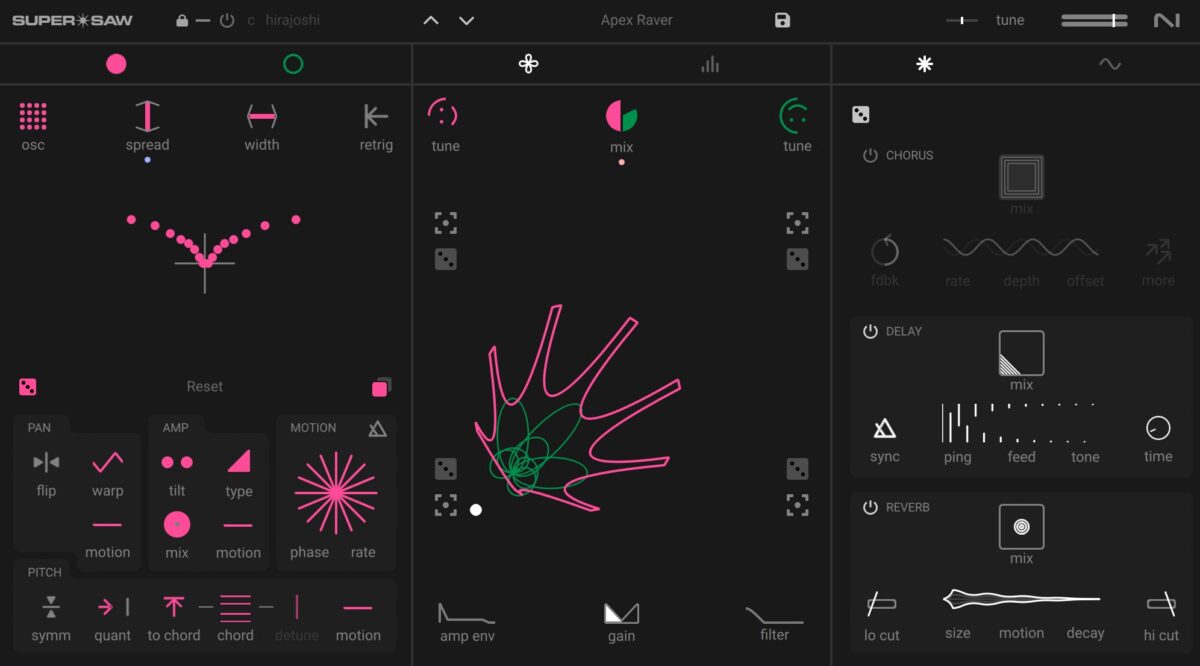
Engineered specifically to celebrate the sonic potential of the sawtooth wave, Super*Saw features a dual 8-voice oscillator architecture. The engine is visually and functionally divided into two distinct, color-coded layers: pink and green. This deliberate dichotomy allows producers to assign disparate roles to each layer within a single patch.
According to Cook, the two-layer concept mirrors his own approach to sound design, functioning akin to a theatrical or musical duo. While one layer can be configured to anchor the fundamental frequency with a stable bassline or heavy low-end presence, the second layer can be pushed to extremes with detuning, modulation, and spatial widening.
To eliminate static patches, the interface incorporates a four-corner "Morpher" pad. This real-time performance controller enables users to transition seamlessly between diverse chord voicings, detuning rates, and modulation states as they play. Furthermore, the instrument features an integrated star-shaped modulator capable of mapping motion directly to panning, amplitude, or pitch, alongside a randomization function designed to spark unexpected sonic discoveries during the patch-creation process.
Industry Implications and the Broader Sonic Landscape
The release of Super*Saw arrives at a time when software developers increasingly lean toward specialized, hyper-focused instruments rather than monolithic, multi-engine workstations. By restricting the synthesis engine entirely to sawtooth waves, Native Instruments and Cook have created a specialized tool that encourages deep sonic exploration within a defined parameter space.
Industry analysts note that artist-led hardware and software collaborations have shifted from mere promotional endorsements to functional extensions of an artist’s personal workflow. For Cook, the instrument functions as a conceptual epilogue to his previous solo releases, capturing the specific sonic worlds of 7G and Apple while democratizing those techniques for the broader production community.
By distilling complex, multi-plugin layering techniques into an intuitive interface, Super*Saw bridges the gap between chaotic underground experimentation and polished commercial pop production. The instrument is available immediately through the Native Instruments ecosystem, signaling a new chapter for one of electronic music’s most enduring sonic signatures.