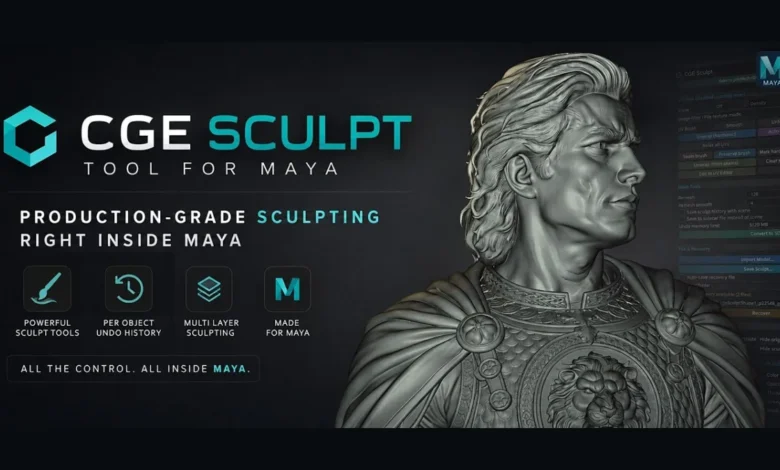
The landscape of 3D digital content creation is witnessing a significant shift as developer Morteza Ahmadi introduces CGE Sculpt, a specialized plugin designed to bring high-performance, GPU-accelerated sculpting capabilities directly into Autodesk Maya. By eliminating the necessity for "round-tripping"—the process of exporting assets to external software like ZBrush or Mudbox to perform high-resolution detailing—the tool promises to maintain the integrity of the user’s Maya workflow while drastically reducing the time lost to file format conversions and data synchronization.
For years, the professional 3D pipeline has been characterized by fragmentation. While Maya serves as the industry standard for rigging, animation, and scene assembly, its internal sculpting tools have historically been viewed as insufficient for high-fidelity character design and complex surface detailing. This has forced artists to adopt a multi-software workflow, often incurring significant costs in software licensing, hardware overhead, and the technical debt associated with constant mesh exporting and importing. CGE Sculpt aims to address this bottleneck by embedding a modern, GPU-native engine directly into the Maya viewport.
The Twelve-Year Genesis of CGE Sculpt
The development of CGE Sculpt is not merely the result of a recent programming sprint; it represents the first tangible output of a long-term architectural vision. Morteza Ahmadi has revealed that his work on this project began over 12 years ago, rooted in a fundamental desire to rethink the core mechanics of Maya. According to Ahmadi, the project was conceived as a comprehensive plan to "reinvent" the foundational tools that Maya artists rely on daily.
The chronology of this development suggests a methodical approach to software engineering. Rather than simply adding a layer of functionality, Ahmadi spent over a decade deconstructing the way Maya handles geometry and vertex data. CGE Sculpt is the inaugural release in a broader series of planned toolsets. Ahmadi has indicated that the current iteration of the plugin represents less than 50 percent of his total developed codebase, with many features currently existing as modular, separate components that are slated for gradual integration in future updates. This phased rollout suggests that the software will continue to evolve, with the developer teasing that upcoming tools are "even more exciting" than the initial sculpting release.
Technical Architecture and GPU Acceleration
The core value proposition of CGE Sculpt lies in its reliance on the GPU for real-time mesh manipulation. Modern 3D sculpting requires the calculation of thousands, or often millions, of vertex transformations per second. By offloading these computations from the CPU to the GPU, CGE Sculpt achieves a level of responsiveness that was previously difficult to attain within the standard Maya interface.
In professional 3D production, the speed of iteration is a primary driver of cost-efficiency. When an artist makes a change to a sculpt, the latency between the stroke and the visual update directly impacts the quality of the work. By utilizing the GPU, CGE Sculpt ensures that the viewport remains fluid, even as the mesh density increases. This performance-first approach is critical for high-end studio environments where time-sensitive tasks, such as creating organic creatures or complex architectural details, are standard requirements.
Industry Impact and Market Positioning
The introduction of CGE Sculpt arrives at a time when the 3D industry is increasingly looking for "all-in-one" solutions. As hardware capabilities continue to advance, the demand for software that utilizes these resources efficiently has never been higher.
The pricing structure for CGE Sculpt reflects a tiered approach aimed at capturing different segments of the market:
- Educational License ($98): Designed for students and non-commercial users, providing access to professional-grade tools at a lower barrier to entry.
- Indie / Freelance License ($144): Targeted at solo practitioners and small studios, offering a balance between cost and professional utility.
- Studio License ($348): Intended for larger organizations requiring deployment across multiple workstations.
This tiered pricing is a strategic move to ensure widespread adoption. By positioning the plugin as a permanent part of the Maya ecosystem, the developer is effectively challenging the necessity of dedicated sculpting software for a large portion of the market. If a studio can perform 80 to 90 percent of its sculpting requirements without leaving Maya, the cumulative savings in licensing fees for auxiliary software could be substantial over a multi-year production cycle.
Implications for the Digital Pipeline
The move toward integrated sculpting tools has profound implications for production pipelines. The "round-tripping" process is a frequent source of technical errors, including issues with UV mapping, vertex ordering, and mesh topology corruption. By maintaining the sculpt within Maya, these variables are minimized. Furthermore, the ability to sculpt while remaining within the Maya environment allows for better integration with existing rigging and animation rigs, as artists can verify how their sculpts deform under motion in real-time.
However, the transition to such a toolset is not without challenges. For studios heavily invested in ZBrush, the industry standard for sculpting, moving to a Maya-native toolset involves a learning curve and a shift in established workflows. The success of CGE Sculpt will depend on the robustness of its feature set as it continues to grow. As Ahmadi integrates the remaining 50 percent of his planned features, the tool will need to demonstrate parity with incumbent solutions in terms of brush variety, performance on massive poly-counts, and integration with Maya’s internal systems like XGen and Arnold.
Expert Analysis of the Future Roadmap
While CGE Sculpt is currently in its nascent stage, the roadmap provided by the developer suggests a broader ambition. By reinventing Maya’s core tools, Ahmadi is essentially building a "plugin-first" ecosystem that could potentially redefine how Maya is used.
From an analytical standpoint, the success of this project could encourage further third-party development within Maya. If a single developer can create a high-performance sculpting suite over a decade, it speaks to the potential for smaller, more agile teams to disrupt legacy software markets. The industry should monitor the upcoming updates to see if the "more exciting" tools mentioned by Ahmadi include advanced topology management, procedural generation, or AI-assisted sculpting features, which are currently the frontiers of 3D development.
Technical Challenges and Long-Term Viability
Developing plugins for Maya is notoriously difficult due to the complex and aging nature of the underlying C++ API. Maintaining stability across various versions of Maya while ensuring compatibility with third-party renderers and animation systems requires constant maintenance. The fact that CGE Sculpt is a GPU-based solution adds another layer of complexity, as it must interface with different graphics drivers and hardware configurations.
Despite these hurdles, the move toward GPU-accelerated tools is inevitable. As the industry moves toward real-time rendering and virtual production, the demand for performance will only increase. CGE Sculpt is well-positioned to ride this wave, provided that the developer can maintain the stability and feature parity that high-end production environments demand.
Conclusion
The release of CGE Sculpt marks a significant milestone in the evolution of Autodesk Maya as an all-encompassing digital content creation platform. By bringing high-performance, GPU-based sculpting into the core workflow, it addresses a fundamental inefficiency that has plagued 3D artists for years. While the plugin is currently in an early phase of its lifecycle, its foundation—built on twelve years of meticulous planning—and its commitment to eliminating round-tripping make it a tool of interest for studios and freelancers alike.
As Morteza Ahmadi continues to roll out the remaining features of his long-term plan, the impact of CGE Sculpt on the industry will become clearer. If the subsequent tools meet the same standard of performance and integration as the current sculpting toolset, the project could serve as a model for how legacy software can be modernized and revitalized through targeted, high-performance plugin development. For now, the software stands as a testament to the persistent demand for efficiency in 3D production, providing a glimpse into a future where the barriers between modeling, sculpting, and animation are increasingly dissolved. Artists and studios interested in testing the current capabilities of the tool can find further details and demonstrations via the developer’s official Gumroad page.
Related posts: