Blackmagic Design Releases Fusion Studio 21 and 21.1 With Major Motion Graphics and Pipeline Upgrades

Blackmagic Design has officially rolled out comprehensive updates for its industry-standard 3D compositing, visual effects (VFX), and motion graphics software, culminating in the recent release of Fusion Studio 21.1. Announced alongside the rollout of DaVinci Resolve 21, these latest software iterations introduce a sweeping array of features designed to modernize workflows for digital artists. From the native integration of the popular Krokodove motion design library and enhanced USD (Universal Scene Description) capabilities to deep compositing upgrades and native support for Windows on ARM architecture, Blackmagic Design continues to solidify Fusion’s position as a powerhouse in post-production pipelines.
The deployment of Fusion Studio 21.0 in May 2026 laid the groundwork for these architectural and creative advancements, which were swiftly expanded upon with the 21.1 update in September 2026. Because Blackmagic Design frequently highlights Fusion’s integrated toolset within its flagship color grading and editing suite, DaVinci Resolve, many of these advanced features debut concurrently within the Resolve ecosystem. Nevertheless, standalone Fusion Studio users retain access to enterprise-grade networking, high-resolution processing, and dedicated node-based compositing environments that cater to high-end feature film, episodic television, and commercial studios.
Motion Graphics Evolution and the Krokodove Integration

One of the most significant highlights of the Fusion Studio 21 release cycle is the official integration of Krokodove. Historically functioning as a third-party add-on, Krokodove brings more than 70 specialized tools directly into the core Fusion environment. The subsequent 21.1 update further expands this toolset by introducing an additional 25 tools focused heavily on 2D shape creation and 3D form manipulation.
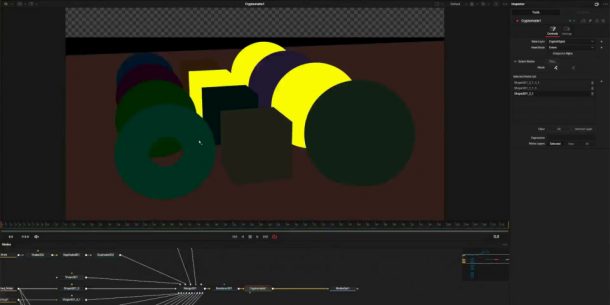
For motion designers working in two dimensions, the new sPrimitive Create node allows artists to generate complex geometric primitives such as stars and crosses with ease, complemented by advanced edge manipulation tools. In the 3D space, artists can now leverage nodes like Connect3D—which connects vertices using intricate networks of lines—HeightFieldCreate3D, and TubeCreate3D, enabling the procedural generation of bitmap-deformed planes and tubular structures directly inside the node graph.
In response to shifting industry demands for web-ready motion graphics, Fusion Studio 21 has added native support for the JSON-based Lottie animation format and the HTML-based OGraf graphics format. Version 21.1 builds on this by adding robust time-based animation actions for imported OGraf assets, complete with refined frame, ease, and scale controls. Furthermore, the Text+ and MultiText tools have received overdue quality-of-life upgrades, including support for colored fonts, emojis, a built-in spell checker, and automated text alignment options.
Deep Compositing and USD Workflow Advancements
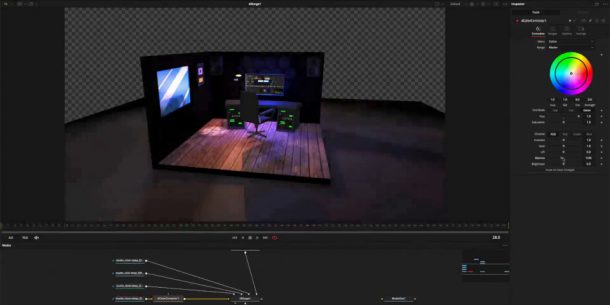
Deep compositing, a workflow philosophy that stores multiple depth and color samples per pixel to eliminate traditional edge-matte rendering artifacts, receives crucial upgrades in version 21. Studio 21.0 introduced the dColorCorrector node, allowing color artists and compositors to perform color corrections natively in deep mode without flattening imagery. Fusion Studio 21.1 deepens this utility further by incorporating flipbook previews for deep images, a new Hard Mix blend mode, and full layer support. When utilizing Renderer3D in deep mode, studios can now take advantage of integrated motion blur, matte object support, and up to eightfold performance enhancements via hardware-accelerated deep rendering.
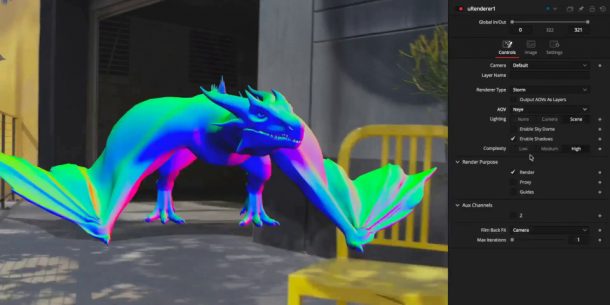
Simultaneously, Fusion’s USD toolset—first established in version 18.5—has matured significantly. Version 21 introduces the uProjector and uCatcher nodes for seamless decal projection and texture reprojection, alongside an "Is Matte" checkbox that designates specific objects to act as holdout mattes. The USD renderer now features the Neye AOV option for rendering camera-relative normals, facilitating advanced scene relighting. Crucially, Fusion Studio now fully supports Hydra 2, aligning it with modern 3D pipelines utilized by applications like SideFX Houdini and Foundry Katana.
Pipeline Integration, Color Management, and OpenPBR Standards
As visual effects pipelines demand tighter interoperability between disparate software packages, Blackmagic Design has updated Fusion’s backend to embrace contemporary industry standards. Fusion Studio 21.1 introduces full support for OpenColorIO (OCIO) 2.5, paving the way for seamless ACES 2.0 color-managed workflows.
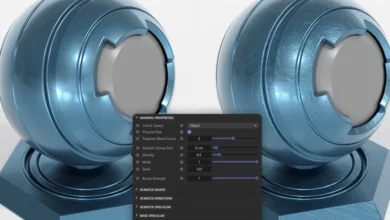
The software has also adopted OpenPBR material shaders, a cross-industry initiative launched by the Academy Software Foundation (ASWF), Adobe, and Autodesk to standardize material definitions across renderers. Additionally, pipeline supervisors will note the inclusion of HTJ2K compression support for EXR file input and export.
Concurrently, legacy technologies are being phased out. To streamline performance and security, native support for Python 2.0—which officially reached its end-of-life in 2020—has been entirely deprecated, encouraging studios to transition fully to modern Python 3 frameworks.
Performance Optimizations and Hardware Adaptation
Beyond feature additions, Blackmagic Design has focused heavily on computational efficiency. SpeedWarp, Fusion’s AI-powered retiming tool, has been refactored to utilize the exact same underlying retiming engine found in the Edit and Cut pages of DaVinci Resolve, resulting in vastly superior processing speeds. Other heavy computational nodes, such as Relight and Depth Map, have been optimized to run up to six times faster than in previous iterations.
Hardware compatibility has also taken a major leap forward with the introduction of native support for Windows on ARM architecture. This optimization unlocks high-performance node-based compositing on modern Copilot+ laptops and tablets, matching the ARM support previously brought to DaVinci Resolve.
Pricing, Licensing, and Availability
Fusion Studio 21.1 is available immediately as a complimentary update for all existing license holders. For new users, Blackmagic Design maintains its competitive pricing model, offering a perpetual license for $295 USD. The software is compatible with Windows 10 and higher, Rocky Linux 8.6 and higher, and macOS 15.0 and higher.
For budget-conscious independent artists and educational institutions, a feature-limited iteration of the Fusion toolset remains accessible within the free edition of DaVinci Resolve. While capped at a maximum image resolution of 16k x 16k and omitting distributed network rendering capabilities, the free version provides access to the vast majority of the node-based compositing ecosystem. Through these aggressive pricing strategies and continuous technological integration, Blackmagic Design ensures that high-end VFX and motion graphics tools remain accessible across all tiers of digital production.