X Expands Its Transparency Tools to Let Users See When Local Laws Limit Their Reach


Social media platform X has announced a significant update to its user-facing analytics and moderation visibility, introducing a feature that explicitly notifies users when their accounts or specific posts have been "shadowbanned" or downranked due to local legal compliance. The update marks a departure from traditional social media moderation practices, where the filtering of content driven by government mandates is typically hidden from the end user or relegated to ambiguous, high-level aggregate transparency reports.
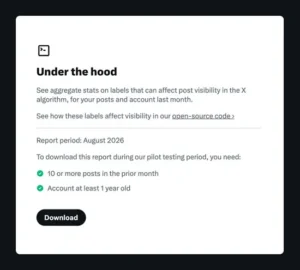
This latest development expands upon X’s existing diagnostic feature known as "Under the Hood." Initially rolled out to offer broader insight into the platform’s algorithmic decisions, the tool now provides granular details regarding how regional laws, legal demands, and government-mandated content filters affect the visibility of individual content creators and everyday posters alike. By lifting the veil on these processes, X is attempting to address long-standing user grievances regarding mysterious drops in engagement and reach.
The Mechanics of the Updated "Under the Hood" Tool
Under the newly expanded system, active users—specifically those who have published at least ten posts within a given monthly cycle—can access detailed data regarding their account standing directly through the application’s settings menu. By navigating to the "Under the Hood" section, users are able to download a comprehensive JSON file containing their monthly statistics.
This data file is designed to be easily processed. While it provides raw, structured data intended for developers and technical analysts, X has noted that non-technical users can simply upload the file into any major artificial intelligence chatbot to receive a plain-language summary of their account’s performance and visibility metrics.
Crucially, the file now itemizes whether an account or its corresponding posts have suffered from algorithmic downranking or intentional visibility limitations mandated by foreign or domestic laws. Furthermore, the updated tool discloses specific details regarding which posts were withheld in response to legal demands, alongside the identity of the country that issued the request.
Historical Context and the Shadowban Controversy
For years, the term "shadowbanning"—a practice wherein a user’s content is made invisible or less prominent to other users without the author’s direct knowledge—has been a source of intense controversy for social media platforms. On X, formerly known as Twitter, users frequently accused corporate leadership of intentionally suppressing political viewpoints, alternative news, or specific ideological discourses.
Historically, tech companies maintained a policy of opacity regarding moderation metrics. While most major platforms eventually began publishing periodic transparency reports, these documents were almost exclusively aggregate in nature. They detailed total numbers of content removals, government requests, and account suspensions on a country-by-country basis, but almost never connected those actions directly to an individual user’s timeline or post history.
This lack of visibility fostered a climate of distrust between digital platforms and their user bases. Creators, journalists, and political commentators often had to rely on anecdotal evidence—such as sudden, inexplicable drops in impressions, likes, and retweets—to deduce whether they had been penalized by platform algorithms or regional authorities. X’s decision to operationalize account-level transparency represents a direct challenge to this historical industry standard.
A Timeline of X’s Open-Source and Transparency Initiatives
The introduction of government-filtering notifications is the latest milestone in a sustained effort by X to overhaul its transparency framework and algorithmic architecture.
The movement toward greater openness began gaining significant momentum in August of the previous year, when X officially rolled out its initial transparency and data-download tools. This rollout coincided with the open-sourcing of the platform’s core recommendation algorithm, famously known as the "For You" feed. By releasing the underlying code, X allowed external researchers and everyday users to examine the specific ranking signals, weights, and filtering parameters that dictate how content is surfaced on the platform.
In January, the platform deepened these efforts by open-sourcing critical components of its overarching codebase. This subsequent release provided unprecedented visibility into model configurations, content filtering mechanisms, and core ranking architecture. It included specific parameters used to weight various signals—data points considered vital for understanding why certain posts achieve virality while others are buried.
At the time of the January codebase release, X’s Vice President of Product, Keith Coleman, remarked on the radical nature of the disclosure, noting that it was "the kind of thing that I think people will be fairly shocked that we are releasing."
Navigating the Complexities of Global Regulations
The necessity for account-level legal disclosures stems from the complex and often contradictory legal frameworks governing digital speech across different jurisdictions. As a global platform, X is legally obligated to comply with the local laws of the countries in which it operates. Failure to do so can result in heavy financial penalties, the blocking of the entire service within a given territory, or legal liability for company executives.
Governments across the globe routinely issue legal demands for content removal or suppression, citing a wide array of justifications. Common legal grounds include prohibitions against hate speech, the dissemination of terrorism-related propaganda, copyright violations, defamation, and the regulation of political speech during election cycles.
However, this intersection of platform moderation and state authority has long alarmed free-expression advocacy groups. Human rights organizations and digital liberty watchdogs frequently argue that authoritarian and semi-authoritarian regimes weaponize vague legal definitions—such as laws against "false news," "insulting state institutions," or "disturbing public order"—to suppress political dissent, silence investigative journalists, and stifle civil rights activism.
By specifying which country issued a legal demand and which specific posts were suppressed as a result, X’s updated tool provides empirical data on how sovereign governments exert influence over digital discourse. Observers note that this shifts the burden of accountability, making it easier for the public to distinguish between voluntary, internal platform moderation and forced compliance with government edicts.
Implications for Users, Competitors, and Regulators
The long-term implications of X’s transparency push are wide-ranging, affecting digital rights advocacy, competitive dynamics within the tech sector, and user behavior.
For users and content creators, the tool eliminates guesswork. Creators who experience sudden dips in reach can now definitively verify whether the suppression is the result of routine algorithmic updates, a violation of platform terms of service, or a government-mandated geoblock. This clarity may reduce unfounded conspiracy theories regarding platform bias, replacing speculation with verifiable data.
For civil society and media watchdogs, the account-level data serves as a valuable research asset. Human rights organizations can aggregate individual reports to map out broader patterns of state censorship, identifying which governments are most aggressive in demanding content suppression and tracking the types of speech most frequently targeted.
From an industry perspective, X’s actions place pressure on competing social media giants—such as Meta, Google, and TikTok—to follow suit. Historically, major tech firms have resisted granular transparency, arguing that revealing specific legal takedown contexts to individual users could compromise ongoing law enforcement investigations or expose local employees to legal retaliation. X’s willingness to bypass these traditional industry hesitations could redefine user expectations regarding platform accountability.
At the same time, the feature highlights the ongoing friction between global internet platforms and national sovereignty. As governments increasingly demand localized control over digital information flows, platforms are forced to choose between withdrawing from lucrative markets or complying with restrictive local laws. By explicitly tagging content as restricted due to government mandates, X is signaling to its user base that its hands are tied by local statutes, even as it provides the transparency needed to hold those very governments accountable in the court of public opinion.
Related posts: