Nvidia Unveils ASPIRE: A Self-Improving Robotic Framework Transforming AI-Driven Automation

Traditional robotic programming has long been constrained by rigid operational pipelines, failing to gracefully manage the dynamic, unpredictable nature of real-world physical environments. Traditional systems rely on fixed code sequences that inevitably halt when confronted with minor environmental variations, sensor inaccuracies, or unforeseen physical collisions. Resolving these bottlenecks historically demanded exhaustive manual intervention, custom debugging, and extensive parameter tuning by human robotics engineers.
To overcome these structural limitations, artificial intelligence research has increasingly shifted toward agentic systems capable of autonomously writing, evaluating, and refining their own control software. Marking a significant milestone in this domain, Nvidia—in active collaboration with an international consortium of university researchers—has officially introduced ASPIRE, a groundbreaking framework designed to facilitate continuous, self-improving robotic learning.
By bridging the gap between high-level reasoning models and physical hardware constraints, ASPIRE empowers artificial intelligence systems to diagnose errors autonomously, distill successful operational repairs into a transferable skill library, and drastically reduce the engineering overhead typically required for complex robotic deployments.
Background Context and the Code-as-Policy Paradigm
The development of ASPIRE arrives at a pivotal juncture in artificial intelligence and robotics research. Over the past several years, the rapid maturation of large language models (LLMs) and vision-language-action (VLA) models has fundamentally altered how researchers approach machine control. Rather than manually programming low-level motor torques and joint angles, modern robotics has increasingly adopted the "code-as-policy" paradigm.

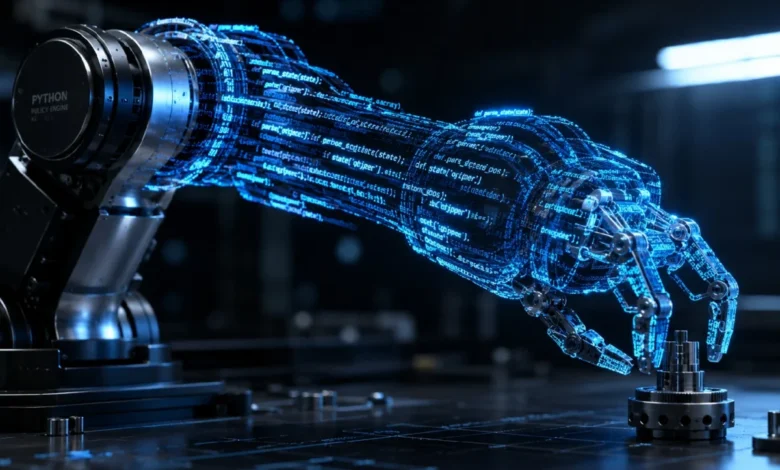
In this paradigm, an AI agent translates high-level task instructions—such as picking up an object or navigating a crowded room—into executable Python scripts. These programs dynamically integrate multimodal perception tools, application programming interfaces (APIs), and motion-planning libraries. Because the robot’s behavior is expressed as code, execution traces can be systematically examined, debugged, and optimized using interaction feedback.
Despite its promise, the code-as-policy approach faces severe operational hurdles. Existing robotic coding agents typically operate within naive testing environments that offer only coarse, binary feedback regarding task success or failure. When an execution rollout fails, a generic error message fails to reveal whether the root cause stems from faulty camera perception, unstable physical grasping mechanics, or a collision-avoidance error generated by the motion planner. Without fine-grained diagnostic traces, agents struggle to localize failures or formulate effective repair strategies.
Furthermore, conventional robotic coding agents suffer from a profound lack of cumulative experience. When an existing agent successfully resolves a complex task, it discards the underlying repair heuristics once the execution loop terminates. Consequently, an AI agent attempting its thousandth assignment operates with the same baseline capability as an agent attempting its very first task. This stands in stark contrast to human robotics engineers, who internalize debugging trajectories, accumulate reusable heuristics, and systematically improve their problem-solving efficiency over time.
The Mechanics of the ASPIRE Framework
To replicate the cognitive accumulation of human experts, the research team designed ASPIRE, an acronym representing Agentic Skill Programming through Iterative Robot Exploration. Rather than treating each robotic task as an isolated challenge, ASPIRE functions as an open-ended, continuous learning ecosystem that compounds its capabilities with every encountered failure.
The framework operates through three core, tightly integrated architectural components:

-
The Closed-Loop Robot Execution Engine: Functioning akin to an aircraft’s flight data recorder, this engine serves as the primary debugging environment. When a robotic task fails, the engine aggregates comprehensive multimodal traces—recording visual keyframes immediately before and after the failure, perception model outputs, code execution logs, and specific motion-planning exceptions. This granular data enables the AI agent to pinpoint the exact line of code or physical interaction responsible for the breakdown.
-
The Compounding Skill Library: Once the agent successfully validates a software patch or recovery heuristic, a central coordinator distills the solution into a generalized rule or strategy. This library catalogs localization tricks, grasping constraints, and procedural debugging workflows. Future agents can dynamically query these stored skills as in-context guidance, acquiring a cognitive head start on unfamiliar assignments.
-
The Evolutionary Search Procedure: To prevent the AI agent from becoming trapped in localized optimization loops—such as repeatedly tweaking identical failed logic without making progress—ASPIRE employs an evolutionary search mechanism. The system generates a diverse population of alternative control programs and task strategies, testing multiple code mutations in parallel. This allows the framework to explore fundamentally different physical and logical approaches to a problem rather than perpetually refining a single failed trajectory.
To contextualize this in a real-world enterprise scenario, consider a mobile manipulator tasked with retrieving a specific object from a crowded workbench. If the robot’s navigation target is mathematically positioned too close to a table’s edge, the motion planner will trigger a hidden collision-avoidance safety buffer, halting the operation. Through ASPIRE, the execution engine logs the planning exception. Utilizing evolutionary search, the agent proposes multiple code patches, ultimately instructing the robot to sample alternative approach angles (such as 45-degree, 90-degree, and 180-degree vectors) to discover a collision-free path. Upon successful execution, the multi-angle approach heuristic is extracted and permanently cataloged in the skill library for future deployment.
Empirical Evaluation and Quantitative Performance
To rigorously test the efficacy of the framework, the research team powered ASPIRE’s core coding agent using advanced reasoning models, including Claude Opus 4.6 for simulation benchmarks and OpenAI Codex running on GPT-5.5 for real-world physical hardware experiments. The system was evaluated across multiple simulated benchmark families designed to test robotic navigation, short-horizon manipulation, and complex long-horizon tasks under varying environmental perturbations.

The quantitative findings demonstrate performance improvements across all tested domains. On the LIBERO-Pro benchmark, ASPIRE outperformed established state-of-the-art coding agents—such as CaP-Agent0—and end-to-end vision-language-action models like OpenVLA, improving success rates by up to 77 percentage points when subjected to object perturbations.
On the Robosuite benchmark, which evaluates intricate bimanual robotic coordination, ASPIRE elevated a complex object handover task from a baseline 20 percent success rate to an impressive 92 percent. Furthermore, when evaluated on long-horizon tasks within the BEHAVIOR-1K benchmark, the framework surpassed both leading AI baselines and human expert benchmarks in overall navigation and task execution accuracy. When applying its accumulated skill library to entirely unseen long-horizon tasks in a zero-shot evaluation, the system achieved a 31 percent success rate, vastly outperforming prior methods that saturated at a mere 4 percent.
Implications for Real-World Deployment and Computational Efficiency
Beyond synthetic benchmarks, the most compelling industrial implication of ASPIRE lies in its optimization of sim-to-real transfer and computational resource management. Deploying large-scale reasoning models for robotic control typically incurs massive computational overhead, measured in millions of reasoning tokens consumed during debugging loops.
During physical deployment experiments involving a robotic arm tasked with lifting a soda can, feeding the agent a pre-learned simulation skill reduced the total reasoning tokens required for debugging from approximately 61.94 million down to just 6.58 million, while simultaneously boosting the final success rate from 65 percent to 95 percent.
The economic and computational impact became even more pronounced during complex drawer manipulation experiments. Without access to transferred simulation skills, the AI agent exhausted a computational budget of nearly 335 million tokens without achieving a single successful execution. However, when equipped with pre-learned skills from ASPIRE’s library, the physical robot achieved a 55 percent success rate while consuming only 81.67 million tokens.

Industry Implications and Future Outlook
The introduction of frameworks like ASPIRE signals a broader, structural transformation within industrial automation and embodied artificial intelligence. As reasoning models continue to advance, the integration of autonomous self-improving code generation addresses one of the most stubborn bottlenecks in robotics: the labor-intensive, costly nature of physical programming and debugging.
By demonstrating that generalized repair heuristics can be seamlessly transferred from high-speed simulations to disparate physical hardware embodiments, Nvidia and its academic collaborators have laid the groundwork for scalable robotic fleets. These systems are no longer bound by static, brittle programming pipelines; instead, they possess the architectural capacity to learn, adapt, and refine their own operational logic autonomously within complex, open-world environments. The research team intends to open-source the underlying code, providing global developers and enterprise organizations with the tools necessary to accelerate the deployment of autonomous robotic intelligence.