The rapid integration of Artificial Intelligence (AI) into consumer and enterprise software has reached a critical inflection point where corporate strategy and user preference have begun to diverge sharply. While global technology leaders operate under the assumption that a pervasive "AI-first" approach is the primary driver of future market value, emerging data and user sentiment suggest a growing resistance to these implementations. The prevailing corporate narrative posits that users crave a total transformation of their digital workflows through generative features; however, market realities indicate that the "AI adoption gap" is widening. High delivery costs and significant reputational risks are increasingly associated with features that users perceive as intrusive, unreliable, or unnecessary.
The Structural Failure of AI as a Value Proposition
In the current landscape of product development, senior leadership often conflates technical capability with market value. Business analysts, including David Bland, have noted a fundamental error in how AI is positioned within the Business Model Canvas. Historically, successful technologies are integrated into "Key Activities" or "Key Resources" to improve efficiency. Current trends, however, attempt to force AI into the "Value Proposition" segment itself. This distinction is vital: users rarely seek "AI" as an end product; they seek solutions to specific problems. When AI is marketed as the primary value, it often fails to meet the basic criteria of user satisfaction—predictability and reliability.
Furthermore, many AI features are currently implemented as "bolt-ons"—disparate tools that exist outside of an employee’s established workflow. Rather than streamlining operations, these tools often force users to "hop" between fragmented systems, increasing cognitive load and disrupting focus. Instead of rectifying long-standing issues such as technical debt or broken internal cultures, AI often acts as an amplifier for these shortcomings. Inconsistencies in data quality or conflicting organizational priorities are magnified by automated systems, often leaving the end-user to reconcile the resulting "AI slop" or hallucinations.
A Chronology of the Generative AI Surge and the Resulting Backlash
The current tension can be traced through a specific timeline of technological acceleration and subsequent market correction:
- November 2022: The public release of ChatGPT triggers a global arms race among tech giants to integrate Large Language Models (LLMs) into every conceivable interface.
- Early 2023: Major enterprise suites (Microsoft 365, Google Workspace) announce "Copilot" and "Duet" integrations, promising a revolution in white-collar productivity.
- Late 2023: Early adoption data begins to surface, showing that while initial "trial" rates are high, long-term retention of AI features is significantly lower than traditional software updates.
- Mid-2024: Reports from organizations like the Nielsen Norman Group and IBM highlight the "AI Adoption Gap," noting that the cost of delivery for many generative features outweighs the measurable productivity gains.
- Present: A growing "human-centric" movement emerges among UX designers and product strategists, advocating for "AI-second" or "ambient AI" approaches that prioritize existing human mental models over automated intervention.
Quantifying the Productivity Paradox
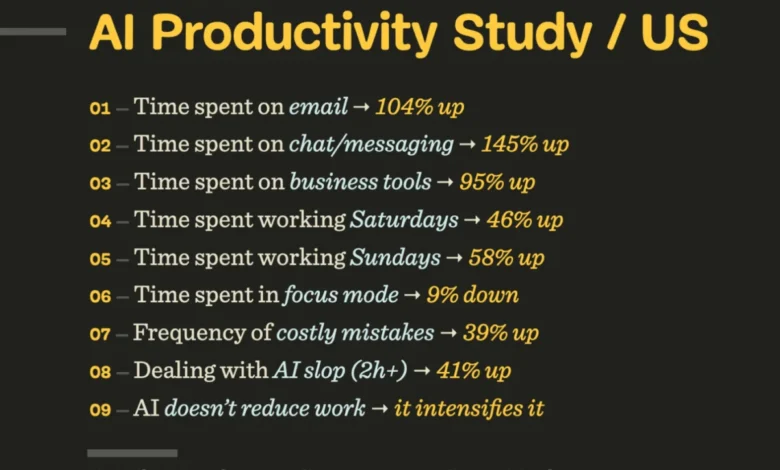
Contrary to the promise of reduced workloads, recent studies conducted across the United States suggest that AI integration may be intensifying work rather than alleviating it. Data compiled from sources including NBC News, Harvard Business Review (HBR), and the Wall Street Journal indicates a "productivity paradox" where the presence of AI tools correlates with increased time spent on administrative communication.

Key findings from recent productivity assessments include:
- Communication Overhead: Time spent on email has increased by an estimated 104%, while chat and messaging platform usage has surged by 145%.
- Extended Work Cycles: The boundaries of the traditional work week are eroding, with a 46% increase in work conducted on Saturdays and a 58% increase on Sundays.
- Quality Control Burdens: Dealing with "AI slop"—low-quality or inaccurate automated output—has become a new category of labor, with users reporting a 41% increase in time spent "cleaning up" after AI agents.
- Accuracy Risks: Costly mistakes attributed to over-reliance on unverified AI outputs have risen by approximately 39%.
These statistics suggest that while AI can generate content in seconds, the human labor required to verify, edit, and contextualize that content often exceeds the time it would have taken to create the material from scratch. This "hallucination tax" is a primary driver of user frustration.
The Psychological and Cultural Resistance to Automation
Beyond technical inefficiency, there is a profound psychological disconnect between AI developers and the general public. While industry leaders envision a world of AI-narrated books, AI-generated art, and autonomous AI agents managing personal finances, consumer sentiment remains skeptical. There is a documented "resistance to change" rooted in the fear of displacement and the loss of human agency.

Statements from cultural observers and industry experts highlight a desire for AI to remain in the background. Bo Young Lee, a prominent voice in organizational culture, recently articulated a sentiment shared by many: the desire for AI to handle the "physical and mental labor" that is taxing, rather than the creative and social activities that provide human fulfillment. The prospect of AI therapists, AI teachers, or AI medical decision-makers often evokes anxiety rather than excitement. For many, the value of a service is inextricably linked to the human effort and empathy behind it.
Industry Analysis: The Shift Toward AI-Second Design
In response to these adoption challenges, a new philosophy in product design is beginning to take hold. Often termed "AI-second" or "Subtle AI," this approach focuses on integration rather than disruption. The goal is to create "calm" technology that supports the user without demanding constant interaction or "prompting."
Key characteristics of successful AI integration include:

- Predictability: Unlike generative models that produce different results for the same input, effective tools must behave consistently to build user trust.
- Workflow Integration: AI must exist within the tools people already use, adapting to their mental models rather than forcing them to learn "prompt engineering."
- Boring Task Automation: Users show the highest satisfaction when AI handles invisible, mundane tasks—such as data entry, scheduling, or basic file organization—rather than creative or strategic work.
- Human-in-the-Loop: Systems that provide suggestions rather than taking autonomous actions are more likely to be accepted in professional environments where accountability is paramount.
Data from the Brookings Institution and GovAI reveals that while software developers and public relations specialists are "highly exposed" to AI automation, these roles also require a high degree of "taste" and "intuition"—qualities that current AI models lack. Consequently, the most effective AI implementations are those that augment these professionals by removing the "drudge work," allowing more time for high-level decision-making.
Broader Implications and the Future of Human-AI Interaction
The long-term success of artificial intelligence will likely depend on a recalibration of corporate expectations. The assumption that users want "more AI" is being replaced by the realization that users want "more time." If AI is used to intensify the pace of work and flood digital channels with unverified content, the backlash from both employees and consumers is likely to intensify.
The financial implications are also significant. As the high cost of running LLMs continues to pressure corporate margins, companies can no longer afford to develop features that users ignore or disable. A shift toward "utility-first" development—where AI is just one of many tools used to solve a problem—is expected to replace the "AI-first" hype cycle.

In conclusion, the path forward for AI is not found in creating "magical boxes" for users to speak to, but in the invisible, seamless automation of the tasks that humans find unrewarding. By prioritizing human connection and respecting the rewarding aspects of human labor, organizations can move past the current adoption gap toward a more sustainable and accepted form of technological integration. The ultimate goal of AI should not be to replace the human experience, but to provide the headspace for humans to engage more deeply with one another and the work they find meaningful.