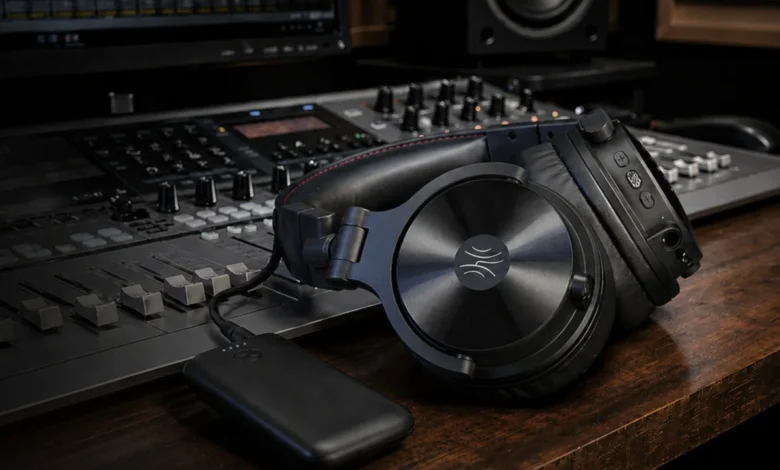
The OneOdio Studio Max 2 emerges as a compelling contender in the increasingly specialized headphone market, designed as a sophisticated closed-back, over-ear wireless solution tailored to meet the exacting demands of developers, competitive gamers, and discerning gadget enthusiasts. These headphones aim to seamlessly bridge the often disparate worlds of studio-grade audio monitoring and high-performance gaming headsets, offering a robust blend of ultra-low latency and expansive connectivity options. By integrating multiple wireless and wired modes, the Studio Max 2 directly addresses and mitigates the inherent audio delay commonly associated with conventional Bluetooth headsets, a critical factor for professional workflows and immersive entertainment. The inclusion of a dedicated 2.4GHz transmitter, specifically engineered for minimal signal lag, positions these headphones as an indispensable tool for time-sensitive applications such as video editing, intensive coding sessions where immediate audio feedback is beneficial, and fast-paced gaming environments where milliseconds can dictate success.
The Quest for Immediacy: Addressing Latency in Modern Audio
In an era defined by real-time interaction and digital precision, audio latency stands as a significant bottleneck, particularly in professional and entertainment sectors. Standard Bluetooth connections, while convenient, typically introduce latency ranging from 100 to 200 milliseconds (ms). While largely imperceptible for casual music listening, this delay becomes profoundly disruptive in scenarios requiring tight audio-visual synchronization or instantaneous auditory cues. For professional video editors, even a slight delay can throw off precise cuts and transitions. Music producers and developers working with audio interfaces require near-zero latency for monitoring their input without echo or lag. In competitive gaming, audio cues—such as footsteps, gunshots, or ability activations—are crucial for tactical advantage, rendering high latency a severe competitive disadvantage.
The OneOdio Studio Max 2 directly confronts this challenge with its innovative multi-connectivity approach. While supporting the latest iteration of Bluetooth technology, designated as Bluetooth 6.0 for its presumed release and widespread adoption by 2026, it primarily differentiates itself through its proprietary M2 USB transmitter. This dongle leverages RapidWill+ 3.0 technology over a dedicated 2.4GHz wireless connection, a frequency band traditionally favored for its stability and lower interference in short-range applications. Crucially, this setup slashes audio latency to an impressive 9 milliseconds. To put this in perspective, even advanced Bluetooth codecs like aptX Low Latency typically achieve around 30-40ms. The Studio Max 2’s 9ms latency is virtually imperceptible to the human ear, placing it firmly in the realm of wired performance and making it a game-changer for applications where instantaneous audio feedback is paramount. This technological leap allows users to experience real-time sound synchronization, enhancing productivity and immersion across their digital endeavors.
Design Philosophy and Ergonomic Considerations for Extended Use
The aesthetic and structural integrity of the OneOdio Studio Max 2 reflect a thoughtful balance between robust functionality and a nod to the brand’s heritage. The headset features a sleek, matte black plastic body, which contributes to a manageable overall weight without compromising on durability. This choice of material is typical in the consumer electronics sector, offering a good balance of cost-effectiveness, weight reduction, and resilience to everyday wear and tear. The integration of a numbered metal headband not only adds a touch of premium feel but also ensures precise and repeatable size adjustments, allowing users to find their optimal fit consistently.
A distinctive design element is the exterior earcups, which proudly display a subtle yet sophisticated vinyl record groove pattern. This detail serves as an elegant homage to OneOdio’s roots in DJ hardware, subtly reminding users of the brand’s commitment to audio fidelity and professional-grade equipment. Beyond aesthetics, the earcups are engineered for practical versatility; they rotate a full 180 degrees and fold inward, a crucial feature for professional DJs who often monitor audio with a single ear. This folding mechanism also significantly enhances portability and reduces the headset’s footprint, making it easier to store in a bag or case.
Comfort during prolonged use is a critical factor for the target demographic. OneOdio addresses this by utilizing plush memory foam earpads, enveloped in high-quality protein leather. Memory foam conforms to the unique contours of the user’s ears, providing excellent sealing for passive noise isolation and distributing pressure evenly. The protein leather, often chosen for its soft texture and durability, mimics the feel of genuine leather while being more resistant to wear and sweat. The clamping force of the headset is carefully calibrated to keep it securely in place, an essential attribute for users who might be moving or intensely focused.
However, extended wear tests revealed a minor ergonomic challenge. Despite the generous padding, the headphones’ weight, combined with the clamping force, can create a localized pressure point on the crown of the head after approximately two hours of continuous use, necessitating occasional readjustment. This is a common issue with many over-ear designs and highlights the ongoing challenge for manufacturers to achieve perfect weight distribution. On a desk, the large over-ear footprint means the headphones occupy a considerable amount of space, which could be a consideration for users with limited workspace. To counter this, the manufacturer wisely includes a rigid EVA (ethylene-vinyl acetate) carrying case. This robust case provides superior protection against impacts and elements, neatly accommodating the headphones and all accompanying cables, making it an ideal accessory for daily commutes, travel, or simply safeguarding the investment when not in use.
Seamless Connectivity: A Multi-Modal Approach to Versatility

The OneOdio Studio Max 2 stands out for its comprehensive suite of four distinct connection methods, offering unparalleled flexibility to adapt to virtually any audio setup. At the forefront of its wireless capabilities is Bluetooth 6.0 (or the latest equivalent standard by 2026), featuring multipoint pairing. This advanced feature allows the headphones to connect simultaneously to two source devices—for instance, a smartphone and a laptop—enabling seamless switching between audio streams without the hassle of manual disconnection and reconnection. This is a boon for productivity, allowing users to manage calls on their phone while listening to music or working on their computer, ensuring they never miss an important notification or interruption.
For mission-critical applications where even minimal delay is unacceptable, the included M2 USB transmitter is the star. This dedicated dongle establishes a 2.4GHz wireless connection, leveraging OneOdio’s proprietary RapidWill+ 3.0 technology to achieve the aforementioned ultra-low latency of 9 milliseconds. This near-instantaneous audio transmission makes the Studio Max 2 an invaluable asset for competitive gaming, where sound cues are often decisive, and for professional audio monitoring in production environments. The 2.4GHz band, less susceptible to the inherent processing delays of Bluetooth, provides a direct, robust link between the source and the headphones, ensuring a pristine and timely audio signal.
Further enhancing its versatility, the headset incorporates both 3.5mm and 6.35mm input jacks directly on the earcups. This dual wired input capability is a particularly unique and powerful feature. It allows users to connect two different audio sources to the headset simultaneously and monitor both channels concurrently. Imagine a musician practicing with a digital piano connected via a 6.35mm cable while also listening to a backing track from a smartphone connected via 3.5mm. Or a streamer monitoring game audio from their PC while keeping an ear on chat from a console. This flexibility significantly expands the headphones’ utility beyond typical consumer use cases, catering directly to the needs of creators and multi-platform users.
Audiophiles and content creators will appreciate the inclusion of the Sony LDAC codec for high-resolution wireless streaming. LDAC, a proprietary audio coding technology developed by Sony, allows for the transmission of high-resolution audio content over Bluetooth connections at a maximum transfer rate of 990 kbps. This is significantly higher than standard Bluetooth codecs like SBC (around 320 kbps) or even aptX HD (576 kbps), enabling the Studio Max 2 to deliver a much richer, more detailed, and expansive soundstage, provided the source device also supports LDAC. This commitment to high-fidelity audio underscores OneOdio’s aim to cater to users who demand superior sound quality even in a wireless format.
The user experience is further refined through the OneOdio companion app, available for mobile devices. This application provides granular control over various headphone settings, including the ability to change EQ profiles to match different listening preferences or tasks. Users can select from predefined presets, create custom equalization curves, and even set maximum volume limits, a useful feature for hearing protection or parental control. The app also typically offers firmware updates, ensuring the headphones remain optimized and benefit from future enhancements.
Despite this impressive array of features, there are a couple of notable limitations. The headphones carry no official IP rating for water or dust resistance. This suggests that while robust for indoor use, they are not designed for strenuous workouts, outdoor activities in inclement weather, or environments where they might be exposed to splashes or heavy dust. Users are advised to exercise caution in such scenarios to preserve the device’s longevity. A more significant operational limitation, particularly for gamers and professional communicators, is that the built-in microphone disables automatically when connected via the 2.4GHz transmitter or any of the audio cables. This means voice chat functionality is strictly limited to Bluetooth mode. While this might be a technical compromise related to bandwidth allocation or audio processing paths in non-Bluetooth modes, it requires users to switch connectivity methods if they need to engage in voice communication while using the low-latency or wired connections, which can disrupt workflow. This is a point of consideration for potential buyers whose primary use case involves simultaneous low-latency audio and voice chat.
Sonic Performance: From Studio Monitoring to Immersive Gaming
At the core of the OneOdio Studio Max 2’s audio prowess are its 45mm High-Flux drivers. These drivers are typically larger than those found in many consumer headphones, allowing for a broader frequency response and more impactful bass reproduction. "High-Flux" refers to the strength of the magnetic field driving the diaphragm, which generally translates to greater efficiency, improved transient response, and the ability to reproduce dynamic audio passages with clarity and power.
Upon initial listening, the default "Music" EQ profile presents a sound signature that emphasizes bass frequencies while notably recessing the midrange. This tuning, common in many consumer-oriented headphones, often aims to deliver a punchy, engaging sound for popular music genres. However, for critical listening, professional audio work, or competitive gaming, this profile can lead to a somewhat "muddy" sound, where bass elements overpower and obscure the clarity of vocals, instruments, or subtle environmental cues. The recessed midrange makes it harder to discern individual elements within complex audio mixes.
Fortunately, the Studio Max 2’s companion app offers crucial remedies. Applying the "Monitoring" preset or the custom DJ KSHMR profile dramatically flattens the frequency response. This adjustment is transformative: it tightens the low-end frequencies, preventing them from bleeding into the mids, and significantly improves midrange clarity. For audio professionals, a flatter frequency response is paramount as it provides a more accurate and uncolored representation of the sound, essential for mixing, mastering, and critical evaluation. For gamers, this enhanced clarity makes it easier to isolate individual instruments in a game’s soundtrack or, more critically, to hear distinct directional audio cues like footsteps or distant gunfire, offering a significant competitive edge.
The collaboration with DJ KSHMR, a renowned electronic music producer and DJ, adds considerable weight to the headphones’ audio credibility. His involvement in tuning a specific EQ profile signifies an endorsement from a professional who understands the nuances of sound production and performance. This custom profile is likely designed to meet the demands of discerning audio professionals and enthusiasts, offering a more balanced and analytical sound signature that aligns with professional monitoring standards.

Regarding noise control, the device lacks Active Noise Cancellation (ANC) and transparency modes. Therefore, noise reduction relies entirely on the passive isolation provided by its physical design. The combination of closed-back earcups and memory foam earpads creates an effective acoustic seal around the ears. In practice, this design successfully blocks out standard room noises, such as air conditioning hums, distant conversations, and the sound of keyboard typing. However, it’s important to note that very loud or abrupt environmental sounds, like those found in a bustling coffee shop, on public transport, or during a busy commute, will still bleed through. While effective for focused work in moderately quiet environments, users requiring complete immersion in very noisy settings might find the absence of ANC a limiting factor.
For communication, the internal microphone, active solely in Bluetooth mode, captures clear voice audio. This makes the Studio Max 2 suitable for standard phone conversations, video conference calls, and casual voice chat. While not explicitly detailed, it is likely that the microphone employs some form of basic noise reduction to ensure the user’s voice remains intelligible, even if it doesn’t offer the advanced beamforming or environmental noise cancellation found in dedicated gaming headsets or premium business headphones.
Endurance and Value Proposition in a Competitive Market
One of the most remarkable aspects of the OneOdio Studio Max 2 is its exceptional battery performance, setting a new benchmark in its category. A single full charge delivers an astounding up to 120 hours of continuous audio playback when connected via Bluetooth. This figure far surpasses most wireless headphones on the market, many of which typically offer between 20 to 60 hours. This extended endurance is a significant advantage for users who frequently travel, work long hours, or simply prefer not to charge their devices often. When utilizing the 2.4GHz transmitter for ultra-low latency, the total runtime remains highly impressive at 50 hours, still outperforming many standard Bluetooth headphones. This difference is expected, as the dedicated 2.4GHz connection often consumes more power due to its constant, high-speed data transmission and proprietary processing.
Recharging the headset is convenient and swift, thanks to its modern USB-C port. Furthermore, the Studio Max 2 supports a fast-charging capability, where a mere five-minute charge can restore up to nine hours of listening time. This rapid power replenishment is invaluable for users on the go, allowing them to quickly top up the battery during short breaks or before heading out, mitigating concerns about running out of power mid-task.
The OneOdio Studio Max 2 retails for $199.99 (USD). This pricing positions it squarely in the upper-midrange segment of the headphone market, where it faces competition from both dedicated gaming headsets and general-purpose wireless headphones. However, its unique combination of ultra-low latency (9ms), multipoint Bluetooth 6.0, dual wired inputs, LDAC support, and industry-leading battery life presents a compelling value proposition. Few, if any, competitors at this price point offer such a comprehensive feature set specifically tailored for both professional audio/video work and high-performance gaming. For tech enthusiasts and professionals who demand versatility and performance without venturing into the premium price tiers of several hundred dollars, the Studio Max 2 represents a highly attractive investment.
The headphones are readily available for purchase directly through the OneOdio official website and major online retailers like Amazon. As part of an ongoing promotional effort, customers can avail a 15% discount using the code BDTECH15 on both platforms, further enhancing its affordability and market appeal. This strategic pricing, coupled with a generous discount, underscores OneOdio’s intent to capture a significant share of the hybrid professional and enthusiast market.
Broader Implications and Market Impact
The introduction of the OneOdio Studio Max 2 signifies a growing trend in the audio industry: the convergence of traditionally separate headphone categories. For years, consumers often had to choose between a gaming headset (optimized for low latency and communication) and a studio monitor (optimized for audio accuracy) or a general-purpose wireless headphone (optimized for convenience and mobility). The Studio Max 2 boldly attempts to integrate the best aspects of these categories into a single, versatile device.
Its appeal to developers, video editors, and content creators highlights the increasing demand for tools that seamlessly integrate into complex digital workflows. The ability to switch between ultra-low latency for critical tasks and high-resolution Bluetooth for casual listening, coupled with multipoint connectivity, addresses the dynamic needs of modern professionals who often juggle multiple devices and applications. For the gaming community, the 9ms latency offers a significant performance edge, potentially influencing competitive play and enhancing immersion in rapidly evolving game environments.
OneOdio, known for delivering feature-rich audio solutions at competitive prices, solidifies its position as an innovator with the Studio Max 2. By addressing a critical pain point (latency) with a robust, multi-faceted solution, they are not only catering to existing needs but also potentially shaping future expectations for what a "hybrid" headphone should offer. While the microphone limitation in non-Bluetooth modes is a compromise, the overall package of features, performance, and extraordinary battery life at its price point makes the Studio Max 2 a formidable product. It positions itself as a key tool for the evolving landscape of hybrid work, immersive entertainment, and dynamic content creation, signaling a future where audio peripherals are expected to be as adaptable and high-performing as the users they serve.
Related posts: