Ilija Brunck and the Evolution of Immersive Storytelling: From Experimental Shorts to the Las Vegas Sphere

The trajectory of Ilija Brunck’s career offers a compelling case study in the evolution of digital artistry, tracing a path from the intimate, conceptual precision of short-form animation to the monumental, high-fidelity demands of the world’s most advanced immersive venues. As a co-founder and the current CEO of the Berlin-based studio Woodblock, Brunck has played a pivotal role in bridging the gap between traditional narrative-driven CGI and the emerging frontier of spatial, large-format entertainment. This transition, underscored by a commitment to design-driven storytelling over mere technical bravado, reflects broader shifts in how audiences consume media and how studios must adapt to new, expansive canvases.
The Origins of a Design-Led Philosophy
Ilija Brunck’s professional foundation was laid at the prestigious Filmakademie Baden-Württemberg, a hub for European animation talent. It was here, in partnership with fellow visual artist Uli Staiger, that the ethos of Woodblock was forged. The studio emerged at a time when digital production was becoming increasingly accessible, yet the market was simultaneously becoming saturated with "technical spectacle."
From its inception, Woodblock distinguished itself by prioritizing the "why" of a project over the "how." This philosophy is evident in the studio’s early portfolio, which included experimental shorts such as 458nm, Loom, and Bye Bear. These works shared a common DNA: they were deceptively minimalist in their visual presentation but deeply layered in their thematic exploration of mortality, human connection, and environmental resonance. By stripping away unnecessary complexity, Brunck and his team ensured that the technical execution served the emotional arc of the story, not the other way around. This approach garnered significant critical acclaim, including a Golden Nica at the Ars Electronica Festival and a Best in Show accolade at SIGGRAPH, establishing Woodblock as a boutique firm capable of producing world-class content with a distinct authorial voice.
Chronology of Expansion: From Broadcast to Global Immersive
The studio’s growth from an experimental collective to a powerhouse catering to global titans—such as Apple, Nike, Microsoft, and Netflix—was characterized by a cautious, steady scaling of operations. By maintaining a focus on design-driven storytelling, Brunck managed to secure high-profile commercial contracts without diluting the studio’s aesthetic identity.
The most significant pivot in this chronology occurred with the rise of spatial computing and high-resolution immersive media. As large-scale, dome-based display technologies became viable, the demand for content capable of filling a 16K, 12-story high, 160,000-square-foot interior—the Las Vegas Sphere—skyrocketed. Brunck saw this not merely as a technical challenge, but as an opportunity to push narrative storytelling into a 360-degree, non-linear environment.
In recent years, the timeline of Woodblock’s major projects includes:
- Early 2010s: Development of core studio capabilities, producing award-winning shorts that defined the "Woodblock style."
- 2015–2020: Strategic expansion into commercial work for multinational brands, establishing robust pipelines for real-time and broadcast CG.
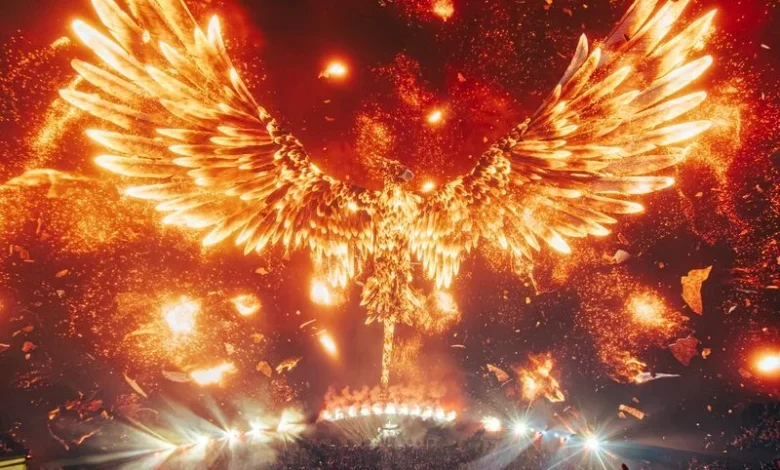
- 2023: Collaboration with Anyma for The End of Genesys, serving as a foundational entry into the Sphere’s technical requirements.
- 2024–2025: Execution of the Odyssey project for Illenium, a 90-minute cinematic experience, marking the studio’s most ambitious production to date.
Technical Milestones: The Odyssey Project
The production of Odyssey represents a new tier of digital production. The project, which required roughly a year of continuous development, involved a collaborative effort between Woodblock, Sphere Entertainment Co., The Third Floor (the preeminent visualization firm), and Silent House.
The technical specifications of this project were unprecedented. To deliver a 12K, fully CG, character-driven experience meant for an interior screen of such magnitude, the studio had to overcome immense challenges regarding resolution, render times, and the psychology of viewer immersion. When viewing content at this scale, traditional cinematography—such as rapid cuts or hyper-active camera movement—can induce motion sickness. Consequently, Brunck’s team had to rethink the "language" of the edit. The focus shifted to long, sweeping shots, atmospheric world-building, and pacing that allowed the audience to explore the vast, digital environment without feeling overwhelmed by the sensory input.
Sustainable Production in a High-Demand Era
Despite the sheer scale of the projects Woodblock now undertakes, Brunck has remained an outspoken proponent of "agile, sustainable production." In an industry currently obsessed with the "more is more" approach, Brunck advocates for smaller, highly focused teams. He argues that large, bloated teams often lead to a loss of creative clarity and a decrease in individual agency.
This management philosophy has significant implications for the studio’s workflow. By utilizing smaller, multidisciplinary teams, Woodblock reduces the communication overhead that typically plagues larger productions. This allows for a more fluid, iterative creative process, where the director’s vision remains intact from the initial sketch to the final high-resolution render. This approach is not only more cost-effective but also more resilient to the shifting demands of modern production pipelines, allowing the studio to pivot quickly as new technologies like AI and real-time game engines continue to mature.
Educational Commitments and Industry Influence
Ilija Brunck’s influence extends beyond the walls of his studio. His ongoing engagement with the Filmakademie Baden-Württemberg serves as a conduit for his philosophy to reach the next generation of digital artists. By participating in international panels and educational initiatives, Brunck seeks to bridge the gap between academic theory and the harsh realities of commercial production.
Industry observers note that Brunck’s pedagogical approach is as much about cultivating "taste" as it is about teaching software. In an era where software proficiency is becoming commoditized, the ability to curate visual language—a hallmark of Brunck’s work—is becoming a rarer and more valuable commodity. This focus on long-term creative development ensures that the talent entering the workforce under his influence is prepared not just to operate tools, but to conceptualize meaningful, immersive experiences.
Broader Implications for the Future of Media
The work currently being produced by Woodblock under Brunck’s leadership is indicative of a broader trend: the "cinematization" of live events. As traditional movie theaters face declining attendance, the "experience economy"—epitomized by venues like the Sphere—is gaining traction. This shift demands a new type of artist: one who understands the pacing of a film, the technical requirements of a high-end game engine, and the spatial awareness of an architect.
The implication for the future is clear. We are entering an era where the distinction between "watching a movie" and "experiencing an environment" is collapsing. As studios like Woodblock continue to refine their pipelines for these massive canvases, the quality of content will continue to improve, likely leading to more interactive, responsive, and deeply personal experiences.
However, the rapid adoption of this technology also brings challenges. The reliance on centralized, proprietary venues like the Sphere creates a bottleneck for independent creators. For the medium to truly evolve, the workflows that Brunck and his team are pioneering must eventually become more accessible to smaller studios. If the "Woodblock model" of sustainable, design-led production can be successfully scaled and democratized, it could catalyze a renaissance in independent immersive media, moving it away from the domain of elite, large-budget projects and toward a more diverse landscape of experimental and artistic works.
Conclusion
Ilija Brunck’s journey from a young, experimental filmmaker to a key architect of the next generation of large-scale, immersive entertainment is a testament to the enduring power of design-led storytelling. While the technology behind his work—from the 2010 short Loom to the 12K, 90-minute Odyssey—has grown exponentially in complexity, the core principles of his approach have remained remarkably consistent. By focusing on the emotional resonance of a project, the necessity of agile production, and the importance of mentorship, Brunck has positioned himself and his studio at the vanguard of a shifting media landscape. As the industry continues to explore the potential of spatial, immersive storytelling, it is the clarity of vision demonstrated by leaders like Brunck that will determine the longevity and cultural significance of these new, monumental mediums.
Related posts: