Sigma 15mm f/1.4 DC: Technical Prowess Meets Creative Enigma in New Lens Review

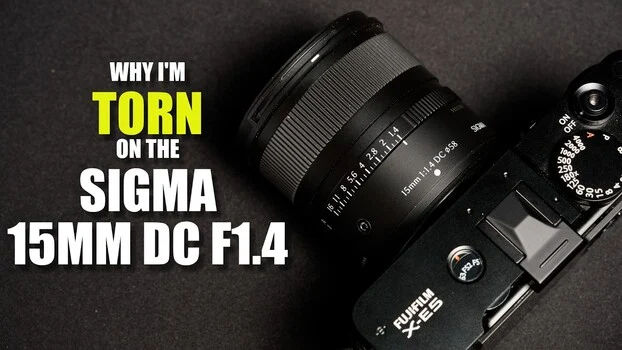
The photography world is often a battlefield of specifications and subjective experiences. A lens, meticulously engineered to meet and exceed every quantifiable metric on paper, can sometimes fall short when the shutter actuates and the final image emerges. This dichotomy is precisely what photographer Luca Petralia explores in his recent in-depth review of the Sigma 15mm f/1.4 DC, a lens that stands as a compelling case study in the often-elusive gap between raw data and the emotional resonance of a photograph.
Petralia, known for his discerning eye and analytical approach to gear, meticulously tested the Sigma 15mm f/1.4 DC on a Fujifilm X-E5 camera body. His analysis transcends mere technical assessments, delving into the nuanced feeling a lens imparts on the photographic process and the resulting images. The review, published on his YouTube channel, @LucaPetraliaPhotography, offers a comprehensive look at a lens that, on the surface, presents an almost unassailable proposition for budget-conscious wide-angle enthusiasts.
A Compact Powerhouse: The Physical Appeal of the Sigma 15mm f/1.4 DC
From a purely physical standpoint, the Sigma 15mm f/1.4 DC is designed to impress. Weighing in at a mere 225 grams, it strikes an impressive balance, ensuring that even when mounted on a compact camera like the Fujifilm X-E5, it does not unpleasantly front-heavy the setup. This thoughtful weight distribution is crucial for photographers who prioritize portability and a comfortable shooting experience, especially during extended sessions.
A significant point of praise from Petralia is the inclusion of an aperture ring. This feature, a welcome return for Sigma’s contemporary DC line, is also present on their 12mm offering. The tactile control of an aperture ring is something many photographers, particularly those transitioning from or appreciating analog workflows, find indispensable. It allows for intuitive and immediate adjustments to depth of field and exposure without needing to navigate complex camera menus or dials, fostering a more fluid and engaged shooting experience.
Further bolstering its practical appeal, the lens boasts weather-sealing, a crucial feature for photographers who venture into diverse and potentially challenging environments. The presence of a gasket at the lens mount provides a vital barrier against dust and moisture, offering peace of mind and extending the operational lifespan of the lens in adverse conditions. The construction itself utilizes high-quality plastics, a material choice that contributes to its lightness without compromising perceived durability. Available in the $500 to $600 price bracket, this combination of features—a compact, fast wide-angle lens with weather-sealing and an aperture ring—presents a formidable value proposition, leaving little room for criticism based solely on its specifications.
Image Quality: Precision Without Passion?
The optical performance of the Sigma 15mm f/1.4 DC mirrors its physical attributes: technically brilliant, yet perhaps lacking a certain spark. Petralia describes the image quality as "clinical." In the center of the frame, the lens delivers exceptional sharpness even at its widest aperture of f/1.4. This impressive center performance is maintained with remarkable consistency, with the corners gradually catching up as the aperture is stopped down to around f/5.6. However, the sheer brilliance of the central sharpness means that for many practical shooting scenarios, stopping down the aperture yields little to no discernible improvement in sharpness, even when evaluated on a high-resolution 40-megapixel sensor.
Vignetting, a common characteristic of wide-angle lenses, is effectively managed and largely disappears by f/2.8. Similarly, chromatic aberration, while present, is subtle enough that it requires deliberate effort to identify in post-processing. The lens’s ability to render pleasing bokeh, often a challenge for wide-angle lenses, is also noteworthy. Petralia found the out-of-focus areas to be surprisingly smooth, maintaining their pleasing quality even when the aperture is stopped down.
Despite this array of technical achievements, Petralia’s primary reservation is harder to quantify but profoundly impacts the photographic experience. He notes that the lens produces a "technically correct" image that, in his estimation, "doesn’t speak to your soul." This sentiment highlights a growing trend in modern lens design, where the pursuit of optical perfection—minimizing aberrations, flattening field curvature, and achieving uniform edge-to-edge sharpness—can sometimes lead to an output that feels sterile or devoid of personality.
Autofocus performance on the Fujifilm X-E5 was reported as robust, with Petralia taking pains to attribute any missed shots in continuous autofocus mode to the camera body rather than the lens. He observed similar behavior with other lenses he was testing on the same Fujifilm body, suggesting a potential limitation of the camera’s autofocus system rather than a failing of the Sigma glass itself.
The Crucial Distinction: Character vs. Technical Correction
Petralia’s critique of the Sigma 15mm f/1.4 DC taps into a fundamental truth that extends far beyond this single lens: the crucial difference between "character" and "technical correction." In the contemporary lens market, manufacturers have achieved an unprecedented level of optical sophistication. The ability to virtually eliminate distortion, control chromatic aberrations, and deliver razor-sharp images across the entire frame is now more accessible than ever. This relentless pursuit of optical perfection, while admirable from an engineering standpoint, can inadvertently lead to lenses that are described as "clinical."
For photographers faced with a multitude of lens choices, the critical question becomes: what do you actually want your images to do? A lens engineered for maximum optical correction provides a clean, predictable image file that performs consistently. This type of lens is an excellent tool for documentary photography, travel, and everyday shooting where reliability and straightforward results are paramount. The photographer can simply point and shoot, confident that the lens will deliver a technically sound image.
Conversely, a lens with more pronounced "optical personality" often trades some of that absolute consistency for a rendering style that can be either deeply loved or frustratingly fought. These lenses might exhibit more pronounced character traits, such as specific bokeh patterns, subtle distortions that can be artistically employed, or a particular way of rendering color and contrast. The choice between these two philosophies—uncompromising technical perfection versus engaging optical character—is not about right or wrong, but about aligning the lens with the photographer’s artistic vision and practical needs. Understanding this distinction can prevent the common pitfall of acquiring a technically flawless lens only to find that the resulting photographs feel emotionally hollow.
Comparative Analysis: Navigating the Wide-Angle Landscape
The true value of Petralia’s review is amplified by his comparative analysis, where he meticulously maps out the strengths and weaknesses of the Sigma 15mm f/1.4 DC against key competitors, catering to different buyer profiles.
For Fujifilm shooters seeking the absolute pinnacle of image quality and rendering within the Fujifilm ecosystem, Petralia continues to recommend the Fujifilm 18mm f/1.4. Despite its significantly higher price point (roughly double that of the Sigma), larger physical dimensions, and increased weight, this lens possesses a rendering that Petralia finds imbues images with a "soul" that the Sigma, in his opinion, lacks. This highlights that for some, the investment in a more artistically inclined lens is well worth the cost.
On the more budget-friendly end of the spectrum, the Viltrox 15mm f/1.7 emerges as a compelling alternative. Priced at approximately half the cost of the Sigma, it sacrifices half a stop of aperture and the physical aperture ring. However, Petralia suggests that the Viltrox offers a more engaging and "fun" shooting experience, with a rendering he perceives as having more character for the money. This option is ideal for those who prioritize a unique aesthetic and a more playful approach to wide-angle photography without breaking the bank.
For Sony shooters, the calculus shifts. The Sony 15mm f/1.4 is presented as a direct competitor to the Sigma, offering a similarly "clinical" look at a premium price. This comparison underscores that while the Sigma provides a specific type of performance at a certain price point, similar optical philosophies exist across different camera mounts, often at a higher cost. Petralia’s detailed discussion of why he moved on from his beloved Fujifilm 18mm f/1.4, even while acknowledging the sense of loss, is a crucial element of the video review, offering invaluable context for viewers considering their own lens purchases.
The Verdict: A Niche Masterpiece for a Specific Vision
Ultimately, Petralia’s review of the Sigma 15mm f/1.4 DC concludes that the lens serves a very specific, albeit significant, audience. He argues that it represents the ideal choice for a photographer who actively seeks a compact, lightweight f/1.4 wide-angle lens with the tactile advantage of an aperture ring and a distinctively "clinical" optical signature, all at the $500 price point. For this particular user, the Sigma 15mm f/1.4 DC delivers precisely what they are looking for, fulfilling its technical promise with unwavering accuracy.
The broader implication of this review is a timely reminder for all photographers. In an era of ever-increasing optical sophistication, it is imperative to look beyond the specifications sheet. Understanding one’s own creative intent and prioritizing the qualities that resonate with personal vision are paramount. The Sigma 15mm f/1.4 DC, while a technically accomplished lens, serves as a powerful illustration that the most important "spec" is often the one that cannot be measured: the ability of a lens to inspire and connect with the photographer, ultimately translating into images that are not just sharp and well-exposed, but also emotionally resonant.
Petralia encourages potential buyers to engage with his full comparison video to gain a comprehensive understanding of where the Sigma 15mm f/1.4 DC fits within the current market and to make an informed decision about which 15mm lens best aligns with their photographic journey. The review is a testament to the ongoing dialogue between technological advancement and artistic expression in the world of photography.