Securing Your Digital Identity: A Comprehensive Guide to Brand Protection in the Age of Search and Artificial Intelligence

In an era defined by decentralized search engines and autonomous AI agents, the integrity of a brand’s digital footprint has become a critical battleground for corporate security and reputation management. Brand protection today extends far beyond traditional trademark monitoring; it now requires a sophisticated understanding of how AI models, search algorithms, and automated coding tools interpret, reference, and occasionally misrepresent corporate entities. Effective brand protection involves identifying where a product, service, or company is being impersonated, misused, or confused with unauthorized intermediaries, and systematically ensuring that official information is both verifiable and dominant across all digital touchpoints.
The current landscape of brand protection diverges significantly from traditional Online Reputation Management (ORM). While ORM focuses on public sentiment and how a brand is perceived by its audience, brand protection is an operational necessity centered on sovereignty: ensuring that users and automated systems can distinguish the authentic brand from malicious actors. When a search engine promotes a fraudulent support page or an AI agent hallucinates a software dependency, the consequences are immediate, ranging from the loss of customer trust to severe security vulnerabilities.
The Rise of Infrastructure-Level Threats: Slopsquatting and AI Hallucinations
The threat surface has expanded into the very infrastructure that developers and automated systems rely upon. A primary example is "slopsquatting," a form of cyberattack where malicious actors register packages under names that AI coding assistants are likely to suggest or "hallucinate."

A notable instance of this occurred when an attacker registered the malicious npm package "unused-imports," intentionally mimicking the legitimate "eslint-plugin-unused-imports." Because AI coding tools often suggest shorthand or simplified package names, developers are frequently prompted to install these compromised assets. In another concerning development, researchers discovered 237 GitHub repositories that had adopted an invented package name suggested by an LLM. While this specific incident did not result in a widespread breach, it highlighted a systemic vulnerability: attackers can intercept branded traffic and trust by occupying naming spaces within development ecosystems before the legitimate brand owners have the chance to secure them.
A Chronology of Risk Evolution
The evolution of these threats follows a predictable, if dangerous, trajectory:
- Initial Exploitation: An attacker identifies a "naming gap" in a software ecosystem or a search query pattern for a brand’s support channels.
- Traffic Interception: The fraudulent entity appears in search results or AI-generated responses, often surfacing higher than official channels due to aggressive SEO or ad spending.
- Information Proliferation: Third-party websites aggregate the false data from the fraudulent source, creating a feedback loop that validates the misinformation.
- AI Integration: AI models ingest this aggregated, false data, cementing it as an "official" answer within their knowledge graphs, making it exponentially harder to excise from the digital record.
Establishing the Brand Knowledge Graph
To combat these threats, organizations must move from reactive defense to proactive asset management. The foundational step is the creation of a definitive "Brand Knowledge Graph"—a centralized, meticulously documented repository of every fact associated with the entity.
For corporations, this includes legal names, historical aliases, official domain architectures, authenticated social media handles, lists of executives, and verified support channels. Each entry must be accompanied by provenance data—a "last-checked" date and a verifiable source. By formalizing this data, organizations can ensure that their internal teams—and by extension, the external AI systems they feed—are working from a single, accurate version of the truth.

Geographic and Linguistic Auditing
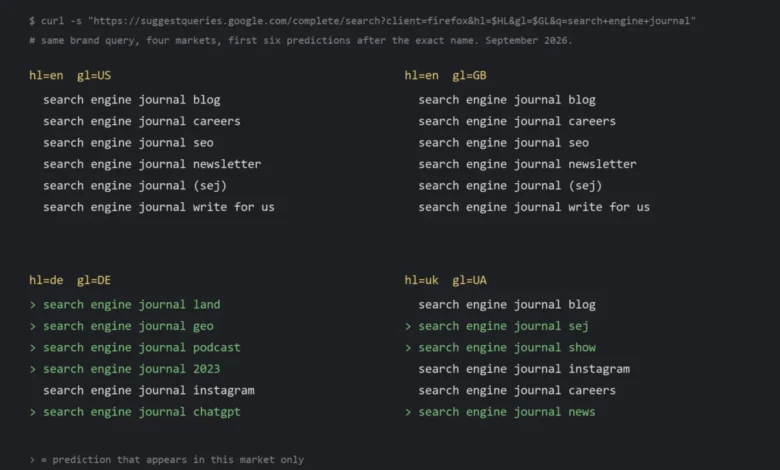
One of the most common pitfalls in brand protection is the assumption that a brand’s search footprint is universal. In reality, search results are hyper-localized, influenced by the user’s language, physical location, and even their device type. An effective audit must be conducted across multiple markets, mirroring the user experience of the target demographic.
Security audits should never rely on a logged-in session, as personalized search history can mask the reality of what a neutral user sees. Instead, teams should utilize clean, geo-specific proxies to evaluate search results. When auditing, it is essential to monitor not just the primary search results, but the autocomplete suggestions as well. Autocomplete can be manipulated by black-hat SEO tactics to steer users toward competitors or malicious sites; consequently, brands must monitor these suggestions across different regions to identify early indicators of an organized manipulation campaign.
The AI System Audit: Beyond Traditional SEO
As users increasingly turn to AI-driven answers (such as ChatGPT Search, Google AI Overviews, and Perplexity) rather than traditional link lists, the brand protection audit must shift focus toward retrieval-augmented generation (RAG) performance.
Testing requires two distinct sets of prompts:

- Direct Prompts: "Who owns [Brand]?" or "What is the official contact for [Brand]?"
- Decision Prompts: "Compare [Brand] to [Competitor]" or "What are the alternatives to [Brand]?"
Each prompt should be tested in fresh, "memory-disabled" sessions. It is a statistical reality that AI models provide different answers based on the time of day and the specific retrieval index being queried. Recent evaluations suggest that over 70% of AI-generated inaccuracies stem from retrieval failures—where the model pulls from a low-authority or impersonating source because that source was more visible at the time of the crawl. Ensuring that official websites are optimized for AI crawlers—by monitoring user-agent access and ensuring pages are not "empty shells" to automated bots—is now as critical as traditional SEO.
Strategic Defense and Response Framework
When a threat is identified, the response must be proportional and tiered:
- Internal Remediation: If the error originates from your own ecosystem (e.g., outdated information on a secondary site), correct the canonical source immediately.
- Evidence Preservation: Before contacting third parties or regulators, capture exhaustive documentation: screenshots, URLs, redirect chains, and, where applicable, the specific AI prompt that yielded the false result.
- Formal Reporting: For impersonation, use the host’s or registrar’s abuse reporting mechanisms. If an attacker is using trademarked terms in ads, file a formal protest via the platform’s trademark protection policy (e.g., Google Ads Transparency Center).
- Containment: If an official fix will take time, publish a "security bulletin" or an "official channels" page on your primary domain to provide a source of truth for users who may have encountered the fraudulent asset.
The Importance of Continuous Monitoring
Brand protection is not a project; it is a permanent operational requirement. Organizations should implement alert systems for new domain registrations that include the brand name, monitor Certificate Transparency logs for unauthorized TLS certificates, and integrate DMARC reporting to detect spoofed emails.
The ultimate objective is to fill the first two pages of search results with verified, controlled assets. By maintaining a strong, authoritative digital presence, a brand creates a natural defensive barrier. While no organization can prevent all malicious attempts, a robust, audit-heavy approach minimizes the visibility of impersonators and ensures that when a user searches for the brand, they find the official, accurate, and secure source of truth. As AI continues to mediate more of our digital interactions, this sovereignty over one’s own identity will be the single most important factor in sustaining long-term consumer trust.
Related posts: