Navigating the Post-Search Era: How Publishers Are Reinventing Themselves for Google Zero


The media landscape is undergoing its most profound structural transformation since the advent of social media algorithms, as publishers increasingly confront what industry experts describe as a “Google Zero” future. For decades, traditional and digital-first news organizations relied heavily on organic search engine traffic to drive page views, attract programmatic advertising dollars, and convert casual readers into loyal subscribers. However, as search engines evolve into conversational AI answer engines that synthesize information directly on the results page rather than sending users to external websites, publishers are facing steep declines in search referral traffic.
Rather than merely tweaking keyword optimization tactics or adjusting meta tags, media companies are implementing deep, structural overhauls. Organizations are actively rewriting organizational charts, redefining audience development teams, and creating specialized executive roles dedicated to artificial intelligence and off-platform discovery. These moves reflect an industry-wide pivot away from chasing volatile click-through traffic and toward building resilient, direct-to-consumer relationships and sustainable alternative revenue streams.
The Shift from Theory to Practice: Major Overhauls at National Outlets
The transition from theoretical preparation to practical survival is best illustrated by recent structural changes at major news institutions such as the USA Today Co. and The New York Times. These media giants are demonstrating that surviving the post-search era requires dismantling legacy newsroom structures that were optimized for a completely different digital ecosystem.
Last week, Monica Richardson, senior vice president at USA Today, announced a significant corporate restructuring aimed at addressing the shifting search environment. According to an internal staff memo obtained by The New York Times, the company is forming a newly centralized audience and digital production team—a move that will unfortunately result in workforce reductions.
Richardson addressed the necessity of the change directly in her memo, noting that growing audiences simply by producing a higher volume of content is no longer a viable strategy. She highlighted that search traffic is under immense pressure as platforms increasingly keep user experiences within their own walled gardens. Acknowledging that the company’s previous operational structure was built for a legacy media landscape, Richardson emphasized the critical need to reorganize in order to compete strategically in the current environment.
The newly formed structure at USA Today will concentrate on centralized production, targeted audience growth within core coverage areas, and diversified off-platform distribution. This reorganization comes on the heels of the company’s second-quarter earnings report, which revealed an 8.3% year-over-year decrease in total revenues, alongside a 9.2% drop in digital advertising revenue—declines partially driven by shrinking page views across the board.
While a USA Today Co. spokesperson, Lark-Marie Antón, declined to disclose the exact number of employees affected by the layoffs, she affirmed that the company remains committed to adapting its business model to evolving audience behaviors, changing market dynamics, and technological advancements. To spearhead this transition, USA Today is actively recruiting an executive editor of audience and digital production to oversee a newly minted team projected to comprise between 23 and 30 professionals within the next six to eight weeks.
New Leadership Roles and the Rise of AI Discovery
Concurrently, other leading publications are reshaping their executive leadership to better navigate the intersection of journalism and artificial intelligence. At The New York Times, Christine Liang stepped into a newly minted role overseeing AI and off-platform discovery, transitioning after seven years as the paper’s head of technical SEO. This high-profile appointment signals a growing institutional commitment to managing relationships with AI platforms and ensuring that high-value journalism remains visible to the expanding audience of AI bots and automated agents.
In a public statement regarding her new position, Liang noted that internet search habits and reading behaviors have fundamentally transformed, with audiences increasingly relying on AI-mediated pathways to consume news. Her primary mandate will be ensuring that the Times’ journalism reaches both human readers and automated agents wherever they consume information.
This trend is rapidly becoming an industry standard. In October 2025, The Washington Post appointed Kyle Sutton—formerly the senior director of SEO at The Points Guy—as its inaugural head of SEO and AI discovery. These appointments underscore a broader recognition that optimizing content for artificial intelligence systems requires dedicated technical expertise that traditional search engine optimization teams were never designed to provide.
Strategic Pivots Toward Loyalty and Diversification
Industry analysts point out that the ongoing decline in traditional search traffic is forcing publishers to abandon click-chasing business models in favor of audience loyalty. Barry Adams, founder of Polemic Digital, an SEO and audience growth consultancy for news publishers, notes that the severe reduction in Google referral traffic—often referred to in the industry as the “AI-pocalypse”—has finally compelled publishers to prioritize deep audience connections.
According to Adams, media organizations are aggressively investing in disintermediated channels. These include direct mobile app installations, curated email newsletters, habit-forming digital puzzles, and immersive multimedia offerings such as podcasts and video series. The overarching objective has shifted from maximizing raw impression volumes to cultivating long-term reader loyalty, prioritizing direct relationships over reliance on intermediaries like Google and Meta.
From a financial perspective, this strategic shift also opens up new commercial avenues. As brands and corporate clients race to improve their visibility within AI-driven answer engines, progressive publishers are beginning to package and pitch AI visibility insights and Generative Engine Optimization (GEO) consulting services to corporate clients, thereby unlocking entirely new revenue streams.
Operational Efficiency and the Role of AI in the Newsroom
While publishers are wary of allowing automated systems to degrade the unique value of human journalism, many are leveraging artificial intelligence internally to drive operational efficiencies. Ameet Shah, partner and global senior vice president of publisher operations and tech strategy at Prohaska Consulting, explains that declining organic traffic makes cost-efficiency an absolute imperative.
Shah emphasizes that publishers are increasingly utilizing AI to enhance data analytics, streamline internal workflows, improve response times, and gain deeper insights into audience preferences. However, he notes a clear boundary: rather than using AI to generate commodity content—which dilutes a publication’s unique journalistic voice—media companies are focusing their technological investments on operational backend improvements and lean team management.
Legal Battles, Copyright, and the Fight for Content Value
Beyond internal reorganizations and leadership appointments, the economic friction between publishers and generative AI companies has spilled heavily into the courtroom. Media organizations are fiercely debating whether the unauthorized scraping of copyrighted journalism to train large language models constitutes fair use.
The legal landscape continues to evolve rapidly. Last week, The Seattle Times and Newsday filed a formal copyright infringement lawsuit against OpenAI and Microsoft in federal court. This legal action joins a growing docket of similar lawsuits filed by publishers seeking compensation and control over their intellectual property.
However, industry watchers are keeping a particularly close eye on the high-stakes lawsuit brought by The New York Times against OpenAI and Microsoft. The case took an unexpected turn when the United States Department of Justice filed a brief supporting OpenAI’s fair-use defense. While the DOJ’s stance does not legally bind the presiding judge’s ultimate decision, it significantly raises the stakes for the publishing industry and grants major tech developers a powerful federal ally.
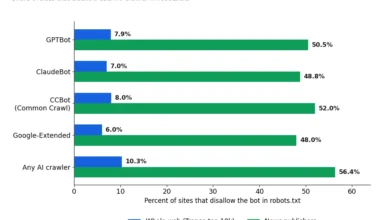
Simultaneously, trade organizations and publishers are exploring alternative monetization pathways through content licensing agreements. Danielle Coffey, president and CEO of the News/Media Alliance, observes that publishers are successfully creating artificial scarcity around their content to increase its perceived value. Through technological countermeasures deployed by third-party infrastructure providers like Cloudflare and TollBit, targeted legislation against malicious web crawlers, and aggressive litigation, publishers are beginning to see a viable horizon where intentional content delivery and licensing deals can yield sustainable financial returns.
Broader Industry Indicators and Market Data
As the media sector navigates this transitional phase, recent operational metrics from various publications offer a mixed snapshot of industry health:
- Subscriber Growth: The Washington Post recently reported reaching a milestone of 300,000 individual digital subscriptions, demonstrating sustained consumer demand for trusted journalism despite broader economic headwinds.
- Programmatic Advertising: Concurrently, The Washington Post recorded a 53% year-over-year increase in its programmatic ad revenue, highlighting successful monetization of its digital inventory.
- Cybersecurity Challenges: Highlighting the ongoing vulnerabilities of media conglomerates, cybersecurity reports indicated that a database containing 32.8 million Condé Nast user records was recently put up for sale on a Russian-language cybercrime forum.
- Executive Stability: In leadership news, Jeff D’Onofrio—who joined The Washington Post as chief financial officer in June 2025 and served as interim publisher and CEO following William Lewis’s departure in February—was officially named permanent publisher and CEO by owner Jeff Bezos.
Looking ahead, industry coalitions are attempting to establish standardized frameworks to govern how artificial intelligence systems interact with news content. Initiatives such as the Publisher-Run Content Telemetry Framework, spearheaded by the SPUR Coalition, are currently engaged in dialogue with major technology firms like Google, Meta, and OpenAI. According to Alex Springer, technical lead for the coalition, while major tech platforms have yet to formally commit to the framework, initial discussions indicate a growing alignment regarding the underlying concepts of content tracking and attribution.
As the year progresses, media analysts expect further corporate restructuring, executive shuffling, and strategic pivots across the publishing sector. The survival of modern journalism in a post-search environment will ultimately depend on a publisher’s ability to diversify distribution, protect intellectual property through robust legal and licensing frameworks, and maintain unwavering trust with a loyal, direct readership.