Native Instruments and A. G. Cook Unveil Super*Saw Synthesizer, Redefining the 1990s Rave Staple for Modern Electronic Music Production

The evolution of electronic music production has long been defined by the quest for greater sonic scale, power, and texture. Among the most iconic innovations of this pursuit is the stacked sawtooth wave—commonly known as the supersaw. Originally popularized during the virtual analog synthesis revolution of the 1990s, this harmonically rich, multi-oscillator waveform became the undisputed backbone of euphoric trance, massive pop hooks, and wall-of-sound club anthems. Expanding upon this enduring legacy, audio technology leader Native Instruments has officially announced the release of Super*Saw, a pioneering software synthesizer developed in close collaboration with visionary producer, songwriter, and PC Music founder A. G. Cook.
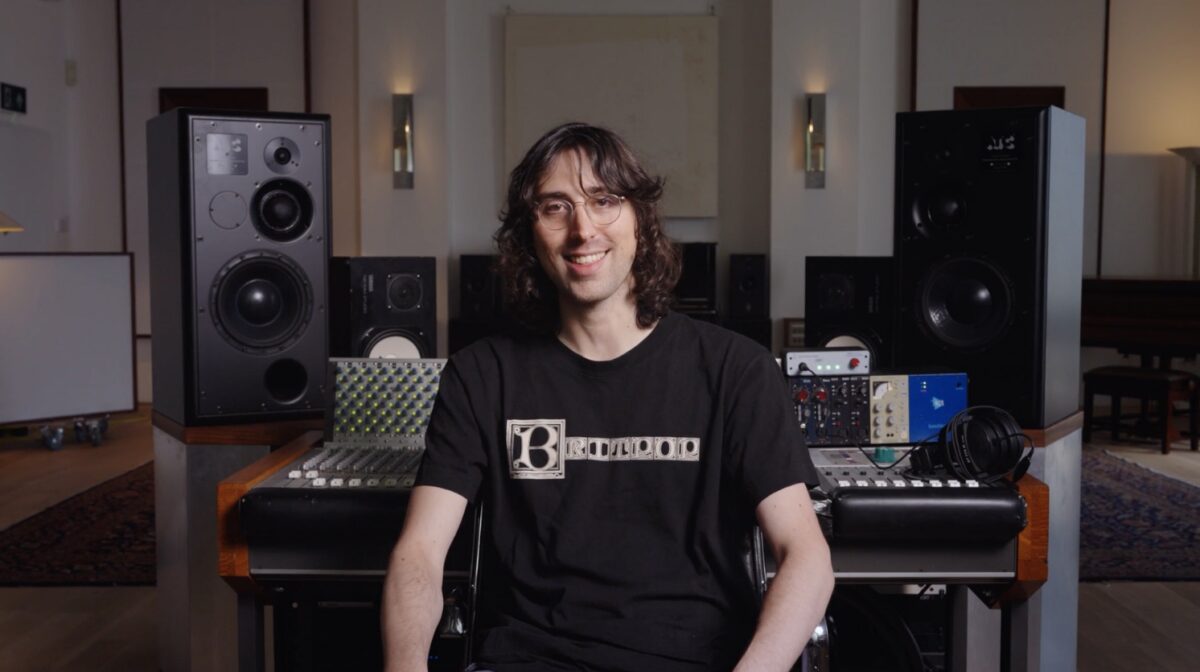
Pronounced "SuperStarSaw," the new instrument aims to condense years of complex, multi-plugin audio routing and tedious digital audio workstation (DAW) workflows into a single, highly intuitive, and expressive interface. To mark the global launch, Cook invited industry analysts and creators to Baltic Studios in London for an exclusive deep dive into the design philosophy, technical architecture, and creative applications driving the hardware-inspired plugin.
Historical Context and Evolution of the Supersaw
To understand the significance of Super*Saw, industry historians must look back to the mid-1990s. As digital signal processing (DSP) advanced, hardware synthesizer manufacturers began moving away from pure analog architectures toward virtual analog (VA) technology. This shift allowed engineers to pack multiple oscillators into a single voice architecture without the severe tuning instability and high manufacturing costs of vintage analog gear.
The breakthrough moment arrived in 1996 with the release of the Roland JP-8000, which introduced a dedicated "Super Saw" waveform. By stacking up to seven detuned sawtooth waves simultaneously within a single voice, the synth produced a thick, sweeping acoustic wall that immediately captivated trance and techno producers. Over the ensuing decades, this sound transcended its underground club origins, finding its way into mainstream pop, EDM, and hyperpop.
A. G. Cook, known widely for his foundational role in shaping modern electronic pop—both through his own acclaimed solo works like 7G and Apple, and his extensive production and executive-producing catalog with boundary-pushing artists such as Charli XCX, Oklou, and Caroline Polachek—has long utilized heavily processed sawtooth stacks as a signature sonic trademark. Tracks like "Superstar" and "Stargon" showcase his penchant for pushing stacked oscillators to their absolute limits, transforming traditional chord progressions into massive, percussion-like walls of noise. However, achieving these complex textures historically required arduous technical workarounds, involving numerous duplicate tracks, meticulous fine-tuning automation, and intricate third-party plugin chains.
Chronology of a Collaboration
The genesis of Super*Saw began as a long-held ambition for Cook, who envisioned creating a specialized tool centered around a singular ideological focus. Discussions between the producer and Native Instruments began several years ago, gaining momentum as electronic music production trends shifted toward tactile, real-time software performance.
- Phase One (Concept & Ideology): Cook and Native Instruments engineering teams mapped out a conceptual framework designed to isolate the sawtooth wave, stripping away unnecessary multi-waveform bloat to focus entirely on the physics of stacking and detuning.
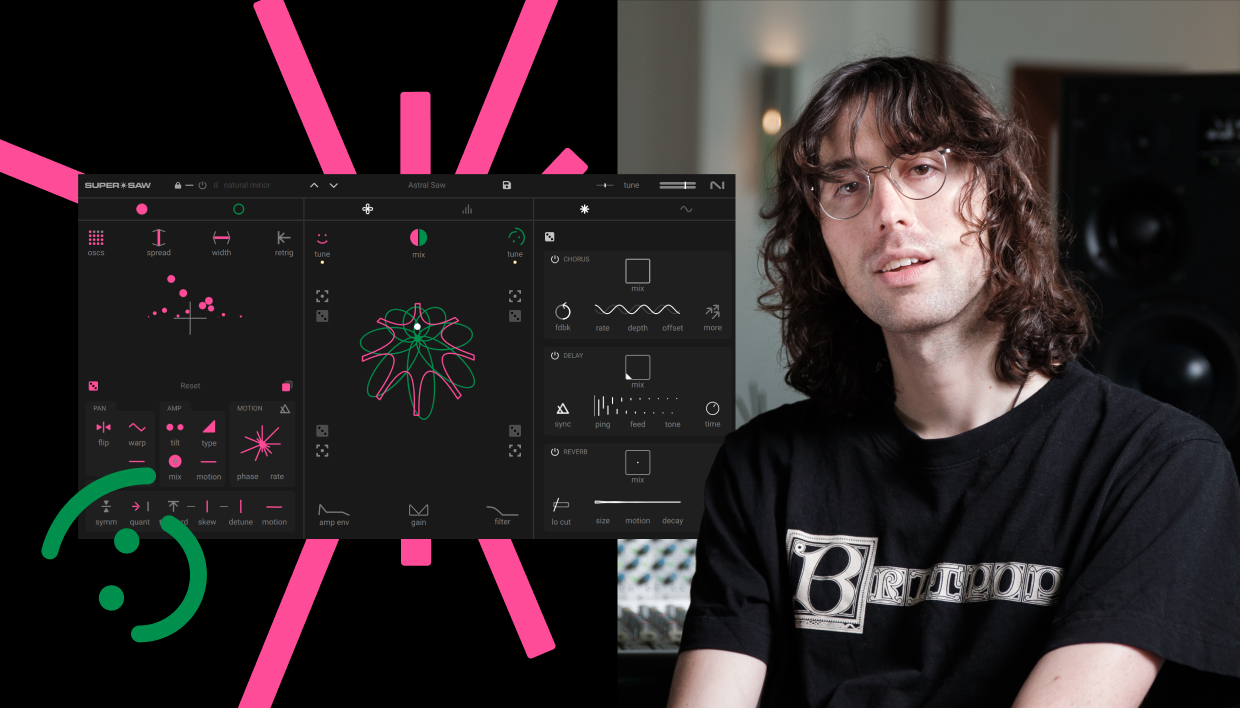
- Phase Two (Architecture Design): The development team established a dual 8-voice sawtooth oscillator system, splitting the sound design engine into two distinct, color-coded visual and functional layers: pink and green.
- Phase Three (Prototyping & Testing): Cook integrated early beta versions of the plugin into his recording sessions for his recent album, Britpop, utilizing the software to test its real-time morphing and modulation capabilities under rigorous studio conditions.
- Phase Four (Global Launch): Native Instruments officially introduced Super*Saw to the public via a comprehensive media rollout, including an in-depth video walkthrough recorded at London’s Baltic Studios.
Technical Architecture and Interface Design
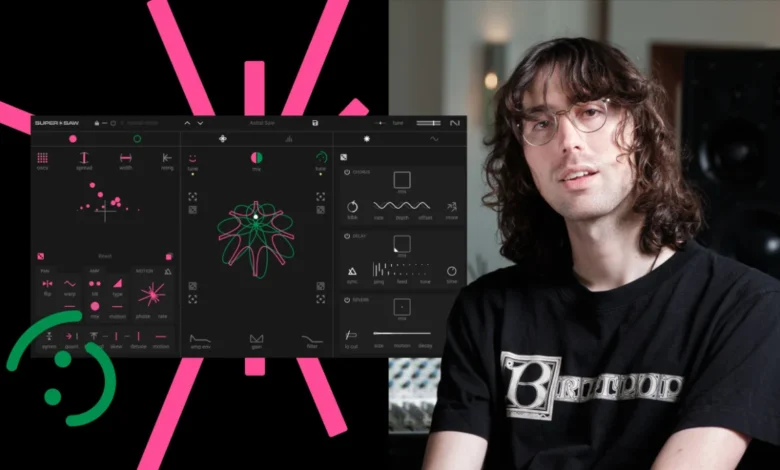
Super*Saw is engineered to bridge the gap between microscopic sound design precision and immediate, performance-oriented playability. Rather than offering a boundless, generalized synthesizer, the instrument imposes a strict limitation: every oscillator is rooted entirely in the sawtooth wave. According to the development team, this intentional constraint forces producers to explore the untapped creative depths of phase relationships, stereo spread, and harmonic stacking.
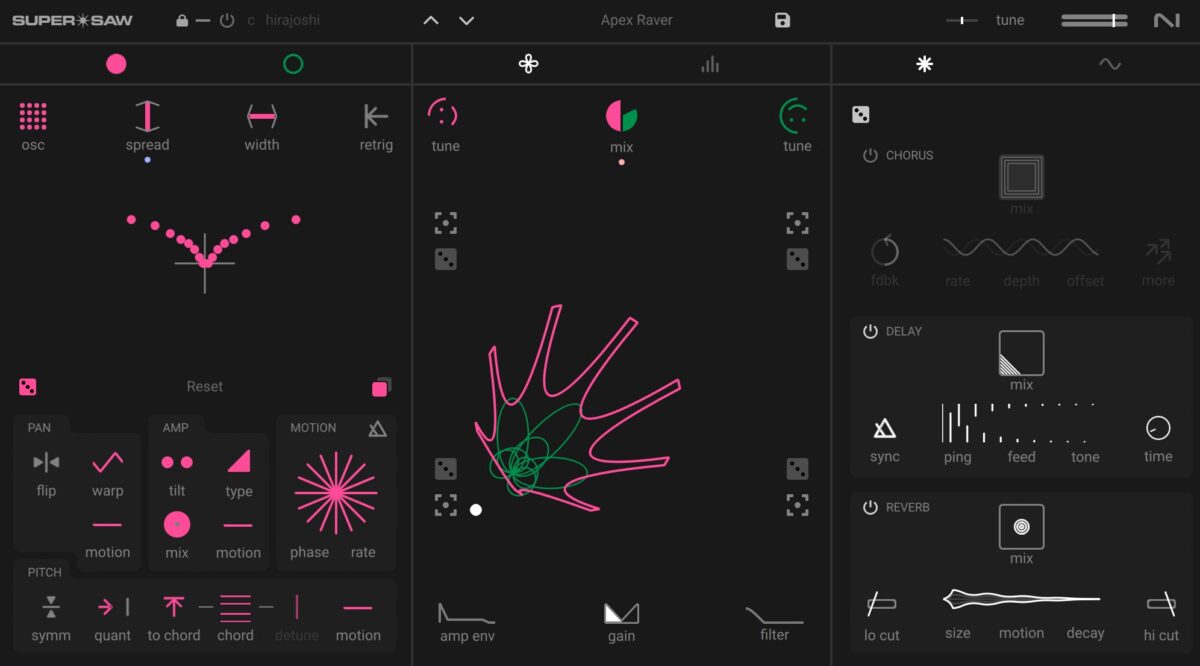
The engine is built around a dual 8-voice architecture, divided into the aforementioned pink and green layers. Cook likens this dual-layer setup to a dynamic comedic duo, where one independent group of oscillators can provide a grounded, fundamental bassline or anchor, while the other functions as a hyper-modulated, wild upper-frequency counterpart.
Key technical features of the Super*Saw plugin include:
- Dual 8-Voice Sawtooth Systems: Independent control over voice count, detuning, stereo spread, and envelope behaviors for both the pink and green layers.
- 4-Corner Morpher: An interactive real-time performance pad that allows users to seamlessly morph between distinct chord shapes, detune depths, and modulation states on the fly.
- Star-Shaped Modulator: A unique visual LFO and modulation source that can be freely mapped across panning, amplitude, and pitch parameters.
- Instant Randomization Tools: Dedicated "dice" randomization algorithms designed to inspire happy accidents and rapid patch generation during active writing sessions.
Industry Implications and Market Impact
The release of SuperSaw arrives at a pivotal moment for the virtual instrument market. In recent years, software developers have increasingly moved away from massive, all-encompassing workstation synthesizers in favor of hyper-focused, genre-specific tools that solve specific workflow bottlenecks. By streamlining a process that previously demanded advanced DAW routing into an accessible, artist-endorsed plugin, Native Instruments has positioned SuperSaw as an essential utility for producers working across pop, electronic, and experimental genres.
Industry analysts note that artist-led hardware and software collaborations—such as those popularized by Native Instruments, Arturia, and Splice—tend to drive high engagement by offering a direct window into a top-tier producer’s personal toolkit. For Cook, the instrument serves as a conceptual culmination of his decade-long artistic output.
"This plugin is a sort of coda, epilogue, or final chapter to the albums that I’ve already released as A. G. Cook," reflects the producer. "Not just the Britpop pink-and-green color scheme, but also the echoes of 7G and Apple’s sonic world. It feels more exciting than just making a big sample pack of all those sounds, to think about boiling that stuff down into an instrument that can be used by other people in completely different ways."
As producers and sound designers begin integrating SuperSaw into their upcoming projects, the instrument’s blend of nostalgia-inducing 1990s grit and modern hyperpop maximalism is expected to leave a lasting footprint on contemporary music production charts. SuperSaw is available now through the Native Instruments online store, compatible with major digital audio workstations via standard plugin formats.