Luce and the Rock series secures major European broadcast partnerships ahead of 2027 rollout

The international animation landscape continues to evolve with the announcement that the highly anticipated 2D preschool series Luce and the Rock has successfully finalized broadcast agreements with three major European public service media organizations. Ahead of its scheduled 2027 premiere, the series, which is produced by the Belgian-French collaboration of La Cabane and Thuristar, has confirmed that Norway’s NRK, Finland’s Yle, and the Netherlands’ NPO have joined its growing list of distribution partners.
These additions represent a significant expansion for the project, which is being handled internationally by the distributor CAKE. The deal marks a strategic consolidation of the show’s footprint across Northern and Western Europe, ensuring that the series will reach a broad demographic of preschool viewers across multiple territories upon its launch.
Expanding the Broadcast Footprint
The inclusion of NRK, Yle, and NPO bolsters a lineup that was already substantial. Prior to this announcement, the series had already secured backing from France Télévisions, Belgium’s VRT-Ketnet and RTBF, Switzerland’s RTS, and Denmark’s DR. Furthermore, the global French-speaking market will be covered by TV5Monde, which will ensure international distribution for francophone audiences regardless of their geographic location.
This network of broadcasters is characteristic of high-quality European children’s programming, which often relies on a consortium of public broadcasters to fund and distribute content that prioritizes artistic integrity and educational value. By securing these specific partners, the production team has effectively guaranteed the series’ presence in some of the most stable and respected media markets in the world.
Creative Origins and Development
The series is an extension of the critically acclaimed short film of the same name, which served as a proving ground for the intellectual property. Directed by Belgian filmmaker Britt Raes, the original short film was a festival sensation, screening at more than 200 events globally, including prestigious venues such as the Annecy International Animation Film Festival, the Clermont-Ferrand International Short Film Festival, and the Ottawa International Animation Festival. Its success was underscored by a collection of more than 50 industry awards, signaling to producers that the aesthetic and narrative potential of the characters could support a long-form episodic format.

In the transition to television, Raes is joined by co-director Mathilde Prévost. The duo is tasked with scaling the gentle, whimsical tone of the original short into a format suitable for a recurring series. The show is designed specifically for children between the ages of three and six, a demographic that requires careful attention to narrative pacing and visual clarity. The series consists of 35 seven-minute episodes and two 14-minute specials, a structure that balances bite-sized storytelling with more immersive, extended narrative arcs.
Narrative Framework
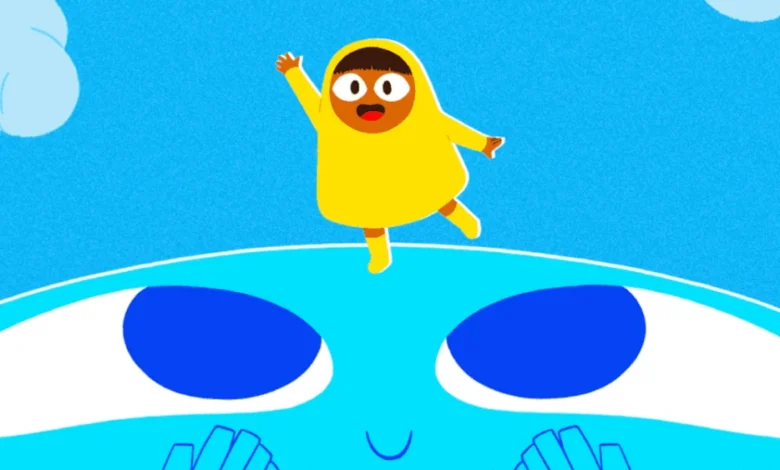
At the heart of the series is the character of Luce, a young, inquisitive protagonist who begins every morning by opening her bedroom window to interact with the world outside, known as the "Lovely Land." The show centers on the relationship between Luce and her best friend, a giant rock. This unusual pairing serves as a metaphor for friendship, acceptance, and the exploration of the "other."
The series utilizes this dynamic to introduce young viewers to themes of social interaction, curiosity, and the embrace of difference. As Luce and her rock companion navigate their surroundings, they encounter a variety of creatures and neighbors who perceive the world through different lenses. This framework allows the show to tackle social-emotional learning—a staple of modern preschool curriculum—without resorting to heavy-handed moralizing.
Production Pedigree and Industry Context
The production of Luce and the Rock is led by Perrine Gauthier of the French studio La Cabane and the Belgian studio Thuristar. The team’s reputation in the animation industry is well-established, having previously collaborated with CAKE on the International Emmy-nominated preschool series Mush-Mush & the Mushables. That series set a benchmark for the studios, proving their ability to develop content that resonates with both international audiences and critical bodies.
The involvement of VRT-Ketnet and RTBF as co-producers further solidifies the project’s grounding in the European animation ecosystem. By leveraging the expertise of these studios, the production maintains a high level of aesthetic cohesion, favoring a 2D animation style that feels both timeless and distinct from the increasingly dominant 3D CGI aesthetic found in many other contemporary children’s programs.
Industry Implications and Market Trends
The move to secure widespread broadcast commitments years in advance of a 2027 rollout reflects current trends in the distribution of children’s content. As the media landscape shifts toward streaming-first models, traditional public broadcasters are increasingly acting as "anchor tenants" for premium animated content. By locking in major public broadcasters early, the producers of Luce and the Rock are insulating the project against the volatility of the global content market.

Furthermore, the emphasis on European co-production is a response to the need for content that travels well across borders. While the show is rooted in a specific artistic vision, its themes—curiosity, friendship, and the beauty of the natural world—are universal. This universality is essential for a series that aims to be profitable in multiple languages and cultures simultaneously.
Analysis: The Value of the "Short-to-Series" Pipeline
The success of Luce and the Rock serves as a case study for the value of the short-film-to-series pipeline. By first creating a high-impact, award-winning short, the creative team was able to demonstrate proof-of-concept to investors and distributors. This approach mitigates the risk inherent in developing new intellectual property, as the characters and the visual style have already been vetted by audiences and critics.
In an industry where competition for screen time is fierce, the data provided by the short film’s festival run acts as a form of "de-risking." Broadcasters are more likely to commit to a series when they have tangible evidence of its appeal. The fact that the film also saw theatrical releases in France, Belgium, Spain, and Switzerland demonstrates its ability to move beyond the small screen, suggesting that the franchise could potentially expand into ancillary markets, such as publishing, merchandise, and live events.
Future Outlook
As the industry looks toward 2027, the focus for the La Cabane and Thuristar teams will shift from development to delivery. With the production pipeline now bolstered by the financial security of multiple European broadcasters, the focus will be on maintaining the quality of the 2D animation throughout the 35-episode run.
The strategy of releasing the series in 2027 also allows the producers to capitalize on the growing demand for high-quality, non-CGI animation, which has seen a resurgence in popularity among parents and educators who value diverse visual storytelling. If the series maintains the standard set by its source material, it is positioned to become a staple of European children’s television, potentially spawning further seasons and international syndication deals.
In summary, the addition of NRK, Yle, and NPO to the distribution roster for Luce and the Rock is not merely a logistical update; it is a validation of the show’s production model and creative direction. By aligning with a network of respected public broadcasters, the producers have ensured that their vision of a curious child and her rock companion will have a prominent place on the global stage when it premieres in 2027. This project stands as a testament to the enduring power of character-driven 2D animation in a rapidly evolving digital era.