HiFiMan HE1000 Stealth: An In-Depth Analysis of High-End Planar Magnetic Audio Engineering


The evolution of headphone tuning has reached a significant inflection point as the industry balances the rising demand for neutral, reference-grade sound against the legacy of artistic, specialized sound signatures that define the high-end market. While budget and mid-range audio equipment have increasingly aligned with the Harman Target Curve—a research-backed standard established in 2012 that suggests a preference for neutral, balanced output—the premium segment remains a bastion of subjective, bold design. The HiFiMan HE1000 Stealth, a 2023 iteration of a flagship line originating in 2015, serves as a primary case study in this dichotomy, challenging the trend toward objective neutrality in favor of a curated, expansive listening experience.

Historical Context and the Evolution of the HE1000 Line
The HE1000 series first arrived on the market in 2015 with a price tag of $3,000, positioning itself as a titan in the planar magnetic headphone category. At the time, HiFiMan established its signature "house sound"—a profile characterized by a wide, holographic soundstage and a specific recession in the upper-midrange frequencies. Over the last decade, the series has undergone multiple revisions, including the V2 and the current "Stealth" version.
The 2023 Stealth iteration represents a refinement of the original architecture, utilizing the company’s "Stealth Magnet" technology. This design philosophy focuses on the acoustic transparency of the magnets themselves, allowing sound waves to pass through the magnet structure without generating interference, diffraction, or turbulence. By minimizing these distortions, HiFiMan aims to improve the resolution and clarity of the transducer output. This technological shift reflects a broader industry movement toward reducing physical obstructions in open-back designs to achieve a more natural, uncolored presentation.

Technical Specifications and Engineering Philosophy
The HiFiMan HE1000 Stealth is built upon a 100mm planar magnetic driver, a large surface area designed to facilitate rapid transient response and low distortion. The unit features an open-back architecture housed within a CNC-machined aluminum frame. The aesthetic is notably retro-industrial, utilizing wooden-printed veneer trim, a leather headband, and hybrid micro-fiber/synthetic leather ear pads.
The technical profile of the HE1000 Stealth includes:
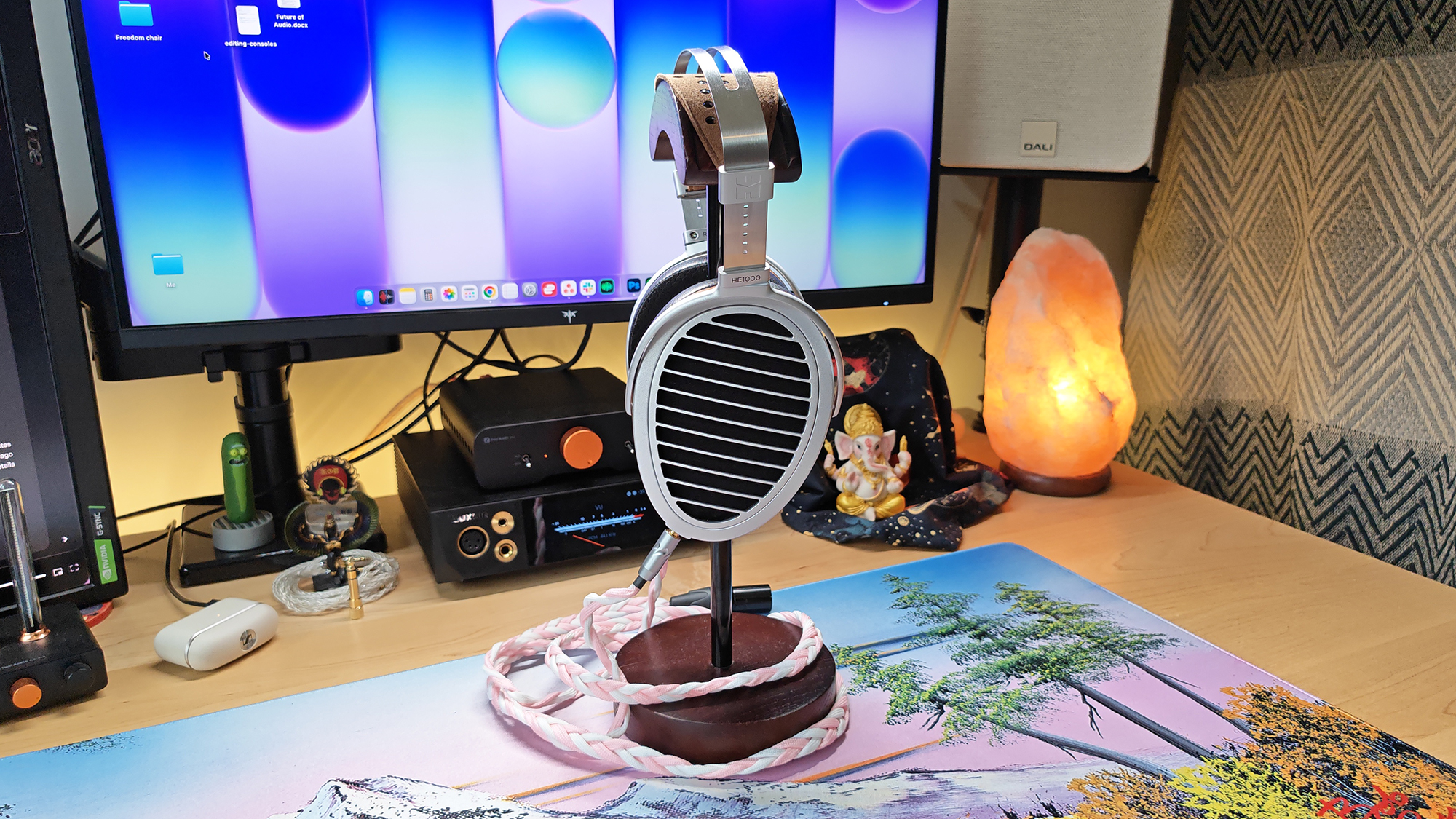
- Price Point: $949
- Impedance: 32 ohms
- Sensitivity: 93dB/mW
- Weight: 458g
- Driver Configuration: Nanometer-thickness diaphragm planar magnetic driver
- Connectivity: 3m cable with 6.35mm termination and dual 3.5mm ear cup connectors
The engineering choice to favor a wide soundstage through upper-midrange recession (typically centered between 1.25kHz and 2.5kHz) distinguishes the HE1000 from strictly neutral reference monitors. While a perfectly neutral headphone aims to replicate the original recording signal with absolute transparency, the HE1000 utilizes this "scoop" to create a psychoacoustic sensation of depth and distance. This technique pushes vocals and lead instruments back in the mix, effectively "opening up" the space around the listener.
Comparative Analysis: Neutrality vs. Artistic Interpretation
The audio industry is currently divided between two distinct ideologies. On one side are manufacturers and engineers who prioritize the Harman Target, which advocates for a flat, natural response that mimics the sound of a well-calibrated loudspeaker in a treated room. This approach has gained massive traction in the $100–$500 range, where brands are increasingly using advanced measurement data to eliminate colorations.

On the other side are high-end manufacturers like HiFiMan, Audeze, and HEDD Audio, who cater to a demographic of audiophiles seeking a specific "flavor" or "character." The HE1000 acts as a bridge; it maintains high-fidelity resolution and technical performance while intentionally deviating from a flat response. For instance, while a monitor like the HEDD D1 offers a more accurate timbre in the midrange, the HE1000 provides a more "exciting" presentation.
This creates a divergence in the market: consumers looking for professional tools for studio mixing typically gravitate toward the neutral camp, whereas those seeking a personalized, "End Game" experience for recreational listening are often drawn to the daring, albeit subjective, tunings of high-end planar magnetic sets.

Performance Data and User Experience
In practical testing scenarios, the HE1000 Stealth demonstrates remarkable performance in the lower frequency registers. The planar magnetic drivers provide a linear bass extension that reaches into the sub-bass regions without the bloom or distortion often found in dynamic driver configurations. However, the driver does exhibit a roll-off below 20Hz, which is typical for this design.
The midrange, while technically recessed, retains a high degree of clarity and instrumental separation. A potential friction point for some users is the "ear gain" region, specifically around 3.4kHz, which provides a level of perceived "spice" or brightness. While this enhances detail, it can lead to listener fatigue on tracks with aggressive high-hats or synthetic percussion. Furthermore, peaks in the 6.5kHz to 9kHz range contribute to the headphone’s analytical nature, though these are entirely subjective in their reception; some listeners perceive them as essential for texture, while others may find them sharp.

Market Implications and Future Outlook
The decision to price the HE1000 Stealth at $949 represents a significant shift from the original $3,000 launch price of the 2015 model. This downward adjustment in pricing for premium hardware suggests a maturation of the manufacturing process for planar magnetic drivers. As economies of scale improve and assembly techniques become more efficient, high-end audio performance is becoming more accessible.
However, the HE1000 remains a specialized product. Its reliance on a specific tuning profile means it is not a "one size fits all" solution. The implications for the broader market are twofold:

- Increased Competition: As specialized, high-end tuning becomes more affordable, the barrier to entry for enthusiasts is lowered, forcing manufacturers to justify their prices through superior materials, longevity, and brand heritage rather than just "entry-level" exclusivity.
- Standardization vs. Personalization: The ongoing tug-of-war between neutral, objective tuning and subjective, artistically curated sound will likely persist. Future developments may see "hybrid" headphones that allow for user-adjustable EQ or modular acoustic dampening, effectively allowing a single pair of headphones to switch between a neutral monitoring mode and a colored, expansive mode.
Conclusion: The Place of the HE1000 in Modern Audio
The HiFiMan HE1000 Stealth occupies a complex space. It is not an objective tool for the clinical engineer, but rather a performance instrument for the enthusiast. Its build quality, while featuring synthetic veneers, provides a high level of comfort and durability that justifies its place in the premium tier.
Ultimately, the value of the HE1000 is determined by the listener’s own tolerance for coloration. For those who prioritize a spacious, grand, and texturally rich presentation over strict adherence to a flat response, the HE1000 offers a unique, high-performance experience. As the industry continues to advance, the HE1000 stands as a reminder that in the world of high-end audio, the "best" sound remains a subjective target, and there is still significant room for daring, non-neutral engineering in a market increasingly obsessed with objective data.