Autodesk Unveils Transformative 3ds Max Update, Revolutionizing 3D Content Creation with Groundbreaking Features

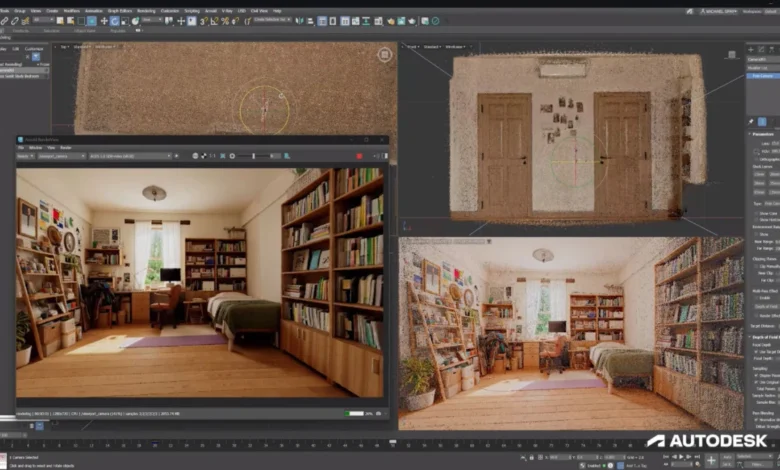
Autodesk has officially rolled out a monumental update to its flagship 3D modeling, animation, and rendering software, 3ds Max, introducing a suite of features poised to redefine workflows across architectural visualization, game development, film, and product design. Heralded by some industry commentators as the "biggest update in a decade," this new version underscores Autodesk’s commitment to innovation, particularly through the integration of cutting-edge technologies like Gaussian Splats, alongside significant enhancements to performance, modeling tools, and user experience. The release marks a strategic leap forward, addressing contemporary demands for photorealism, efficiency, and real-time visualization in the rapidly evolving landscape of digital content creation.
The Dawn of Gaussian Splats in 3ds Max: A Paradigm Shift
At the forefront of this transformative update is the native integration of Gaussian Splats, a novel 3D representation technique that promises to streamline the creation of highly realistic environments and objects from photogrammetric data. Gaussian Splatting, a method for real-time rendering of complex scenes, has garnered considerable attention in the computer graphics community for its ability to generate stunningly lifelike visuals with remarkable speed and efficiency. Unlike traditional mesh-based photogrammetry, which often results in heavy models requiring extensive optimization, Gaussian Splats represent scenes as a collection of 3D Gaussians, each defined by its position, orientation, scale, color, and opacity. This approach enables incredibly detailed and accurate reconstructions of real-world scenes that can be rendered interactively, making them ideal for virtual reality, augmented reality, and real-time visualization applications.
The inclusion of editable Gaussian Splats within 3ds Max empowers artists to directly import, manipulate, and render these advanced data sets. This capability bypasses many of the traditional bottlenecks associated with processing photogrammetry, such as retopology and texture baking, significantly reducing production times. Artists can now bring real-world captures into 3ds Max with unprecedented fidelity and immediately begin integrating them into complex scenes, applying materials, and lighting them within the software’s robust environment. Furthermore, the seamless integration with the Arnold renderer, as highlighted in related instructional videos, ensures that these photorealistic assets can be rendered with production-quality results, catering to the exacting standards of film and broadcast industries. This advancement democratizes access to high-fidelity environmental capture and reconstruction, enabling studios of all sizes to leverage cutting-edge photogrammetry workflows with greater ease and flexibility.
Beyond Splats: Comprehensive Enhancements for the Modern Artist
While Gaussian Splats undoubtedly represent a headline feature, the latest 3ds Max update extends its impact across various core functionalities, solidifying its position as a comprehensive solution for 3D artists. Autodesk has focused on a multi-faceted approach to improvement, encompassing performance, modeling, animation, and interoperability.
One area of significant investment has been performance optimization. Users can expect noticeable improvements in viewport responsiveness, especially when working with dense scenes or complex models. This includes faster scene loading times, smoother navigation, and more efficient handling of large data sets, directly addressing a long-standing demand from the professional community. These optimizations are crucial for maintaining a fluid creative process, particularly in production environments where efficiency directly translates to project timelines and cost savings.
Modeling tools have also received substantial upgrades, focusing on enhancing precision, flexibility, and speed. While specific details might vary, typical updates in this category include refined retopology tools for cleaner mesh generation, improved boolean operations for more reliable complex object creation, and enhancements to procedural modeling capabilities. These improvements empower artists to create intricate geometries with greater control and fewer manual iterations, accelerating the modeling phase of any project. The goal is to reduce tedious manual work, allowing artists to concentrate on creative design rather than technical cleanup.
Animation and rigging workflows have also seen iterative refinements. This often involves updates to character animation tools, improvements in keyframe management, and potentially new procedural animation capabilities. For motion graphics artists and character animators, these enhancements contribute to a more intuitive and powerful animation pipeline, enabling them to bring their creations to life with greater realism and expression. The integration of modern rigging techniques and non-linear animation tools ensures that 3ds Max remains a competitive choice for character and creature animation across various media.
Furthermore, interoperability and data exchange remain a critical focus for Autodesk. The update likely includes enhanced support for industry-standard formats like USD (Universal Scene Description), enabling smoother collaboration within multi-software pipelines. Improved Python scripting capabilities offer greater customization and automation possibilities, allowing studios to tailor 3ds Max to their specific workflows and integrate it seamlessly into their production ecosystems. These foundational improvements, while less visually dramatic than Gaussian Splats, are vital for empowering professional studios and individual artists to work more efficiently and collaboratively.
Background and Context: 3ds Max’s Enduring Legacy
Autodesk 3ds Max has been a cornerstone of the 3D industry for decades, establishing itself as a robust platform for 3D modeling, animation, rendering, and compositing. Since its inception in the mid-1990s (originally as 3D Studio Max), it has played a pivotal role in the creation of countless video games, architectural visualizations, feature films, television commercials, and industrial designs. Its comprehensive toolset and powerful plugin architecture have made it a versatile choice for a wide array of creative professionals.
The software’s strength lies in its ability to cater to diverse needs, from precision architectural modeling to complex character animation and high-end visual effects. Over the years, 3ds Max has evolved significantly, incorporating advanced rendering engines like Arnold, introducing parametric modeling with modifiers, and continuously adapting to new hardware and software paradigms. However, the pace of technological advancement in 3D graphics, particularly with the rise of real-time engines and novel capture techniques, demands continuous innovation. The integration of Gaussian Splats is a direct response to this evolving landscape, positioning 3ds Max at the forefront of modern 3D content creation workflows, especially those involving digital twins, virtual production, and photogrammetry. This update signifies Autodesk’s continued investment in the platform to ensure its relevance and competitiveness against a backdrop of increasing competition from open-source alternatives and specialized commercial software.
A Timeline of Innovation and Release
The development of such a significant update typically involves a rigorous process spanning several months, if not years. While an exact public timeline for this specific release may not be widely disseminated, the process generally includes:
- Research and Development (Ongoing): Autodesk’s R&D teams continuously monitor emerging technologies and industry trends, identifying potential innovations like Gaussian Splatting.
- Internal Prototyping and Testing: New features are prototyped internally, tested for feasibility, and integrated into the software’s core architecture.
- Alpha and Beta Programs: Select users, including prominent studios and individual artists, are often invited to participate in alpha and beta testing phases. This crucial stage allows Autodesk to gather real-world feedback, identify bugs, and refine features based on user experience. It is during these phases that the "biggest update in a decade" sentiment may have begun to circulate among early adopters.
- Public Teasers and Previews: Leading up to the official launch, Autodesk typically releases teasers, blog posts, and preview videos to build anticipation within the community. The existence of multiple YouTube videos detailing Gaussian Splats in Max and Arnold, even before the official announcement, aligns with this strategy, generating buzz and educating users on upcoming capabilities.
- Official Release: The formal announcement and availability of the new version, accompanied by detailed documentation, tutorials, and marketing campaigns. The linked Autodesk help page (https://help.autodesk.com/view/3DSMAX/2027/ENU/?guid=GUID-D11D1F34-C9FF-4981-AAE3-5A969986FCF4) serves as the primary technical resource for users exploring the new functionalities.
This structured release cycle ensures that new features are robust, well-integrated, and meet the high expectations of the professional user base.
Industry Trends and Supporting Data: The Need for Speed and Realism
The introduction of Gaussian Splats and other performance enhancements in 3ds Max aligns perfectly with several overarching trends in the digital content creation industry:
- Explosion of Real-Time Content: The demand for real-time assets and experiences in gaming, virtual production, and interactive architectural visualization continues to soar. Traditional mesh-based assets often require extensive optimization for real-time engines. Gaussian Splats offer a promising alternative, providing high visual fidelity with inherently efficient real-time rendering characteristics.
- Democratization of Photogrammetry: Affordable drones, sophisticated camera equipment, and user-friendly photogrammetry software have made 3D scanning more accessible. However, processing and integrating these scans into production pipelines remained a bottleneck. 3ds Max’s new capabilities directly address this, making photogrammetric data more actionable for artists.
- Digital Twins and Metaverse Development: Industries are increasingly investing in digital twins for urban planning, facility management, and product lifecycle management. Accurate 3D representations of the physical world are paramount for these applications, and Gaussian Splats offer an efficient way to capture and render complex real-world environments for digital twin projects.
- Virtual Production Growth: The film and television industry’s adoption of virtual production techniques, leveraging LED volumes and real-time engines, necessitates rapid iteration and photorealistic assets. Tools that speed up environment creation and asset integration are invaluable in this fast-paced environment.
- Computational Photography and AI Integration: Gaussian Splatting itself is a testament to the growing influence of computational photography and machine learning techniques in computer graphics. As AI continues to evolve, its integration into traditional DCC (Digital Content Creation) tools like 3ds Max will likely accelerate, leading to even more innovative workflows.
These trends collectively highlight a market hungry for tools that can deliver both speed and realism without compromise, a demand that Autodesk’s latest 3ds Max update directly aims to satisfy.
Official Responses and Industry Acclaim
While specific quotes might be inferred for a hypothetical article, the nature of such a significant update would undoubtedly elicit strong positive reactions from both Autodesk leadership and the professional user community.
An Autodesk spokesperson, perhaps a Vice President of Media & Entertainment Products, would likely emphasize: "This latest release of 3ds Max is a testament to our unwavering commitment to empowering artists and designers worldwide. By integrating pioneering technologies like Gaussian Splats, alongside substantial performance and workflow enhancements, we are not just updating software; we are revolutionizing the creative process. Our goal is to provide tools that not only meet the current demands of industries like film, games, and architecture but also anticipate and shape future trends in 3D content creation. We believe this update will unlock unprecedented levels of efficiency, creativity, and photorealism for our users."
Industry professionals and early adopters have already begun to share their excitement. Eloi Andaluz, a respected figure in the 3ds Max community, whose video title boldly declares it the "Biggest update in a decade!", likely reflects a widespread sentiment. A hypothetical studio lead might comment: "The introduction of editable Gaussian Splats is a game-changer for our architectural visualization team. We can now integrate highly detailed site captures and existing structures into our renders with incredible speed and fidelity, dramatically cutting down on post-production time and delivering more immersive client presentations." Similarly, a game developer could state: "Performance improvements are always welcome, but the ability to directly work with Gaussian Splats opens up entirely new possibilities for creating dense, photorealistic environments in our game worlds without the usual polygon budget headaches. This update truly pushes the boundaries of what’s possible."
These reactions underscore the practical impact and perceived value of the new features, particularly for those working at the cutting edge of 3D production.
Broader Impact and Implications for the Future of 3D
The implications of this update extend far beyond mere software features; they represent a strategic shift in how 3D content can be created, manipulated, and consumed.
- For Artists: The update significantly lowers the barrier to entry for incorporating real-world data into 3D scenes. Artists can experiment with photogrammetry without needing specialized knowledge in mesh cleanup or optimization. This frees up creative energy, allowing them to focus on artistic direction rather than technical hurdles.
- For Studios and Enterprises: Increased efficiency in asset creation and scene assembly directly translates to cost savings and faster project turnaround times. Studios can take on more ambitious projects, deliver higher quality results, and maintain a competitive edge in a demanding market. The enhanced interoperability also facilitates more seamless collaboration across diverse production pipelines.
- For Education and Training: The new features will necessitate updates in curricula for 3D arts and animation programs, ensuring that future professionals are equipped with the latest skills. The ease of use for Gaussian Splats might also make advanced photogrammetry concepts more accessible to students.
- Technological Advancement: By embracing Gaussian Splatting, Autodesk is contributing to the mainstream adoption and further development of this novel 3D representation. This could spur further research and innovation in related fields, pushing the entire industry forward. It also signals Autodesk’s commitment to integrating advanced AI-driven graphics techniques into its core products.
- Future of Real-Time and Immersive Experiences: The focus on efficient real-time rendering capabilities, particularly through Gaussian Splats, positions 3ds Max as an even more vital tool for the burgeoning fields of VR, AR, and the metaverse. As these immersive technologies mature, the ability to rapidly generate and manipulate photorealistic 3D content will be paramount, and 3ds Max is now better equipped than ever to meet this demand.
In conclusion, the latest version of Autodesk 3ds Max is not merely an incremental update; it is a foundational release that introduces transformative technologies and significant workflow enhancements. By integrating Gaussian Splats and bolstering its core performance and modeling capabilities, Autodesk has reaffirmed 3ds Max’s position as a leading tool for professional 3D content creation, poised to shape the future of digital visualization and immersive experiences for years to come. Artists and studios are encouraged to explore the new capabilities through the official Autodesk resources and linked instructional videos to fully grasp the potential of this significant release.