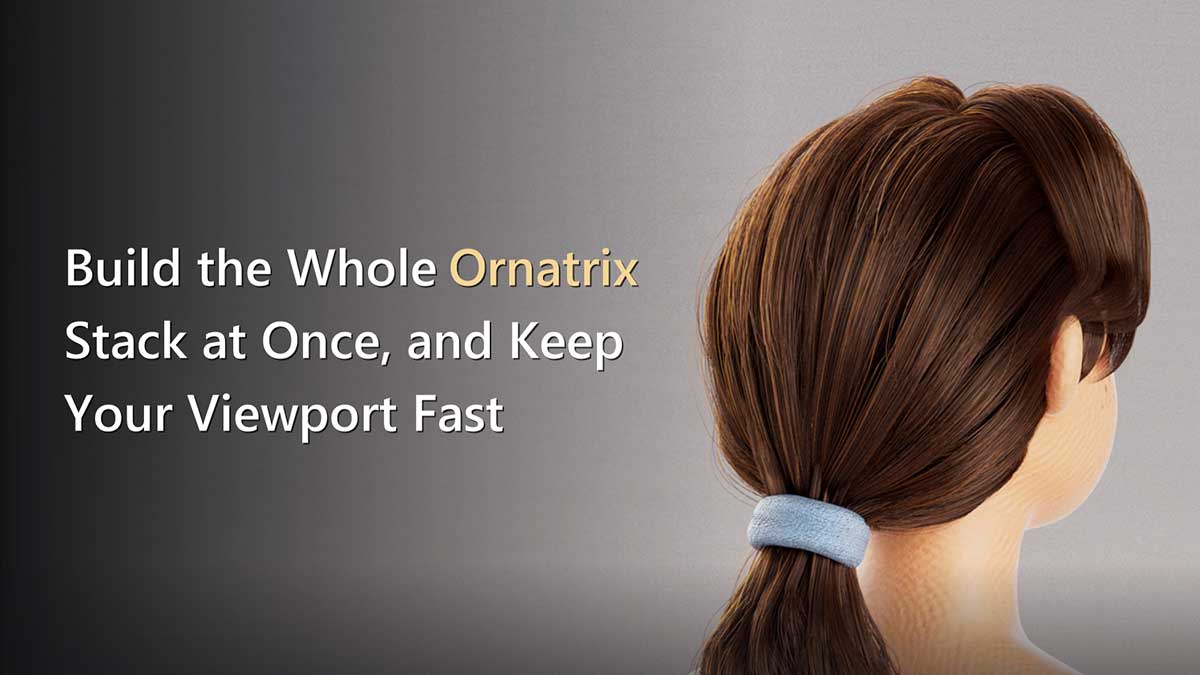
Build the Whole Ornatrix Stack at Once, and Keep Your Viewport Fast


Grooming hair and fur in high-fidelity 3D production environments remains one of the most computationally demanding tasks for technical artists and character designers. As software like Ephere’s Ornatrix for Maya continues to evolve, the complexity of operator stacks—the series of modifiers used to simulate, shape, and style hair—often leads to significant performance bottlenecks. When a production pipeline involves multiple layers of clumping, frizzing, curling, and noise, the Maya viewport frequently suffers from latency, forcing artists to choose between visual fidelity and real-time responsiveness. Recent technical workflows suggest a shift in methodology: moving away from incremental stack building toward a pre-configured, modular approach that prioritizes viewport performance without compromising the final render quality.
The Mechanics of Performance Degradation in Grooming
The standard workflow for most digital groomers involves a progressive build: creating the base guides, styling the silhouette, and subsequently adding complexity. While this ensures an artist is not overwhelmed by data, it creates a "feedback gap." By the time an artist adds heavy modifiers like noise or complex clumping, the underlying base flow may be fundamentally incompatible with the final look, requiring a time-consuming iterative cycle of backtracking and re-styling.
Ornatrix functions by evaluating the operator stack from the bottom up. The base generator serves as the foundation, while subsequent operators pass data upward, transforming the strands. When an operator stack grows to include a dozen or more nodes, the cumulative calculation time required for the viewport to redraw after a single tweak can extend into several seconds. Over the course of a standard eight-hour production shift, these cumulative delays result in significant loss of productivity and a fragmented creative flow.
Strategic Stack Optimization: A Chronological Approach
To mitigate these performance issues, industry experts now advocate for the "all-at-once" stack construction. This method involves building the entire required operator stack at the initial stage of the grooming process. By establishing the order of operations—starting with direction, followed by shape, variation, settling, and finally, render-time tuning—artists can maintain a consistent data structure from start to finish.
The recommended stack order for optimal performance and logic is as follows:
- Directional Operators (Surface Comb, Rotate): These define the primary silhouette and flow of the groom. They are computationally inexpensive and must remain active to provide a constant visual reference.
- Shape Operators (Clump, Curl): These define the structural volume of the hair. In the proposed workflow, these are initially disabled.
- Variation Operators (Frizz, Detail, Noise): These add the micro-geometry necessary for realism. These are also kept disabled during the initial styling phase.
- Settling Operators (Gravity): These provide the final physical resting state for the strands.
- Render Tuning (Change Width): The final stage, which ensures the visual scale of the hair is consistent at render time.
By keeping the "heavy" operators (those responsible for shape and variation) in a disabled state, the artist retains the ability to manipulate the base silhouette at full speed. When a specific section of the groom requires review, the artist can selectively enable the necessary operators to visualize the final result before immediately disabling them to return to high-speed grooming.
Technical Implementation and Command Line Control
A critical distinction in this workflow is the method used to toggle operator states. While many users rely on the nodeState attribute, this often leads to synchronization errors where the Maya interface does not accurately reflect the actual status of the operator. Technical best practices dictate the use of the specific Ornatrix command: OxEnableOperator "<node>" 0. This ensures that the operator stack dialog remains in sync with the actual evaluation state of the nodes, preventing the common issue of "zombie" operators—nodes that appear active but are disabled, or vice versa.
Furthermore, managing viewport density is a secondary but equally vital lever for performance. By utilizing the generator’s "view percentage" setting, artists can limit the number of strands drawn in the viewport to 5% while maintaining the full density for final rendering. It is essential to note, however, that different Ornatrix generators utilize varying scales for this parameter. Failure to account for these discrepancies can result in viewport overloading, where an attempt to reduce complexity inadvertently increases it by an order of magnitude.
Addressing Default Workflow Inefficiencies
Industry analysis of common grooming pitfalls highlights two frequently overlooked areas: guide length and render width management. Default Ornatrix settings often produce excessively long guides, which obscure the underlying mesh and necessitate immediate, manual scaling. Establishing a standard baseline—such as a guide length of 1.0—streamlines the initial setup phase.

Similarly, the management of strand width has historically been a source of discrepancy between viewport representations and final render output. By deleting the default Render Settings node and centralizing width control within a single "Change Width" operator at the top of the stack, artists can ensure a "single source of truth." This prevents the common scenario where hair appears thin in the viewport but renders with unexpected thickness due to conflicting global settings.
Broader Implications for Production Pipelines
The adoption of a pre-configured stack workflow has measurable implications for studio pipelines. By reducing the time spent waiting for viewport refreshes, technical artists can focus on the artistic intent of the groom rather than the constraints of the software. This approach also improves the consistency of grooms across a character team, as artists are encouraged to adhere to a standardized stack hierarchy.
To facilitate this, open-source initiatives have emerged to automate the construction of these stacks. Tools such as "Groomist"—a shelf-based utility for Maya—allow artists to deploy a pre-formatted, optimized stack with a single click. Such tools underscore a growing trend in the 3D industry: the movement toward "pipeline-as-code," where standardizing technical foundations allows for greater creative freedom.
Future Perspectives
As real-time rendering engines like Unreal Engine and Unity become more integrated into the film and animation pipeline, the demand for viewport-efficient grooming will only increase. The techniques outlined here represent a fundamental shift in how hair and fur are managed, moving away from reactive troubleshooting toward proactive, structured development. As Ornatrix continues to update, these core principles of stack hierarchy and node management remain the most effective defense against the inherent complexities of grooming in high-density production environments. For technical directors and leads, promoting these standardized workflows is essential for maintaining both the quality of the visual output and the health of the production schedule.
Related posts: