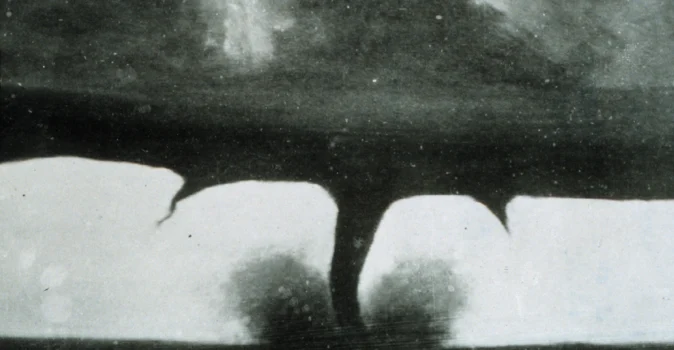
On a quiet afternoon in April 1884, A. A. Adams, a Kansas fruit grower with a background in professional photography, accomplished a feat that would fundamentally alter the history of meteorology. While the public consciousness is often dominated by the dramatic, high-contrast imagery of 19th-century storm photography—much of which has been debunked as artistic fabrication—it is Adams’s modest, unassuming shot of a distant, gray funnel cloud that historians now accept as the earliest surviving photograph of a tornado.
The image, captured on April 26, 1884, near the town of Garnett in Anderson County, stands in stark contrast to the mythologized "spectacular" captures that followed later that same year. By examining the technical constraints of the era, the provenance of early atmospheric records, and the motivations of Victorian-era commercial photographers, we can reconstruct a clearer timeline of how the first tornado was truly documented.
A Chronology of Early Atmospheric Documentation
The late 19th century was a period of intense curiosity regarding severe weather, yet the tools available to document these phenomena were severely limited. Before the widespread adoption of roll film and handheld cameras, photography was a deliberate, static, and often hazardous pursuit.
Adams’s success was a product of both patience and circumstance. As a former studio photographer, he possessed the technical knowledge required to operate a heavy, tripod-mounted plate camera. When a tornado formed approximately 14 miles west of Garnett near Westphalia, the storm’s slow movement—remaining in view for nearly 30 minutes—provided a rare window of opportunity. Adams positioned his equipment near the United Presbyterian Church, focused his camera under a dark cloth, and exposed a plate. The result was a faint, rope-like funnel that appears almost unremarkable by modern standards.
Four months later, on August 28, 1884, photographer F. N. Robinson captured a much more dramatic image near Howard, in the Dakota Territory. Robinson’s photograph, which featured a wide, dark funnel with smaller vortices, became the de facto "first" photograph of a tornado for over a century. However, modern forensic analysis by experts like Thomas P. Grazulis, author of Significant Tornadoes, suggests that Robinson’s image was likely a composite—a practice common in the late 1800s to increase the commercial appeal of cabinet cards. The Robinson image, while aesthetically superior for its time, lacks the verifiable authenticity of the Adams photograph, which aligns precisely with Signal Corps weather maps and eyewitness reports from Garnett.
Technical Constraints and the Evolution of Storm Photography
To understand why early tornado photography is so riddled with controversy, one must look at the technology of the 1880s. The transition from the "wet-plate" collodion process—which required the photographer to develop the plate while the chemicals were still tacky—to the more convenient, factory-made gelatin dry plates was still underway.
Even with dry plates, the equipment remained cumbersome. There were no mass-market snapshot cameras until George Eastman introduced the Kodak roll-film box in 1888. Prior to this, any photograph of a moving weather system required the photographer to be stationary, patient, and prepared to wait for the subject to enter their field of view.
Furthermore, the emulsions of the era were orthochromatic, meaning they were primarily sensitive to blue light and largely blind to red light. This technical limitation resulted in skies that appeared washed out or bleached, while funnels appeared as high-contrast, dark strokes. These limitations often compelled early photographers to "enhance" their images—painting in cloud bases or adding debris—to satisfy a public that associated "tornadoes" with dark, violent, and cinematic shapes.
Validating the Historical Record
The verification of the Adams photograph is a triumph of interdisciplinary research. Meteorologists have cross-referenced the 1884 image with records from the U.S. Army Signal Corps, which was the primary entity responsible for meteorological data collection at the time. By analyzing the atmospheric pressure systems and weather patterns of April 26, 1884, researchers confirmed that a system capable of producing such a storm was present in the region.
Additionally, the geography of the shot serves as a primary source of authentication. A wider, uncropped version of the Adams image reveals the Presbyterian Church in the foreground. By mapping the church’s historical location to the street layout of 19th-century Garnett, historians have been able to pin the vantage point to a specific, real-world coordinate. This level of forensic validation is largely absent in the case of the Robinson photo and the numerous "spurious" images that circulated in the late 1890s.
The Monthly Weather Review eventually took notice of these fraudulent practices, publishing warnings under the heading "Spurious Tornado Photographs" to alert the public to images that had been manipulated with ink or composite darkroom techniques. Despite these warnings, the allure of a dramatic storm photo was powerful enough that misattributions persisted well into the 20th century.
The Shift from Artistic Documentation to Scientific Utility
The implications of these early efforts were profound. Before reliable photography, scientists were forced to rely on sketches, anecdotal evidence, and post-storm damage surveys. These methods were inherently subjective and prone to exaggeration. The introduction of the camera—even one as basic as the wooden field cameras of the 1880s—provided a tangible anchor for scientific inquiry.
While the U.S. Weather Bureau did not maintain a consistent, modern-era database until later in the 20th century, the emergence of photography allowed for the first visual assessment of tornado structure and scale. Later, Dr. Tetsuya Fujita’s development of the Fujita Scale—used to categorize tornado intensity based on damage—relied heavily on the legacy of photographic and anecdotal documentation to reconstruct the severity of historical storms. Today, that retrospective analysis is the only reason we can confidently classify the 1884 Dakota storm as an F4 event, albeit with the caveat that such ratings are estimates based on historical accounts rather than real-time data.
Modern Implications: The Ethics of Storm Documentation
The technological divide between the 1880s and the present day is immense. Modern digital sensors, high-speed shutters, and weather-sealed equipment have removed the technical barriers that once confined photographers to capturing distant, slow-moving storms. However, this ease of access has introduced new ethical and safety concerns.
The transition from the tripod-bound photographer to the high-mobility "storm chaser" has changed the nature of the documentation itself. While current meteorological research benefits from high-resolution imagery, the human cost has risen. The tragic deaths of researchers like Tim Samaras, his son Paul, and colleague Carl Young during the 2013 El Reno tornado serve as a stark reminder of the dangers inherent in documenting these systems.
The advice from the National Weather Service remains unchanged since the 19th century: the priority during a severe weather event is safety, not documentation. Modern meteorology has moved toward remote sensing—using radar, satellite imagery, and automated weather stations—to collect data without the need for proximity.
Conclusion
A. A. Adams, the Kansas fruit grower, likely did not realize that his 1884 photograph would become the bedrock of a field that would eventually utilize satellites to track storms from space. By standing on a street corner and capturing a faint, gray thread against a washed-out sky, he provided a record that was honest, accurate, and scientifically significant.
While the "dramatic" photos of the late 1800s may have dominated the parlors and galleries of the era, it is the quiet, unassuming image from Garnett that has endured. It stands as a testament to the fact that, in both meteorology and photography, the most important records are rarely the most spectacular ones—they are simply the most truthful. As we continue to refine our ability to predict and document extreme weather, we do so on the foundation laid by these first pioneers, who recognized that a single frame, when captured correctly, could reveal the power of the natural world in ways that words never could.