GrowFrame: A New Desktop Utility Designed to Catalog and Sustain Long-Term Creative Endeavors


The landscape of professional production tracking has long been dominated by high-end, enterprise-level solutions designed for large-scale studios. Platforms like Autodesk’s Flow Production Tracking (formerly ShotGrid) are indispensable for managing multi-hundred-person crews, complex asset pipelines, and intricate version control across global time zones. However, these tools are often prohibitively expensive, overly complex, and ill-suited for the unique requirements of the independent creator. Recognizing this gap in the digital ecosystem, Miquel Campos, the developer behind the well-regarded mGear framework, has launched GrowFrame, a desktop-native application engineered specifically to support the lifecycle of solitary passion projects.
The Genesis of a Specialized Tool
Miquel Campos, a Tokyo-based developer and artist, began the development of GrowFrame as a direct response to his own challenges while working on a long-form animated short film. As an individual creator, the technical overhead of managing a multi-year project often competes with the creative process itself. Standard project management software typically emphasizes team collaboration, task assignments, and budget oversight—features that are largely irrelevant for a single artist operating in a home studio.
Campos realized that the primary struggle for independent creators is not just project management, but psychological maintenance. The "marathon" nature of an independent animation or complex art project often leads to burnout, as the incremental progress made on a daily basis is easily forgotten or obscured by the sheer scale of the undertaking. GrowFrame was designed to bridge this gap, acting as a visual ledger that documents the daily labor of creation. After refining the tool for his own workflows, Campos transitioned the project into a commercial product to provide other artists with a streamlined, local-first alternative to the bloated industry standards.
Mechanics and Workflow: The Kanban for Personal Craft
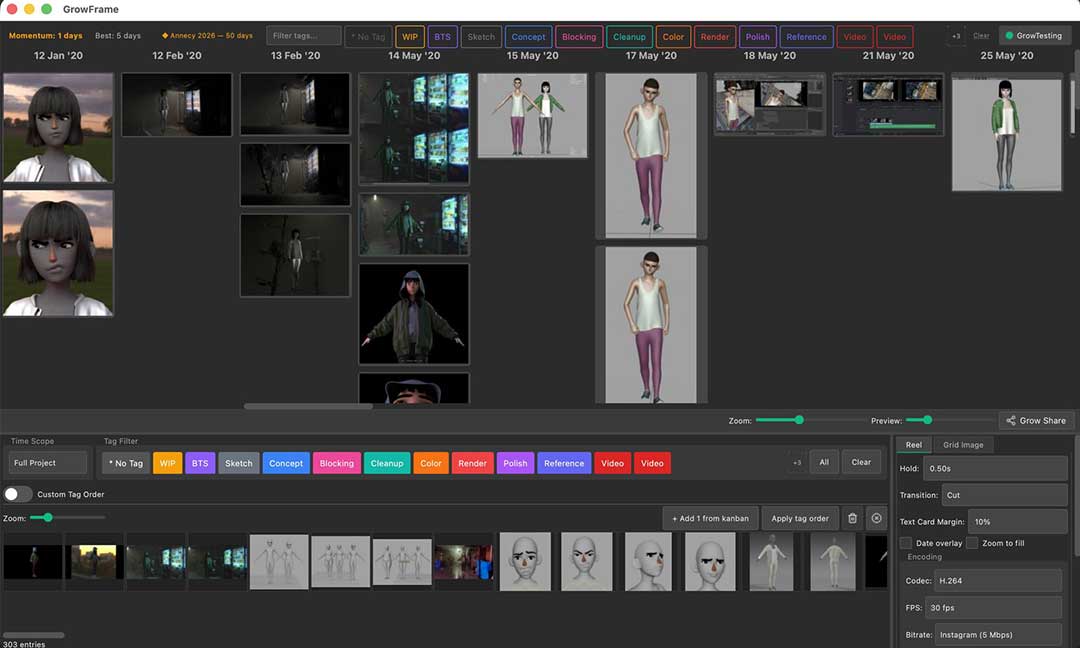
At its core, GrowFrame utilizes a Kanban-inspired interface that encourages users to ingest their daily output. Whether an artist is working in 3D animation, digital painting, traditional sculpture, or photography, the application serves as a central repository for "work-in-progress" snapshots. Users can drag and drop renders, animation tests, or high-resolution photos of physical work directly into the interface.
The application’s primary function is the creation of a visual timeline. By organizing files chronologically, the software allows the creator to scroll backward through the history of their project, visualizing months or years of iterative growth. This feature serves a dual purpose: it acts as a diagnostic tool for reviewing artistic evolution and as a powerful psychological motivator. In an era where "finished" work is often presented as a polished final product, GrowFrame elevates the "process" to a status equal to the outcome.
Beyond mere archival, the software includes a sophisticated export utility. It allows users to select specific durations of their timeline and automatically compile them into a coherent reel across various social media formats. This functionality addresses a common pain point for independent creators: the significant time cost associated with promotional content creation. By automating the compilation of progress footage, GrowFrame effectively recovers time that would otherwise be spent on video editing, allowing the artist to remain focused on the core creative task.
The Philosophy of the "Local-First" Movement
GrowFrame arrives at a time of growing concern regarding data ownership, cloud dependency, and the rising cost of SaaS (Software as a Service) subscriptions. In stark contrast to the industry trend toward cloud-based management suites, Campos has implemented a strictly local-first architecture for GrowFrame.
The software operates entirely on the user’s machine. There are no monthly subscription fees, no cloud-based storage requirements, and no telemetry tracking beyond the initial license verification. This model reflects a deliberate return to the "permanent license" ethos of earlier software generations. By removing the dependency on external servers, the tool ensures that the artist’s project data remains private and accessible even in the event of an internet outage or the eventual sunsetting of the developer’s servers.
This approach is particularly significant in the context of intellectual property. Independent creators often hold their work in high regard, and the risk of storing proprietary WIP (work-in-progress) data on third-party cloud servers is a frequent concern for freelance animators and independent filmmakers. GrowFrame’s commitment to local storage mitigates these security concerns entirely.
Contextualizing the Rise of AI and Human-Made Art
The launch of GrowFrame is implicitly positioned against the current backdrop of rapid advancements in generative AI. As artificial intelligence models become increasingly capable of generating high-fidelity imagery and video in seconds, the value of the "slow-made" project has faced a period of existential questioning.
Campos has been transparent about his intentions: GrowFrame is not a tool designed to compete with the speed of AI. Instead, it is a tool designed to celebrate the friction and the time inherent in human craftsmanship. By focusing on the manual effort required to move a project from concept to completion over several years, the app serves as a digital monument to the artist’s dedication.
From an analytical perspective, this represents a shifting trend in the professional creative tools market. While enterprise-level AI integration is becoming the standard for efficiency, there is a burgeoning market for "slow-tech"—tools that prioritize the human experience, intentionality, and the long-term sustainability of the creator rather than just the efficiency of the output.
Educational Integration and Future Outlook
While initially conceived for professional independent animators, the utility of GrowFrame has expanded into the educational sector. Art schools and animation programs are increasingly adopting the software as a pedagogical tool. In a classroom environment, students often struggle to document the iterative process—a critical component of academic assessment and personal growth. GrowFrame provides a structured way for students to maintain a longitudinal record of their studies, allowing instructors to review the evolution of a student’s skills over the course of a semester or a degree program.
Several academic institutions have already integrated GrowFrame into their beta testing pipelines, noting its ability to encourage reflective practice among students. As the software gains traction, it is expected that its feature set will continue to evolve, potentially incorporating more robust annotation tools or deeper integrations with common DCC (Digital Content Creation) software like Maya, Blender, or Houdini.
Market Analysis: Why Small Projects Need Specialized Tools
The global market for creative production software is currently valued in the billions, yet the vast majority of that value is captured by tools designed for high-budget production houses. Small-scale creators are often left with a choice: use free, general-purpose tools like Trello, Notion, or basic file folders, which lack specific functionality for visual media, or force-fit their workflow into enterprise tools that are ill-suited to their budget and technical infrastructure.
GrowFrame’s entry into this market is a test case for the viability of niche, developer-led software. By focusing on a "one-person" studio model, the software minimizes the feature bloat that characterizes larger platforms. It targets a specific subset of the industry: independent filmmakers, freelance concept artists, and creative students who value their time and data sovereignty.
Financials and Accessibility
As of its current release, GrowFrame is available for a one-time purchase price of €35. This price point is notably aggressive, aimed at individual artists rather than production studios. Furthermore, the inclusion of an educational discount underscores a commitment to the next generation of artists.
The software’s development and maintenance remain under the purview of mcsGear GK, the entity through which Campos operates from Tokyo. By maintaining a lean operational structure, the developer is able to avoid the high overheads associated with larger software firms, which in turn allows for the lower, one-time price point.
Implications for the Creative Industry
The emergence of tools like GrowFrame suggests a broader trend toward the democratization of high-quality, professional-grade workflows. As the barriers to entry for creative work continue to lower due to hardware advancements and software accessibility, the challenge for the individual creator is no longer about "having the tools" to create, but about "having the discipline" to finish.
By providing a visual, structured, and local way to document long-term projects, GrowFrame addresses the "middle-of-the-marathon" blues that define the vast majority of creative failures. It transforms the act of archiving from a chore into an essential component of the project’s creative narrative. As the creative industry continues to navigate the implications of AI, the focus on documentation, provenance, and the history of human effort—areas where GrowFrame excels—may become increasingly vital for creators looking to distinguish their work in an increasingly crowded visual landscape.