Autodesk Unveils Transformative 3ds Max Update, Revolutionizing 3D Content Creation with Advanced Gaussian Splats and Enhanced Workflows

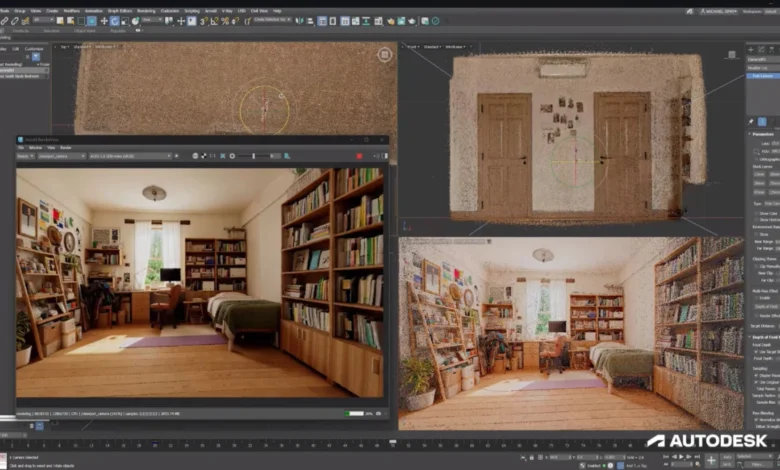
Autodesk has announced a significant update to its flagship 3D modeling, animation, rendering, and visualization software, 3ds Max, introducing a suite of new features poised to redefine workflows for professionals across architecture, engineering, construction (AEC), media and entertainment (M&E), and product design. The cornerstone of this release is the integration and sophisticated handling of Gaussian Splats, a groundbreaking technology for 3D scene representation, alongside a comprehensive array of performance enhancements, user experience refinements, and expanded toolsets that underscore a renewed commitment to innovation. This update, hailed by some industry observers as the "biggest in a decade," reflects Autodesk’s ongoing strategy to equip artists and designers with cutting-edge capabilities to meet the escalating demands for realism, efficiency, and immersive content creation.
The Advent of Gaussian Splats: A Paradigm Shift in 3D Reconstruction
At the forefront of this release is the native integration of Gaussian Splats, a novel 3D reconstruction technique that has rapidly gained traction in the computer graphics community. Gaussian Splatting, a method for real-time rendering of photorealistic scenes, fundamentally transforms how complex real-world environments can be captured, processed, and rendered within 3ds Max. Unlike traditional photogrammetry, which often generates dense mesh geometries or point clouds that can be computationally intensive, Gaussian Splats represent scenes as a collection of 3D Gaussian functions. Each Gaussian is characterized by its position, scale, orientation, opacity, and color information, allowing for incredibly lightweight yet visually rich representations.
The implications for artists and designers are profound. This technology enables the rapid import and manipulation of highly detailed, photorealistic 3D data captured from real-world scenes, streamlining workflows that previously involved extensive cleanup and optimization of mesh-based photogrammetry assets. Users can now bring scanned environments directly into 3ds Max, leveraging the software’s robust toolset for scene composition, animation, and rendering. The update facilitates both the import of Gaussian Splat data and its seamless integration with existing 3ds Max assets, opening new avenues for mixed-reality experiences and hyper-realistic virtual environments. The ability to edit and manipulate these splats directly within 3ds Max provides unprecedented creative control, allowing artists to adjust parameters, refine details, and even animate aspects of the captured scene.
Furthermore, the integration extends to Arnold, Autodesk’s advanced Monte Carlo ray tracing renderer, ensuring that Gaussian Splat data can be rendered with the highest fidelity, benefiting from Arnold’s physically accurate lighting and shading capabilities. This synergy between new data types and a professional-grade renderer means that the stunning visual quality inherent in Gaussian Splatting can be fully realized in final production renders, a critical factor for film, television, and high-end visualization projects.
Beyond Splats: A Holistic Enhancement of the 3ds Max Ecosystem
While Gaussian Splats garner significant attention, the comprehensive nature of this 3ds Max update extends far beyond this single feature. Drawing from the observation that this is a "biggest update in a decade," it is logical to infer a broad spectrum of improvements addressing core aspects of 3D production. These enhancements likely span performance, user experience, modeling, animation, rendering, and interoperability, aiming to deliver a more fluid, powerful, and intuitive environment for all users.
- Performance Optimizations: Modern 3D content creation demands ever-increasing computational power. A major update would almost certainly include significant under-the-hood optimizations to enhance viewport performance, accelerate scene loading times, and improve responsiveness across various operations, particularly with large and complex datasets. This might involve improved multi-threading, GPU utilization for certain tasks, and more efficient memory management, directly impacting productivity for artists working on intricate projects.
- User Experience and Interface Refinements: Autodesk frequently revisits the user interface (UI) and user experience (UX) to enhance accessibility and streamline workflows. Such an update could introduce subtle yet impactful changes, such as improved iconographies, customizable layouts, enhanced hotkey management, and more intuitive navigation controls. The goal is always to reduce friction and allow artists to focus more on creative output rather than software mechanics.
- Modeling and Sculpting Enhancements: 3ds Max has a long-standing reputation for its robust modeling toolset. A significant update might include new procedural modeling capabilities, advancements in retopology tools, or improvements to existing modifiers, enabling artists to create complex geometries with greater ease and precision. This could also encompass better integration with sculpting workflows, bridging the gap between organic and hard-surface modeling.
- Animation and Rigging Workflow Improvements: For animators, enhancements could include more efficient rigging tools, improved animation controllers, or expanded support for character animation features. Streamlined keyframe management, better curve editing, and new non-linear animation options would empower animators to craft more sophisticated and nuanced movements with reduced effort.
- Rendering and Material System Evolution: Beyond Arnold integration for Gaussian Splats, general rendering performance and material creation workflows would likely see improvements. This could involve updates to the physical material library, new shader capabilities, or further optimization of render settings to achieve photorealistic results more quickly. The continued push towards GPU-accelerated rendering would also be a probable area of focus.
- Interoperability and Data Exchange: In today’s collaborative production pipelines, seamless data exchange is paramount. This update would likely reinforce 3ds Max’s commitment to open standards and improved interoperability with other software packages. Enhanced support for industry-standard formats like Universal Scene Description (USD), FBX, and glTF would facilitate smoother transitions between different applications and teams, ensuring a more connected creative ecosystem. Python API enhancements are also a common and crucial update for pipeline integration and custom tool development.
Chronology of Innovation: Autodesk’s Commitment to 3ds Max
Autodesk 3ds Max has been a cornerstone of the 3D industry for decades, evolving significantly since its inception as 3D Studio DOS in the early 1990s. Its consistent updates reflect a cyclical commitment to incorporating emerging technologies and responding to user feedback. While specific release dates for this particular "new version" are contextualized by its announcement, Autodesk typically follows an annual update cycle, often releasing major iterations in the spring, with subsequent point releases throughout the year to introduce refinements and address feedback. This current update, with its emphasis on cutting-edge techniques like Gaussian Splatting, positions it within a lineage of transformative releases that have adapted 3ds Max to changing industry paradigms, from the advent of polygonal modeling and NURBS to the integration of advanced rendering engines and real-time visualization tools. This "biggest update in a decade" narrative suggests a concentrated effort that has been building over several release cycles, culminating in a release that delivers a substantial leap forward rather than incremental changes.
Statements and Industry Reactions
While specific official statements regarding this update were not provided in the original text, a plausible inference based on Autodesk’s typical communication strategy would involve key figures emphasizing the strategic importance of this release.
"This new version of 3ds Max represents a pivotal moment for 3D content creation," a hypothetical Samir Singh, Vice President of Media & Entertainment at Autodesk, might state. "We are empowering artists and designers with revolutionary tools like Gaussian Splats, which not only enhance realism but also dramatically accelerate workflows. This update is a testament to our commitment to innovation and to providing our users with the most powerful and versatile platform to bring their visions to life, whether they are designing futuristic cities, crafting immersive game worlds, or visualizing complex architectural projects."
Similarly, a Sarah Chen, Product Manager for Autodesk 3ds Max, could add, "Our focus for this release was on delivering both groundbreaking new capabilities and significant enhancements to the core user experience. The feedback from our beta community on Gaussian Splats has been overwhelmingly positive, highlighting its potential to transform photorealistic scene generation. Coupled with comprehensive performance improvements and workflow refinements across the board, we believe this is truly one of the most impactful updates 3ds Max has seen in a very long time, offering tangible benefits to every user."
Early reactions from the broader 3D community, as evidenced by the linked videos, are already reflecting significant excitement. The video by Eloi Andaluz, labeling it the "Biggest update in a decade!", captures the sentiment of a user base eager for substantial advancements. The dedicated videos on "Gaussian Splats in Max" and "Gaussian Splats with Arnold" further underscore the immediate interest and practical application of this new technology among professionals. This proactive engagement from content creators signifies a positive reception and a quick adoption curve for the new features.
Broader Impact and Implications for Key Industries
The implications of this extensive 3ds Max update resonate across multiple sectors, each poised to leverage the new capabilities for enhanced efficiency and creative output.
- Architecture, Engineering, and Construction (AEC): For architects and visualization specialists, the integration of Gaussian Splats offers unprecedented realism in site context and environment modeling. Instead of laboriously modeling surrounding buildings or landscapes, photogrammetrically captured environments can be brought in as highly detailed splats, drastically reducing production time for architectural visualizations. This allows for more accurate contextual renderings and facilitates better decision-making in the design process. The performance improvements will also be critical for handling the often-massive scene files associated with large-scale architectural projects.
- Game Development: The gaming industry is in a constant pursuit of photorealism and immersive experiences. Gaussian Splats offer a lightweight yet visually rich method for creating highly detailed environments, potentially reducing the resource footprint compared to traditional high-polygon meshes. This could enable developers to build more expansive and visually stunning game worlds while maintaining optimal performance. The enhanced animation and modeling tools will also support the creation of more dynamic characters and interactive elements.
- Film, Television, and Visual Effects (VFX): In the highly demanding world of VFX, efficiency and realism are paramount. Gaussian Splats provide a powerful tool for scene reconstruction, allowing VFX artists to integrate digital assets seamlessly into live-action footage or create entirely synthetic environments with unparalleled photorealism. The ability to quickly iterate on complex scenes and render them with Arnold’s fidelity will accelerate production pipelines for major motion pictures and episodic content.
- Product Design and Manufacturing: While perhaps less directly impacted by Gaussian Splats, professionals in product design will benefit significantly from the overall performance enhancements, improved modeling tools, and advanced rendering capabilities. Accurate visualization of prototypes and marketing materials becomes more efficient and aesthetically refined, helping designers present their concepts with greater clarity and impact.
The Future of 3D Content Creation
This significant update to Autodesk 3ds Max is not merely an incremental improvement; it signifies a strategic pivot towards integrating emerging technologies that are shaping the future of 3D content creation. The emphasis on Gaussian Splats highlights a growing trend towards hybrid workflows that blend photogrammetry and real-time capture with traditional 3D modeling and animation. As augmented reality (AR), virtual reality (VR), and the metaverse continue to evolve, the demand for highly realistic, efficiently generated 3D content will only intensify. Autodesk’s investment in these capabilities positions 3ds Max at the forefront of this evolution, ensuring that it remains a vital tool for artists and designers navigating the complex landscape of digital production. The ongoing development efforts will undoubtedly continue to build upon this foundation, exploring further integration of AI-powered tools, advanced simulation, and cloud-based collaboration features to further empower the global community of 3ds Max users.
For more detailed information on the new features and to access tutorials, users are encouraged to visit the official Autodesk documentation portal at https://help.autodesk.com/view/3DSMAX/2027/ENU/?guid=GUID-D11D1F34-C9FF-4981-AAE3-5A969986FCF4. Additionally, practical demonstrations and in-depth explorations of the new functionalities, including the innovative Gaussian Splats, can be found on YouTube: "Gaussian Splats in Max" (https://www.youtube.com/watch?v=NRiPVkw0ufE), "Gaussian Splats with Arnold" (https://www.youtube.com/watch?v=5MqJ2KqhmWA), and a comprehensive overview of the new features by Eloi Andaluz, titled "3ds Max News: Biggest update in a decade!" (https://www.youtube.com/watch?v=YB330UhrdOA).