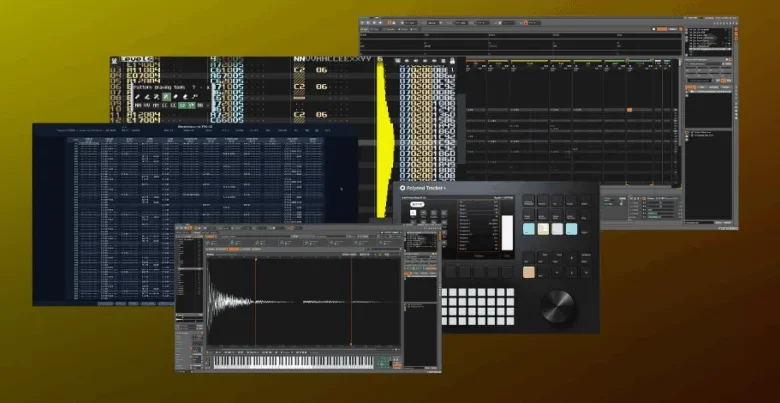
The landscape of modern music production is overwhelmingly dominated by the horizontal timeline, a design philosophy rooted in the linear nature of magnetic tape. Digital Audio Workstations (DAWs) like Ableton Live, Logic Pro, and FL Studio have perfected this "left-to-right" visualization, where note information is represented by blocks on a piano roll. However, a significant and vocal contingent of the electronic music community—particularly those operating within the intricate realms of jungle, breakcore, and Intelligent Dance Music (IDM)—is increasingly turning toward an older, more numerical alternative: the music tracker. Unlike the traditional DAW, a tracker operates on a vertical axis, with data flowing from the top of the screen to the bottom, representing musical events through hexadecimal code and alphanumeric parameters rather than graphical blocks.

This resurgence of interest in trackers is not merely a byproduct of retro-fetishism. The vertical workflow offers a precision in micro-programming that horizontal sequencers often struggle to match. For genres characterized by rapid-fire breakbeat chops, complex polyrhythms, and granular parameter modulation, the tracker provides a streamlined interface where every subtle nuance of a sound—pitch, volume, panning, and effect triggers—is visible and editable on a per-step basis. As music production enters a new era of hybrid hardware-software setups, the tracker has evolved from a relic of the 1980s computer scene into a sophisticated, modern tool available in both high-end hardware and streamlined software formats.

The Historical Evolution of the Vertical Sequencer
To understand the current state of tracker technology, one must look back to the limitations of early computing. The tracker format originated in 1987 with the release of Karsten Obarski’s Ultimate Soundtracker for the Commodore Amiga. At a time when professional digital recording was prohibitively expensive, the Amiga’s 8-bit, four-channel audio chip allowed hobbyists to sequence short samples into complex arrangements. This sparked the "demoscene" culture, where programmers and musicians competed to squeeze the most impressive visuals and music into the smallest possible file sizes.

Throughout the 1990s, the tracker became the engine behind the burgeoning breakbeat and jungle scenes. Software like OctaMED became the primary workstation for legendary producers such as DJ Aphrodite, Bizzy B, and DJ Zinc. The tracker’s ability to "slice" a breakbeat—assigning different parts of a drum loop to different keys and then re-sequencing them at lightning speeds—defined the sound of early UK rave music. This era established the "hexadecimal" mindset, where values are calculated in base-16 (0-9 followed by A-F), providing a higher resolution of control within a compact numeric display.

The transition into the 2000s saw trackers evolve to meet modern standards. While many producers moved to the burgeoning VST-based DAWs, others stayed loyal to the vertical workflow. Aphex Twin famously utilized PlayerPro to compose the intricate, drill-and-bass structures found on the 2001 album Drukqs. Meanwhile, the development of Renoise in 2002 marked the birth of the "modern tracker," bridging the gap between old-school sequencing and contemporary plugin support. Today, the lineage continues through a new generation of hardware and software that prioritizes the tactile, keyboard-driven efficiency that defined the original Amiga era.

Top Software Trackers: From Modular Engines to Self-Contained DAWs
For producers looking to integrate tracker logic into a modern computer-based workflow, several software options cater to different levels of complexity and budget.

Alexander Zolotov’s SunVox represents the most accessible entry point into this world. Available as a free download for desktop and a low-cost app for iOS, SunVox is a modular synthesizer disguised as a tracker. It utilizes a node-based "Module View" where users can connect various synthesizers, samplers, and effects via virtual cables. These modules are then sequenced using a traditional tracker interface. SunVox is noted for its extreme CPU efficiency, making it a favorite for mobile production and those working on older hardware. Its inclusion of AUv3 support for Logic and Live on iOS further cements its utility as a modern production companion.

Moving into the realm of dedicated indie development, Electronisounds TRX-12 offers a streamlined, self-contained DAW experience. Created by Dean Daughters, TRX-12 focuses on the "Step-FX" philosophy. In a tracker, a Step-FX is a command placed alongside a note that dictates a specific behavior for that moment in time—such as a "ratchet" (re-triggering the note multiple times), a pitch glide, or a randomized sample start point. TRX-12 includes 35 such commands, allowing for the kind of "controlled chaos" required for IDM. With 4GB of included samples and multiple internal synth engines, it serves as an affordable alternative for those who find traditional DAWs too visually distracting.

The industry standard for software-based vertical sequencing remains Renoise. Currently at version 3.5, Renoise is a fully featured DAW that supports VST and AU plugins, multi-core processing, and advanced internal modulation. It is frequently cited by professionals as the most stable and powerful tracker ever built. One of its most significant contributions to the genre is the "Meta Device" system, which allows for complex modulation routing that mimics a modular rack. For those who want the tracker experience inside another DAW, the developers also offer Redux, a plugin version of the Renoise sampler and sequencer. This allows producers to keep their horizontal timeline in Ableton or Logic while using a tracker to handle intricate drum programming or glitch effects.

The Hardware Renaissance: M8 and Polyend
The most surprising development in the last five years has been the migration of the tracker from the computer screen to dedicated hardware. This shift has been driven by a desire for "distraction-free" environments and the tactile feedback of physical buttons.

The Dirtywave M8 is perhaps the most cult-followed device in this category. Inspired by LSDJ (Little Sound Dj), a tracker used to make music on Nintendo Gameboys, the M8 is a handheld powerhouse. It features eight monophonic tracks and a surprisingly deep internal architecture, including an FM engine and a synthesizer based on the open-source code of Mutable Instruments’ Braids. Despite its small form factor, the M8 is capable of full-scale professional production. Its "Live Mode" allows performers to trigger patterns and manipulate parameters in real-time, making it a staple in the modern chiptune and IDM live circuits.

At the top end of the hardware spectrum lies the Polyend Tracker+. When the original Polyend Tracker was released in 2020, it was the first major commercial hardware to embrace the vertical workflow in a desktop "groovebox" format. The updated "Plus" model features a large, crisp screen and a mechanical grid of keys for note entry. It integrates stereo sampling, granular synthesis, and even a built-in FM radio for field sampling. The Tracker+ is designed to be the centerpiece of a studio, offering 16 tracks of sequencing and the ability to send audio over USB directly into a DAW. For more mobile-oriented users, the Tracker Mini provides the same engine in a battery-powered, handheld chassis, complete with a built-in microphone for on-the-go sampling.

Technical Analysis: Why the Tracker Workflow Excels
The efficiency of a tracker is rooted in its relationship with the computer keyboard. In a standard DAW, the mouse is the primary tool for navigation, which can lead to "visual fatigue" as the producer constantly zooms in and out of a timeline. In a tracker, the QWERTY keyboard is the primary instrument. Commands are entered with rapid keystrokes, and navigation is instantaneous.

Supporting data suggests that tracker users often complete complex rhythmic sequences faster than their piano-roll counterparts because of the "command-based" nature of the interface. For example, to create a volume fade in a traditional DAW, one must draw an automation curve. In a tracker, a user simply enters a start volume (e.g., 80) and an end volume (e.g., 00) and uses a "linear interpolate" command to fill the steps in between. This mathematical approach allows for a level of rhythmic rigidity and mathematical precision that defines the "mechanical" soul of breakcore and IDM.

Furthermore, trackers utilize a "one-to-one" relationship between the sequencer and the instrument. Each column in a tracker typically represents a single voice. This limitation—though seemingly restrictive—forces a clarity in arrangement. It prevents the "muddiness" often found in modern productions where dozens of layers overlap without a clear rhythmic purpose. In a tracker, every note has a place, and every silence is visible.

Broader Impact and the Future of Production
The return of the tracker signifies a broader shift in the music technology industry. We are seeing a move away from the "infinite possibilities" of the modern DAW toward "constrained environments" that foster creativity. As veteran producers like Pete Cannon continue to demonstrate the power of the Amiga-era workflow to millions of viewers online, a younger generation of artists is discovering that the "old ways" offer a unique sonic character that modern software often smooths over.

The implications for the future are clear: the tracker is no longer a niche tool for hackers. It has become a legitimate third pillar of music sequencing, alongside the linear timeline and the step-sequencer. Whether through the portable power of the Dirtywave M8 or the deep software integration of Renoise, the vertical sequencer is proving that in the world of electronic music, sometimes the most forward-thinking way to move is down. As hardware becomes more powerful and software becomes more modular, the lines between these formats will continue to blur, but the hexadecimal heart of the tracker will remain a vital, rhythmic pulse in the underground.