Kirki Redefines WordPress Design with First Freeform Infinite Canvas and High-Performance No-Code Workflow

The WordPress ecosystem is currently undergoing a fundamental shift in how digital experiences are constructed, moving away from traditional grid-based constraints toward fluid, design-first methodologies. For over a decade, the platform’s users have been largely confined to "building inside boxes," utilizing page builders that, while revolutionary at their inception, often imposed rigid layout structures and significant performance overhead. The emergence of Kirki, the first freeform visual builder featuring an infinite canvas, represents a departure from these conventions. By prioritizing clean code output, zero plugin dependency, and absolute design freedom, Kirki aims to bridge the gap between the flexibility of professional design tools like Figma and the robust content management capabilities of WordPress.

The Evolution of WordPress Site Building
To understand the significance of Kirki’s arrival, one must examine the chronology of WordPress development interfaces. The journey began with the Classic Editor, which treated web pages as basic text documents. This gave way to the era of "Shortcode Builders," followed by the rise of dominant visual builders like Elementor and Divi. While these tools democratized web design, they introduced the "div-bloat" phenomenon—a technical issue where excessive nested HTML elements slow down browser rendering and negatively impact search engine optimization (SEO).

In 2018, WordPress introduced the Gutenberg block editor, attempting to modernize the core experience. However, many professional designers found the block-based system too restrictive for high-end, bespoke layouts. Kirki enters the market at a critical juncture where users are increasingly seeking the "SaaS-like" design experience of platforms such as Webflow or Framer, but within the open-source sovereignty of the WordPress environment.

Technical Performance and Benchmark Data
In a landscape where Google’s Core Web Vitals directly influence search rankings, performance is no longer a luxury but a requirement. Industry benchmark tests comparing Kirki against market leaders like Elementor reveal a stark contrast in technical efficiency. In controlled environments using the default Twenty Twenty-Five theme, Kirki-built pages consistently achieve higher Lighthouse performance scores.

The primary driver of this performance gap is the Document Object Model (DOM) depth. Traditional builders often wrap a single image or text block in five or more nested <div> tags to manage alignment and styling. In contrast, Kirki utilizes a streamlined code generation engine that produces semantic HTML. During performance audits, Kirki demonstrated significantly faster Largest Contentful Paint (LCP) times and lower Total Blocking Time (TBT). By eliminating the need for heavy third-party CSS libraries and redundant JavaScript execution, the builder ensures that the final product remains lightweight and mobile-responsive without the manual optimization typically required in WordPress development.

The Infinite Canvas: A New Design Paradigm
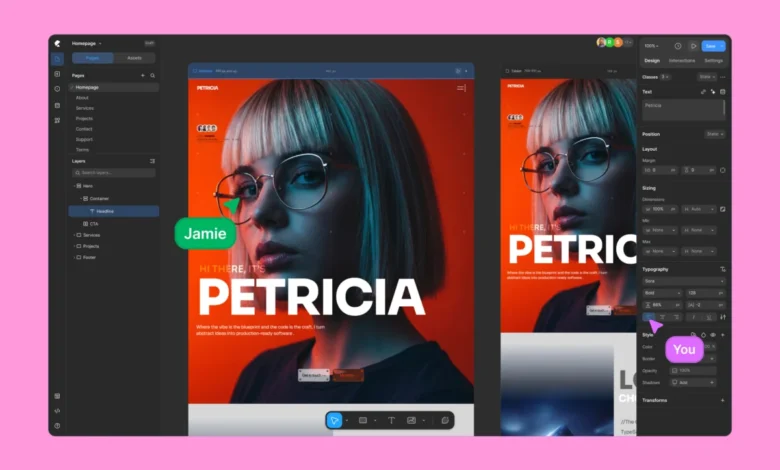
The most striking feature of Kirki is its transition from a linear, top-down editing interface to an infinite canvas. This mirrors the workflow of professional UI/UX design software, allowing creators to pan, zoom, and place elements with pixel-level precision. This freeform approach removes the "row and column" restriction that has defined WordPress layouts for years.

Key design capabilities within this new paradigm include:

- Layered Backgrounds and Overlaps: Designers can visually stack elements and create complex Z-index interactions without writing custom CSS.
- Concurrent Responsive Editing: Unlike traditional builders that require users to toggle between desktop, tablet, and mobile views, Kirki displays all breakpoints side-by-side on the infinite canvas. This allows for real-time adjustments across the entire responsive spectrum, ensuring that a change made on a desktop view does not inadvertently break the mobile experience.
- Figma Integration: Recognizing the industry-standard status of Figma, Kirki includes a seamless handoff system. Designs can be imported directly into the WordPress environment, where they are automatically converted into functional, responsive web elements, drastically reducing the time between the mockup phase and the final launch.
Native Integration and the End of "Plugin Fatigue"
A long-standing criticism of the WordPress ecosystem is the "dependency trap," where a simple website requires dozens of third-party plugins for basic functionality like forms, pop-ups, and custom post types. This reliance increases security vulnerabilities and creates "update hell," where a single plugin update can break the entire site.

Kirki addresses this through a centralized "Apps" system and native feature integration. The platform includes a built-in Dynamic Content Manager, which performs the functions traditionally handled by Advanced Custom Fields (ACF). This allows users to create custom fields, manage relationships between data types, and build dynamic templates for blogs or e-commerce stores directly within the builder. Furthermore, the inclusion of a native interaction builder enables the creation of scroll-based animations and complex hover effects without the need for external libraries like GSAP, further preserving the site’s performance integrity.

Collaborative Workflows and Quality Control
For agencies and large-scale enterprises, the lack of native collaboration tools in WordPress has historically been a bottleneck. Kirki introduces a multi-user co-editing experience similar to Google Docs or Figma. Multiple team members can work on the same canvas simultaneously, with color-coded cursors indicating real-time activity. This feature, combined with a built-in commenting system, allows for immediate feedback loops and streamlined project management.

To ensure the technical quality of the output, Kirki incorporates a Page Audit tool. This utility scans layouts before publication, identifying common errors such as broken links, missing image alt text, and accessibility violations. By integrating these checks into the design workflow, Kirki helps developers maintain high standards of SEO and ADA compliance from the outset, rather than treating them as afterthoughts.

Economic Impact and Market Positioning
The pricing structure of Kirki suggests a strategic move to capture both the freelance market and the agency sector. While a robust free version is available on WordPress.org, the Pro tiers are positioned competitively. At $59 per year for a single-site "Starter" plan and a $499 "Lifetime" option for unlimited sites, Kirki offers a value proposition that challenges the recurring cost models of many competitors.

Market analysts suggest that Kirki’s "all-in-one" subscription model—which includes the builder, pop-up creator, form manager, and template library—could significantly reduce the total cost of ownership for web projects. By eliminating the need for separate premium subscriptions for various add-ons, agencies can improve their profit margins while delivering faster, more reliable websites to their clients.

Broader Implications for the WordPress Ecosystem
The introduction of a freeform, high-performance builder like Kirki may force a response from established players in the WordPress space. As users become accustomed to the freedom of an infinite canvas and the speed of clean code, the demand for traditional grid-based builders may wane.

Furthermore, Kirki’s success could influence the future direction of the WordPress core project. As the "Site Editor" (FSE) continues to evolve, the innovations seen in Kirki—specifically regarding real-time collaboration and Figma-to-WordPress workflows—provide a blueprint for what a modern CMS should offer. For the broader industry, Kirki represents a maturation of the no-code movement, proving that "no-code" does not have to mean "low-quality" or "poor-performance."

Conclusion: The Future of Visual Building
Kirki arrives as a comprehensive solution for the modern web designer who refuses to choose between creative freedom and technical excellence. By reimagining the WordPress interface as an infinite, collaborative workspace, it removes the friction points that have hindered professional development for years.

As the digital landscape continues to prioritize user experience and loading speeds, tools that generate clean, semantic code while offering unlimited design flexibility will likely become the standard. For developers, designers, and business owners, Kirki is not merely a new plugin; it is a signal that the era of "building in boxes" is coming to an end, replaced by a more fluid, intuitive, and efficient future for the world’s most popular content management system. Through its combination of freeform design, high-velocity performance, and deep native integration, Kirki stands as a formidable contender for the title of the definitive WordPress builder for the next generation of the web.