Beyond the Frame: How Contemporary Designers Are Transforming Mirrors Into Sculptural Masterpieces

Mirrors have historically served as utilitarian household items, valued primarily for their flat, reflective surfaces and practical ability to check one’s appearance before leaving a room. However, a significant shift is underway within the contemporary design landscape. Today, leading studios and independent creators are redefining the medium, turning mirrors into immersive sculptural objects that alter how individuals perceive both themselves and their immediate architectural environments.
This evolution was a central topic of discussion at the inaugural Walker Design Triennial held last month. During the opening keynote, Eleni Petaloti—co-founder of the New York- and Athens-based design practice Objects of Common Interest—explored the philosophical dimensions of reflective surfaces. Petaloti noted that manipulating optics and reflections can raise fundamental questions about human memory, which she characterized as another form of internal reflection.
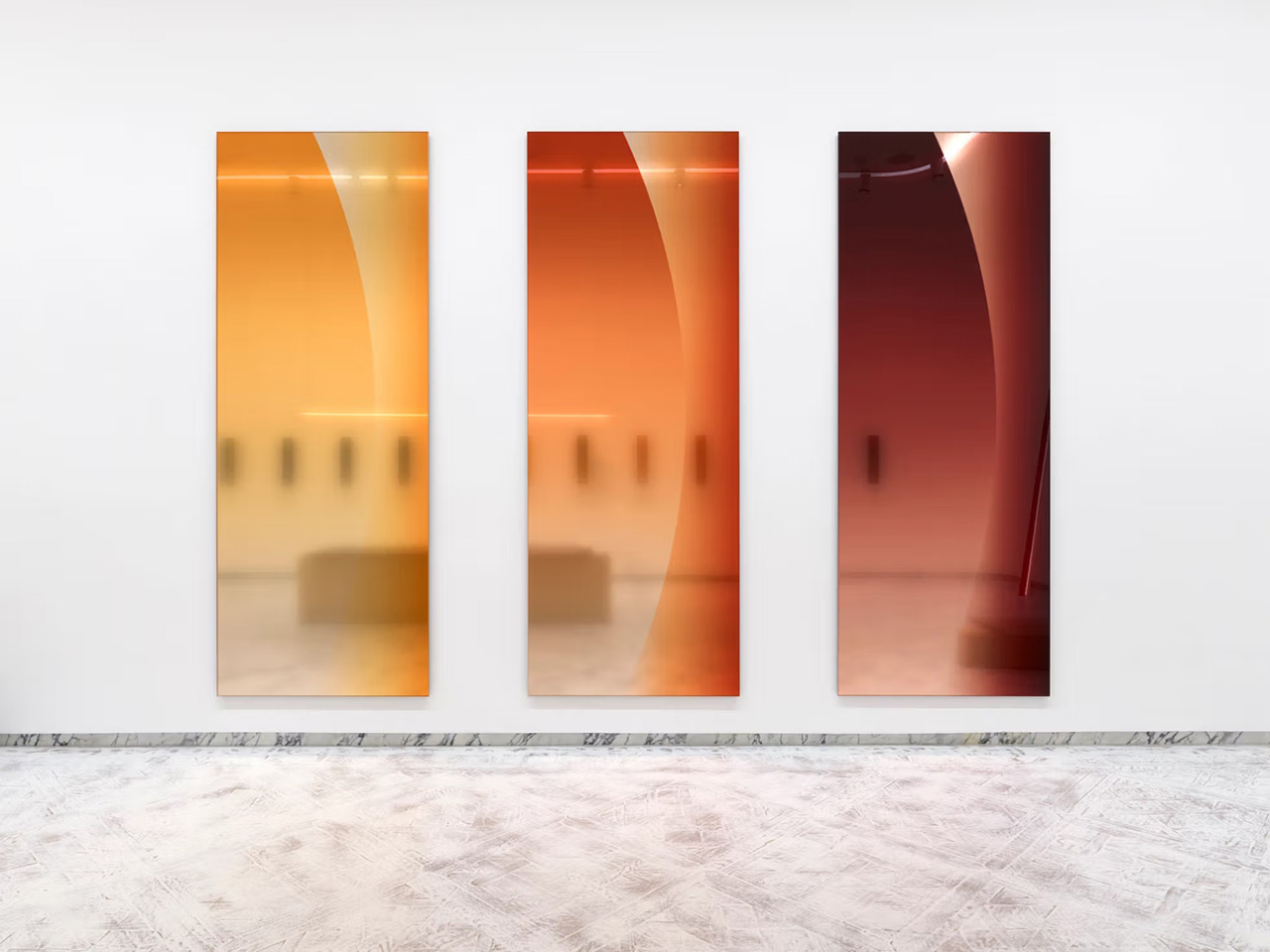
This conceptual approach underscores the mirror’s unique position in modern material culture. Unlike the digital screens that increasingly dominate daily life and mediate human experience through pixelated interfaces, a physical mirror engages directly with its tangible surroundings. It reacts in real-time to changing light patterns, spatial movement, and the physical presence of the viewer, establishing a dynamic dialogue between art and utility.
The Evolution of Reflective Design
The intersection of object, environment, and viewer forms the backbone of a new wave of interior products. Contemporary designers are bypassing conventional frames and standard flat glass, choosing instead to manipulate the reflective surface itself through color theory, advanced textures, and unconventional fabrication techniques.
The material palette driving this trend is remarkably diverse. Designers are utilizing tinted resins, cast bronze, glazed ceramics, and hand-worked metals to challenge preconceived notions of what a mirror can be. These innovations demonstrate that even the most familiar domestic objects can be elevated into compelling pieces of collectible design. Below is a comprehensive look at eight standout collections and pieces that are currently shaping the trajectory of modern interior aesthetics.

Roll & Hill and Bower Studios: The Fringe Collection
Collaborating with high-end manufacturer Roll & Hill, Brooklyn-based Bower Studios has pushed reflective glass firmly into sculptural territory with its new Fringe collection. Founded by Danny Giannella and Tammer Hijazi, the studio is recognized for exploring rich dimensional layering through precise geometric arrangements.
For the Fringe series, Bower Studios integrates warm timber frames that anchor multi-toned mirrored panels, interspersed with subtle graphic outlines. This careful composition creates an illusion of depth across flat planes by successfully interlacing clean silhouettes with tactile nuance.
The Fringe collection is currently available through Roll & Hill, with retail prices starting at $3,960. Industry analysts note that collaborations between specialized design studios and major production houses like Roll & Hill are becoming increasingly vital for bringing complex, craft-intensive pieces to a broader collector base.

MoMA Design Store and Ready To Hang: Jelly Ring Mirror
Bringing a playful yet sophisticated edge to functional decor, the Jelly Ring Mirror was produced for the MoMA Design Store by New York-based studio Ready To Hang. Founder Jeffrey Renz extends his studio’s garment-inspired design language by embedding smooth, hand-turned spherical elements around a rounded reflective plane.
The resulting silhouette mimics a tactile embrace or a compressed form, establishing a subtle visual dialogue between rigid glass and organic, plump curves. Fabricated in vibrantly colored glass, this wall ornament transforms a straightforward daily ritual into an unexpected visual encounter.
Retailing at $995 through the MoMA Design Store, the Jelly Ring Mirror exemplifies a growing market demand for accessible, museum-quality design objects that inject personality and humor into residential spaces.

Salon 94 Design and Sabine Marcelis: Phase / Phase Vertical Mirrors
Debuted during a solo exhibition at Salon 94 Design in Manhattan, the Phase collection by Dutch designer Sabine Marcelis offers a deep dive into light dynamics through circular and vertical forms. Utilizing her signature ombré-hued cast resin, Marcelis creates subtly tinted surfaces that filter incoming light alongside shifting reflections of the surrounding environment.
The visual composition of these pieces changes continuously throughout the day depending on natural light conditions, evoking quiet lunar cycles and fluctuating atmospheric moods. Rather than functioning as ordinary looking glasses, these luminous objects blend precise forms with fluid gradient tones.
Art market observers have noted that Marcelis’s exploration of cast resin continues to influence contemporary furniture and lighting design significantly. Collectors interested in acquiring pieces from the Phase collection must inquire directly through Salon 94 Design.

Mutina and Ronan Bouroullec: Carrousel Dynamic Mirrors
Renowned French designer Ronan Bouroullec collaborated with prominent Italian tile producer Mutina to create Carrousel, a series of limited-edition ceramic-framed mirrors available in various dimensions. Covered in high-gloss Gris or Orange glazes, these openwork ceramic borders interact dynamically with surrounding sunlight, casting colorful highlights across domestic interiors just as effectively as the mirrored glass they house.
Exhibiting his characteristic blend of playfulness and restraint, Bouroullec emphasizes clean, minimalist geometry. The collection demonstrates how traditional ceramic manufacturing techniques can yield sleek, modern accents while successfully retaining the subtle, imperfect imprint of the human hand.
Carrousel is distributed through Mutina’s platform, with pricing available upon request. The partnership highlights a broader industrial trend where ceramic manufacturers leverage the creative visions of top-tier designers to cross over into the collectible design market.

The Future Perfect and Studio RENS: Glass Ensemble
Eindhoven-based Studio RENS introduced Glass Ensemble at New York gallery The Future Perfect. This expansive series comprises mirrors crafted entirely from fused sheets of upcycled glass, reflecting a growing industry commitment to sustainable material sourcing and circular design principles.
The collection stems from an ongoing academic and artistic exploration of color theory by designers Renee Mennen and Stefanie van Keijsteren. By combining transparent material with colorful foils and meticulously polishing the resulting surfaces, the designers actively alter light transmission and reflection.
Each piece functions simultaneously as a three-dimensional geometric accent and a practical mirror, generating subtle tonal shifts designed to evoke an emotional response from the viewer. Glass Ensemble starts at $4,900 and is available through The Future Perfect and Studio Rens.

Cristina Grajales Gallery and Fernando Mastrangelo: The Divide
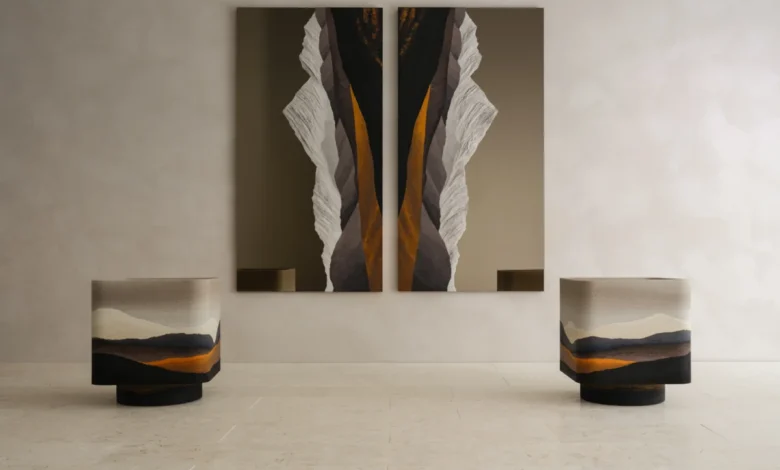
Presented at the Cristina Grajales Gallery in New York as part of Fernando Mastrangelo’s recently debuted Territories collection, The Divide mirror merges raw, earth-like textures with refined silvered glass. Mastrangelo casts crushed minerals, colored sand, and cement along the perimeter of the work, creating a striking visual contrast against the smooth, reflective central plane.
The subtly variegated gradients appear to erode visually, evoking the natural strata of vulnerable coastal landscapes and climate-affected topographies. Viewers find themselves reflected within this imagined yet plausible geological setting. By treating the frame as the primary expressive vehicle, Mastrangelo elevates a standard looking glass into a profound work of fine art. Inquiries regarding The Divide can be made directly via the designer’s studio or Cristina Grajales Gallery.
Otras Formas and Jennifer Choi: Seasons Mirror
Unveiled at New York design showroom Otras Formas, the Seasons Mirror by designer Jennifer Choi presents a harmonious study in architectural proportion and traditional craft. Measuring 33 inches square, the wall-mounted piece features a meticulously sculpted wooden frame that contours smoothly around its central glass panel.

Choi draws deep inspiration from natural seasonal cycles, successfully translating organic environmental shifts into fluid lines and warm tonal variations across carved timber surfaces. The Seasons Mirror is available through Otras Formas, with pricing supplied upon request. Gallery representatives emphasize that the piece appeals to collectors seeking warmth, tactility, and narrative depth in their interior furnishings.
Blu Dot: Mojo Mirror
Rounding out this survey of contemporary reflective design, Blu Dot introduced the Mojo mirror as part of its seasonal collection. The piece reimagines classic floor-standing mirrors by incorporating a generous, organic outline that breaks away from conventional rectangular geometries.
Standing 79 inches tall, the Mojo’s fluid asymmetrical contours mimic the natural, weathered form of a roughly hewn rock. This undulating shape successfully transforms what is ordinarily a practical dressing aid into a dramatic, room-defining architectural centerpiece.

Priced at $1,250 and available directly through Blu Dot, the Mojo demonstrates how accessible manufacturing processes can achieve impressive visual scale and artistic ambition, making avant-garde design forms attainable for a wider consumer demographic.
Broader Impact and Industry Implications
The rapid transformation of the mirror from a functional utility into a collectible art object reflects a broader psychological shift in contemporary interior design. As virtual environments and digital screens consume an ever-larger share of daily human attention, residential spaces are increasingly viewed as sanctuaries for tactile engagement, emotional grounding, and introspection.
Designers working with reflective media are tapping into this cultural desire for physical authenticity. By integrating sustainable materials, historical craft techniques—such as ceramics and hand-cast resin—and organic geometries, these studios are validating the home as a gallery for meaningful, thought-provoking objects. As evidenced by upcoming showcases like the Walker Design Triennial and major gallery exhibitions, the intersection of optics, art, and functionality will likely remain a fertile ground for creative experimentation for years to come.