From Bricklayer Aspirations to Architectural Design: Inside the Creative Evolution and New Collaborative Work of Bram Vanderbeke

The trajectory of contemporary design often bridges disparate disciplines, but few practitioners navigate the realms of structural engineering, fine art, and raw materiality quite like Belgian creator Bram Vanderbeke. Long before his works were exhibited in major international galleries or commissioned by luxury fashion houses, a young Vanderbeke envisioned a career far more grounded in physical labor: laying bricks. This early fascination with the foundational elements of construction ultimately steered his academic path toward woodwork and construction, before refining his spatial philosophy through formal design studies at the Royal Academy of Fine Arts in Ghent and the prestigious Design Academy Eindhoven. Today, operating out of his hometown in Belgium, Vanderbeke produces tactile, sculptural objects that persistently interrogate the relationship between an object, its architectural environment, and its end user. His portfolio blurs the boundaries of conventional categorization, operating simultaneously in the domains of high art, functional design, and monumental architecture.

The roots of Vanderbeke’s multidisciplinary aesthetic can be traced to both high-culture institutions and counter-cultural subenvironments. Among his most formative influences is Insel Hombroich, a renowned museum and sculpture park located in Neuss, Germany. The site’s seamless integration of architecture, fine art, and untouched nature left an indelible mark on the designer’s philosophy. By revisiting the sanctuary across different seasons, Vanderbeke observed firsthand how the shifting natural landscape actively transformed the human experience of space, teaching him that objects and buildings do not exist in isolation from their environmental context. Paradoxically, this refined spatial awareness coexists with the raw, uncompromising energy of hardcore punk. Growing up deeply embedded in this DIY subculture, which relies heavily on self-produced shows and tight-knit community networks, instilled in Vanderbeke a foundational work ethic. The intrinsic motivation to bypass institutional gatekeepers and simply make things happen continues to govern the pace and execution of his studio practice today.

This hands-on ethos has driven a prolific period of creative output and institutional collaboration for the designer. This fall, Vanderbeke’s footprint in the collectible design market expanded further with Cavea, a sprawling group exhibition featuring more than 70 works by upwards of 40 designers. The showcase was collaboratively organized by DesignUnDisciplined and the Brut Collective, a progressive Belgian collectible design group that Vanderbeke cofounded in 2018 to champion experimental, material-driven work outside mainstream commercial constraints. Beyond his curatorial and independent studio projects, Vanderbeke’s commercial profile has surged through high-profile institutional and luxury commissions. His recent contributions include bespoke spatial and product designs for the newly reopened museum shop at Design Museum Gent, alongside targeted creative commissions for global luxury houses such as Bottega Veneta, high-end interior designer Kelly Wearstler, fashion designer Pieter Mulier, and esteemed jeweler Lore Van Keer.

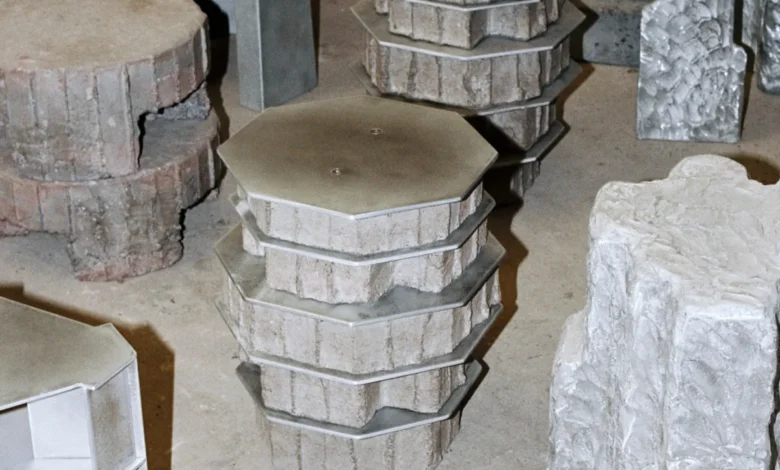
At the intersection of these diverse collaborations sits the newly unveiled LVK x BV collection, featuring a limited-edition silver necklace and the striking Anthology Side Table/Stool. Produced in exceptionally rare runs of 20 and eight pieces respectively, the collection represents a rare synthesis of jewelry craftsmanship and large-scale architectural furniture. The genesis of the Anthology Side Table/Stool began when Belgian jeweler Lore Van Keer invited Vanderbeke to reinterpret her core Anthology jewelry line through his distinct material lens. The resultant furniture piece—functioning seamlessly as both a robust side table and a structural stool—is handcrafted directly within Vanderbeke’s Belgian atelier. Utilizing a unique casting process for every single iteration, the piece relies on alternating, layered strata of raw cast concrete and tactile aluminum. Designed with versatile deployment in mind for both indoor and outdoor environments, each piece is fabricated strictly on a made-to-order basis.

The conceptual framework underpinning the LVK x BV collection draws from a diverse reservoir of art-historical references and architectural precedents, meticulously cataloged within Vanderbeke’s studio research. Central to the design is the geometry of Lore Van Keer’s Anthology 10 ring, whose stacked annular and hexagonal forms provided the rhythmic blueprint for the furniture’s three-dimensional silhouette. In translating the micro-scale geometry of precious metal jewelry into a macro-scale functional object, Vanderbeke looked to historical monographs for structural inspiration, most notably A Sculptor’s World by Isamu Noguchi. Within its pages, the magnificent architectural ceiling and cascading waterfall designed by Noguchi for the lobby of 666 Fifth Avenue in New York—prior to its controversial removal in 2020—provided a masterclass in linear, layered aluminum composition that Vanderbeke directly channeled into the metal components of the Anthology table.

Further contextualizing his structural approach, Vanderbeke frequently finds inspiration in archaeological excavations, ancient ruins, and the weathered, monumental textures of classical Roman columns. These ancient building blocks share a direct lineage with the designer’s ongoing Cast Bricks collection, an experimental body of work that similarly informs the Anthology side table. For his celebrated Brick Chair, Vanderbeke arranged standard industrial bricks into methodical yet intuitively derived configurations, intentionally leaving negative spaces between the masonry units. These voids served as bespoke casting molds for his architectural furniture pieces, establishing a direct methodological link to the foundational techniques employed by traditional construction workers. By turning construction materials into casting matrices, Vanderbeke successfully loops back to his childhood ambitions of bricklaying, transforming humble materials into objects of high collectible design value.

The broader implications of Vanderbeke’s work reflect a growing market demand for collectible design that prioritizes authentic materiality, narrative depth, and slow, artisanal production methods over mass-manufactured uniformity. As the boundaries separating contemporary art, interior architecture, and functional objects continue to dissolve, creators like Vanderbeke are redefining the commercial landscape for independent studios in Europe and beyond. Through collaborative cross-pollination—such as bridging the worlds of fine jewelry and heavy concrete fabrication—designers are discovering resilient economic and creative models. These cross-disciplinary ventures not only challenge the traditional silos of luxury goods and industrial manufacturing, but they also offer collectors a tangible connection to the labor, history, and structural integrity embedded within each handcrafted piece.