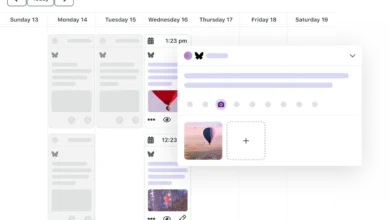
Meta Expands Test to Restrict External Link Posts for Non-Paying Facebook and Instagram Professional Accounts

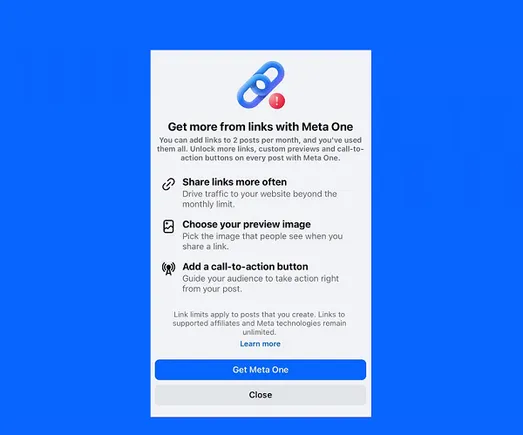
The digital marketing landscape is undergoing a notable shift as Meta accelerates the rollout of its paid tier architecture, bringing new monetization hurdles for professional account holders. Following the recent introduction of the Meta One for Business subscription packages, platform managers across Facebook and Instagram have reported a widening test that restricts organic outbound link sharing. Under this updated framework, non-paying business accounts are increasingly facing caps of just two link-containing posts per month, signaling a broader strategic push by the tech conglomerate to monetize outbound referral traffic.
This development marks a significant escalation from initial experiments conducted late last year, transforming what was once a localized trial into a core component of Meta’s burgeoning subscription ecosystem. As social media managers and enterprise brands grapple with these evolving restrictions, industry analysts are closely examining the implications for content distribution, organic reach, and digital marketing return on investment.
Background Context and Evolution of Meta One for Business
The integration of link-sharing caps into Meta’s operational model is deeply intertwined with the introduction of Meta One for Business. Designed to bundle various administrative, promotional, and analytical tools into tiered subscription packages, Meta One positions itself as an all-in-one suite for growing enterprises and professional creators. Among its advertised features is the ability to incorporate outbound links into Instagram posts and Reels, with allocation limits scaling proportionally with the subscription tier.
While initial documentation for Meta One primarily targeted Instagram workflows, recent administrative alerts circulating among Facebook Page managers indicate that the policy is actively expanding to the core Facebook platform. Pop-up notifications appearing across professional dashboards explicitly warn managers that their ability to publish content directing users away from Facebook is now subject to a monthly ceiling of two posts unless they upgrade to a paid Meta One tier.
This strategy did not materialize overnight. The groundwork was laid in December 2025, when Meta initiated a preliminary, highly targeted test limiting specific pages to two link posts per month. At the time, company representatives framed the trial as an exploratory measure designed to assess whether granting an increased volume of outbound links genuinely adds value for commercial users. Furthermore, Meta carved out specific exemptions for recognized publisher pages, ensuring that news organizations and traditional media outlets could continue flowing informational content into the app without disruption. However, with the formal debut of Meta One for Business, the scope of these restrictions appears to be widening well beyond the initial test parameters, ensnaring a broader cross-section of commercial entities and service-based brands.
A Chronological Overview of Meta’s Outbound Link Policy
Understanding the current state of Meta’s link restrictions requires examining the platform’s historical approach to outbound traffic over the past decade.
In 2016, Meta CEO Mark Zuckerberg articulated a clear three-stage monetization strategy for the company’s family of apps. This framework dictated that the platform would first build utility and amass a massive user base, subsequently foster vibrant communities and business ecosystems, and finally introduce targeted monetization mechanisms once reliance on the platform had solidified.
Over the ensuing years, Meta systematically adjusted its algorithmic priorities to favor native content over external links. The platform argued that keeping users engaged within the feed provided a superior user experience, resulting in a steady, deliberate suppression of organic reach for posts containing URLs that directed traffic to external websites.
By 2022, empirical data from Meta’s own transparency initiatives began quantifying this decline. The company’s Widely Viewed Content reports revealed that external links accounted for a modest yet significant portion of top-viewed content. However, this figure eroded rapidly year-over-year. By early 2026, internal reporting indicated that a mere 1.3% of total post views in the United States included a link to an external source, down dramatically from 9.8% just four years prior.
This continuous algorithmic demotion sets the stage for the current policy shift. Having systematically reduced the organic value and visibility of link posts over several years, Meta is now introducing subscription packages that restore or guarantee access to a feature that was once an unrestricted standard of social media marketing.
Platform Data and the Realities of Outbound Link Exposure

To fully evaluate the impact of Meta’s new link restrictions, digital marketers must reconcile the policy change with the hard data published by the platform itself. Meta’s Q1 2026 Widely Viewed Content report provides striking empirical evidence regarding how users consume information across the platform.
According to the transparency data, an overwhelming 98.7% of post views in the United States during the monitored period did not include an outbound link to an external source. This statistic underscores a fundamental behavioral reality: the vast majority of Facebook and Instagram users do not visit these platforms to click through to external websites, e-commerce stores, or journalistic outlets. Instead, they consume native video, imagery, and text-based discussions that exist entirely within the digital walls of Meta’s ecosystem.
This structural decline in external link consumption carries profound implications for the anxiety surrounding the new two-post limit. While many brand managers view the restriction of link posts as a catastrophic blow to their top-of-funnel traffic generation strategies, objective performance data suggests that organic link posts were already delivering diminishing returns for the vast majority of accounts. For small and medium-sized enterprises that relied on sporadic, organic URL sharing to drive conversions, the actual volume of traffic generated via these posts was likely marginal. Consequently, the transition to a capped model may compel marketers to re-evaluate whether the subscription cost is justified by the negligible historical performance of organic link sharing.
Industry Reactions and Strategic Implications for Brands
The quiet expansion of the link-capping test has generated mixed reactions across the digital marketing community. While enterprise-level brands with dedicated advertising budgets may readily absorb Meta One subscription fees as an operational expense, smaller businesses and independent creators have expressed frustration over what they perceive as a coercive monetization tactic.
Critics argue that charging businesses for the basic capability to reference external web destinations represents a classic "bait-and-switch" maneuver. For over a decade, social media platforms actively courted businesses by championing their platforms as essential conduits for driving web traffic, community engagement, and lead generation. Now, as organic reach approaches near-zero baselines for unboosted content, commercial users face a choice between accepting severe functional limitations or paying recurring subscription fees to maintain standard marketing workflows.
Conversely, digital strategy consultants point out that professional accounts should view this development as a long-overdue catalyst for modernizing their distribution strategies. For years, relying on organic social media posts to drive meaningful web traffic has been an inefficient tactic compared to targeted paid advertising, search engine optimization (SEO), email marketing, and SMS outreach.
If non-paying accounts are restricted to two link posts per month, marketing teams will be forced to exercise greater selectivity, reserving their allocated link slots for high-impact announcements, major product launches, or critical conversion campaigns. Furthermore, brands may lean more heavily into Meta’s paid advertising infrastructure—such as sponsored link ads and Lead Generation campaigns—which remain governed by traditional ad-spend auctions rather than the newly implemented Meta One subscription tiers.
Future Outlook for Professional Accounts on Meta
As Meta continues to roll out Meta One for Business across international markets and diverse account categories, the digital marketing industry is bracing for further structural changes. The distinction between organic utility and paid features is becoming increasingly rigid across all major social media networks, mirroring similar subscription-based verification and utility models introduced by competing platforms like X (formerly Twitter) and LinkedIn.
For organizations navigating this transition, the immediate path forward requires a rigorous audit of past social media performance. Marketing managers must analyze whether historical link posts genuinely drove attributable revenue or if they served merely as a habitual posting routine with minimal return. By aligning content distribution strategies with platform-specific realities—such as prioritizing native engagement, community building, and direct advertising investments—businesses can adapt to Meta’s evolving monetization framework without compromising their overarching commercial objectives.