GrowFrame Offers an Inspirational Way to Visualize Passion Projects

The Genesis of a Specialized Workflow Tool
The origin of GrowFrame is rooted in the personal experience of its developer. Miquel Campos, a veteran of the animation and rigging industry, spent several years working on a personal animated short film. Throughout this arduous process, Campos encountered a common hurdle for independent filmmakers: the difficulty of maintaining motivation during the long, invisible middle stages of a production.
Most existing project management software is built for high-velocity studio environments where multiple departments must sync their output. These platforms often require complex configurations, administrative oversight, and recurring subscription costs that are prohibitive or simply excessive for a single user. Campos found that while he needed a way to log his progress, he lacked a tool that treated his work as a chronological diary rather than a series of billable tickets.
By early 2024, Campos began coding a prototype to track his own milestones. As the application matured, he realized that the same friction he experienced—the disconnect between the time invested and the visible, shareable results—was a shared pain point among animators, sculptors, and digital artists. The software transitioned from a private utility to a public-facing product, designed to provide a cohesive view of an artist’s long-term creative trajectory.
Operational Mechanics and Features
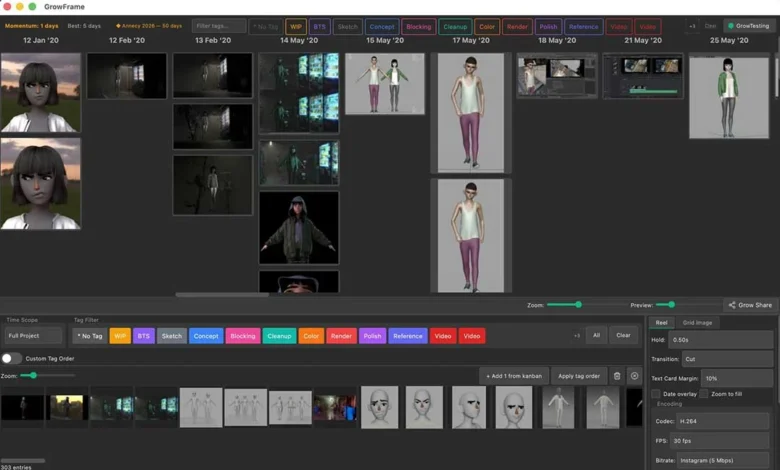
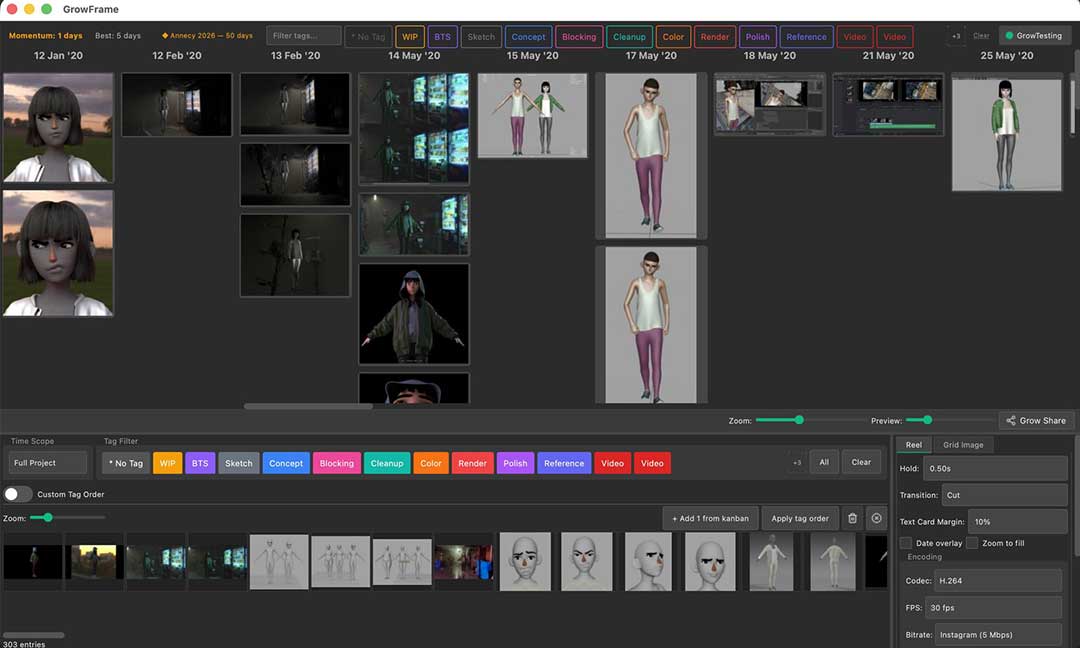
At its core, GrowFrame utilizes a Kanban-inspired interface, though it diverges significantly from the productivity-obsessed frameworks typically associated with that methodology. Instead of focusing on task completion or deadline management, GrowFrame encourages users to input daily visual artifacts. These can be frame renders, animation playblasts, photographs of physical sculptures, or preliminary sketches.
Once imported, these files are indexed into a scrollable, visual timeline. This functionality addresses the psychological "plateau" that many creators experience, where the daily grind can make it difficult to perceive the distance traveled since a project’s inception. By allowing a user to scroll back through months or years of work in a single interface, GrowFrame transforms raw output into a visual history.
A significant feature of the application is its automated "reeling" capability. In the modern creative economy, social media presence is often a prerequisite for professional growth, yet the labor required to edit progress reels can detract from the actual production time. GrowFrame simplifies this by allowing users to select a range of their timeline and automatically format it into various aspect ratios suitable for different social platforms. This enables artists to showcase their process and maintain a professional presence without sacrificing hours of labor to administrative or marketing tasks.
Philosophical Stance in the Age of Generative AI
The release of GrowFrame occurs during a period of significant technological disruption in the arts. The rapid rise of generative AI, capable of producing high-fidelity imagery and video in seconds, has shifted the conversation regarding the value of human-made work. Campos has been vocal about his design philosophy, which positions GrowFrame as a direct response to the ephemeral nature of current digital trends.
In a statement regarding the software’s intent, Campos noted, "I’m not against AI as a technology, but GrowFrame is for the slow, hand-made work that takes humans months and years—work I think is more valuable, not less, in a moment when feeds are flooded with images made in seconds."
This stance is reflected in the software’s technical architecture. GrowFrame is built as a local-first application. In an era where "Software as a Service" (SaaS) is the industry standard, necessitating constant internet connectivity and recurring monthly subscriptions, GrowFrame represents a return to traditional software models. It does not rely on cloud storage, nor does it require monthly fees or extensive telemetry tracking. Users purchase a permanent license, ensuring that their creative data remains on their local hardware, independent of the developer’s servers or future subscription changes.
Educational Applications and Institutional Adoption
While designed with the independent filmmaker in mind, GrowFrame has seen unexpected traction in academic environments. The educational arc of an animation or fine arts student mirrors the long-term nature of professional passion projects. Students are often tasked with multi-semester capstone projects where the final submission is a culmination of years of iterative study.
Several institutions began utilizing GrowFrame during its beta testing phase, finding that it provides students with a valuable portfolio tool. By documenting the evolution of their work from initial concept to final execution, students can demonstrate not only the final result but also their growth, technical problem-solving skills, and consistency over time—key metrics for educators and future employers alike. The developer has recognized this utility by offering educational discounts, aiming to integrate the tool into the standard workflows of design and animation departments.
Industry Implications and Future Outlook
The introduction of GrowFrame highlights a broader trend toward "boutique" software. As large-scale production tools continue to become more complex and expensive, a subset of the creative community is seeking tools that are focused, lightweight, and respectful of user autonomy.
From an industry analysis perspective, GrowFrame’s success will likely depend on its ability to integrate with the varied pipelines of independent creators. Because it focuses on the output of the work rather than the proprietary files of specific DCC (Digital Content Creation) software like Maya, Blender, or ZBrush, it avoids the compatibility issues that often plague more complex tracking tools. Its simplicity is its primary asset; it does not demand that the user alter their creative process to fit the software’s logic, but rather adapts to the artist’s existing workflow.
The development of the app by a single individual—Miquel Campos—operating out of a small studio in Tokyo, also underscores the decentralization of software development in the creative sector. By leveraging his background in the mGear framework, Campos has brought a high degree of technical credibility to a niche application, ensuring that the software remains stable and useful for professionals who cannot afford the downtime associated with experimental, unpolished tools.
Conclusion
As the creative industry continues to balance the rapid acceleration of AI-assisted workflows with the traditional value placed on human-led craft, tools like GrowFrame provide a necessary infrastructure for those committed to the latter. By turning the act of documentation into a source of motivation and simplifying the burden of content distribution, the application addresses the specific, often overlooked needs of the solo creator.
For artists who view their projects as a long-term investment in skill and expression, GrowFrame serves as a digital archive that honors the time, patience, and iterative labor inherent in the creative process. Available now through its official portal, the software remains a testament to the idea that in a world of instant generation, the documentation of the slow, human journey is becoming an increasingly important form of creative currency.
Related posts: