Filming the Apocalypse: How Fallout Season 2 Pushed VFX Boundaries with Innovative Virtual Production on Film


Season 2 of Prime Video’s critically acclaimed series Fallout dramatically expands the scope of its post-apocalyptic world, introducing new creatures, vast environments, and a faithful recreation of the iconic New Vegas. At the heart of this ambitious visual endeavor is a pioneering approach to virtual production, notably the decision to shoot volume stage sequences on film. This unique methodology, combined with extensive digital artistry, has positioned Fallout Season 2 as a benchmark in modern television visual effects, demanding unprecedented collaboration and technical ingenuity from its production team.
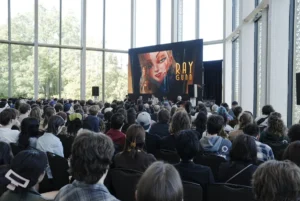
Jay Worth, the Visual Effects Supervisor for Fallout, whose distinguished credits include groundbreaking series like Westworld and Altered Carbon, spearheaded the complex VFX pipeline for the latest season. Worth emphasized that while the expansion of the wasteland setting and the introduction of new, formidable creatures presented their own challenges, the integration of traditional film capture with cutting-edge virtual production technology was a particularly demanding, yet ultimately rewarding, aspect of the production. This hybrid approach aimed to imbue the digital elements with an organic, tactile quality often sought after in high-end cinematic productions.
The Analog-Digital Frontier: Shooting on Film in Virtual Production
The decision to shoot virtual production sequences on film represents a significant departure from standard industry practices, where digital cameras are almost exclusively used for volume stage work due to their immediate feedback capabilities. Worth explained the inherent difficulties of this choice: “If you are shooting on digital in a volume stage, you can go into your DIT tent, take a look at it and say, ‘Let’s up the luminance, bring up the saturation, fix the color balance, try brightening the wall and bringing down the key light. Alright, let’s shoot it again.’” This instant gratification is non-existent when shooting on film.
For Fallout Season 2, the process involved rigorous and iterative testing. “For us, we have to shoot five different bracketed versions of luminance, color saturation, key light and fill light, develop the film, take a look at it, go back in, make more adjustments, learn what we learned, guess to make sure it’s going to make the effect we want, refilm it and relook at it,” Worth detailed. This blind trust in the technical team and the cinematic process required an extraordinary level of expertise and patience. Cinematographer Bruce McCleery, known for his work on Blue Beetle, played a pivotal role in navigating these complex balances, mastering the interplay between film technology and the virtual environments. Worth lauded McCleery’s “amazing job doing those balances and understanding the technology and how film works with the technology,” underscoring the vital synergy required.
Despite the arduous testing phase, the final aesthetic payoff justified the effort. Worth noted that shooting a digital asset through film inherently “softens it in a way that makes it a lot more believable.” He articulated the transformative effect: “You look at the asset on the wall, and you’re like, ‘I don’t know about that.’ Then you look at the film, and you’re like, ‘It looks great.’” This softening effect provides a naturalistic integration that digital capture alone often struggles to achieve, adding an authentic, lived-in texture to the post-apocalyptic world.
Expanding the Wasteland: Crafting New Vegas and Beyond
The narrative of Fallout Season 2 takes viewers to more expansive and iconic locations from the game franchise, most notably the glittering ruins of New Vegas. Virtual production was instrumental in realizing many of these ambitious environments. For instance, the abandoned vault from Season 1 was revisited and reimagined, with the team introducing a dramatic visual element: “What if we pop a hole in the ceiling and have sunlight blasting through?” Worth remarked. This seemingly simple addition leveraged virtual production to create dynamic lighting and atmospheric effects that would be challenging to achieve practically.
The New Vegas penthouse sequences and the majestic Caswennan airship also heavily relied on virtual production. The LED volume stages allowed for the seamless integration of digital backgrounds with live-action foregrounds. Worth highlighted the intricate details achieved: “All of the waving flags and the drifting desert was done on the volume.” This extended to complex aerial sequences, such as the Brotherhood’s Caswennan airship drifting in, Max’s return in Episode 202, and solo flying work for Max and Xander.
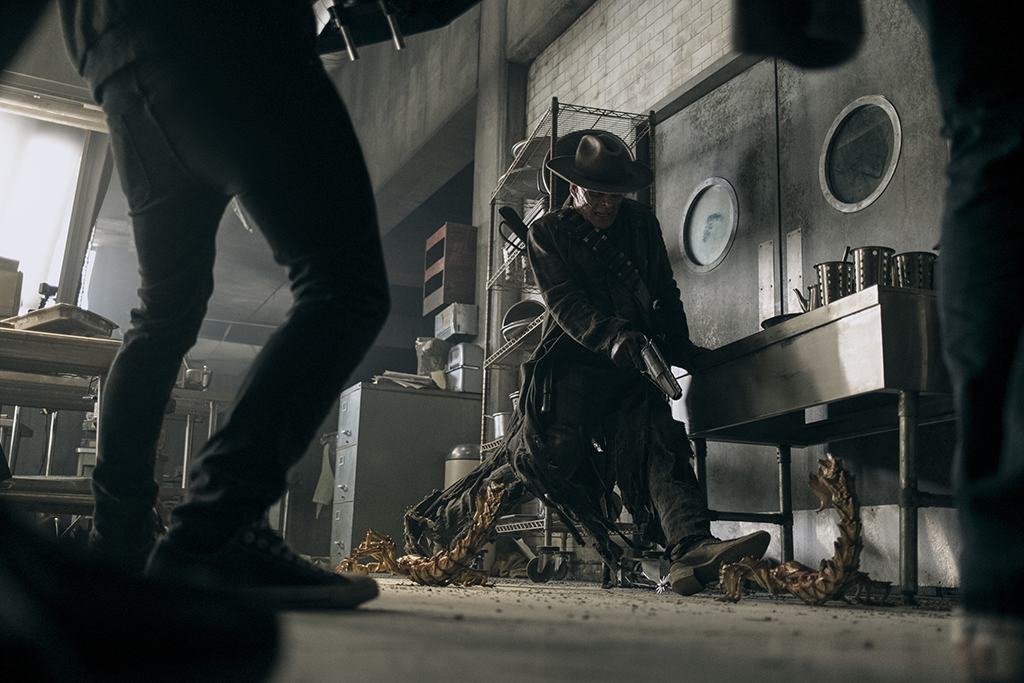
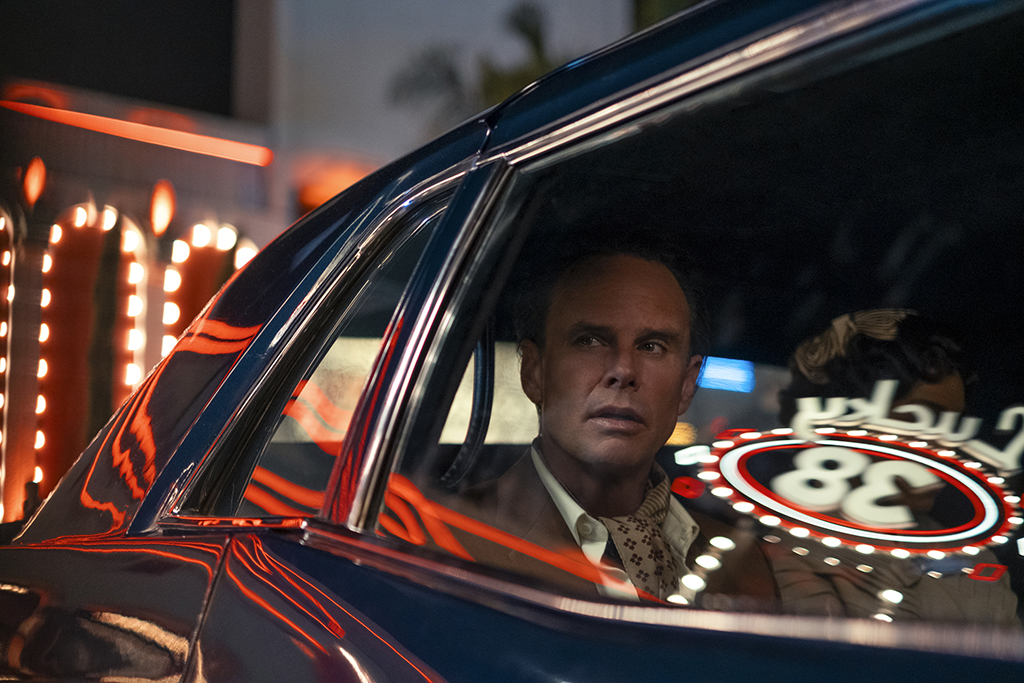
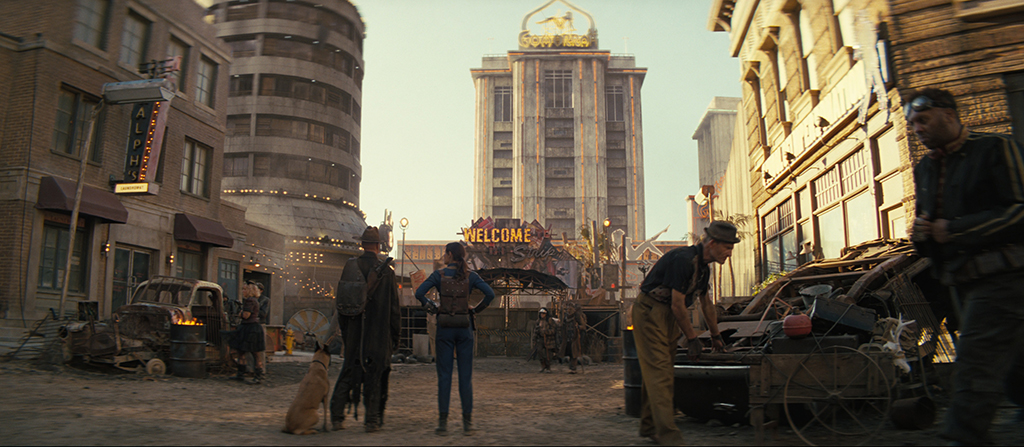
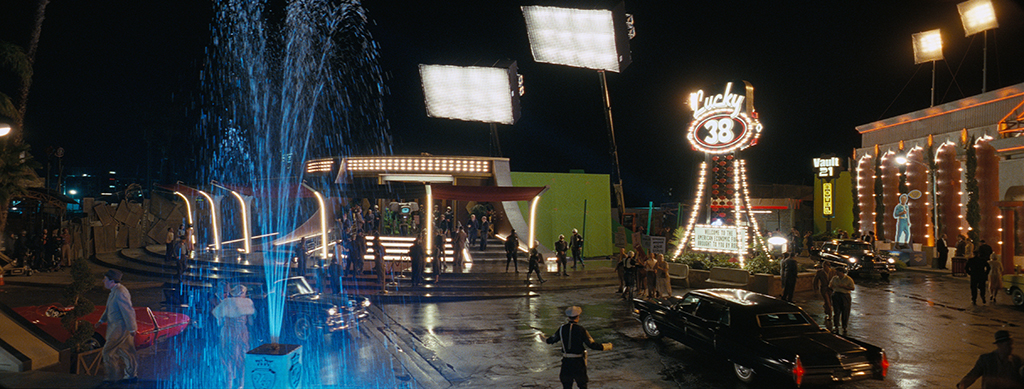
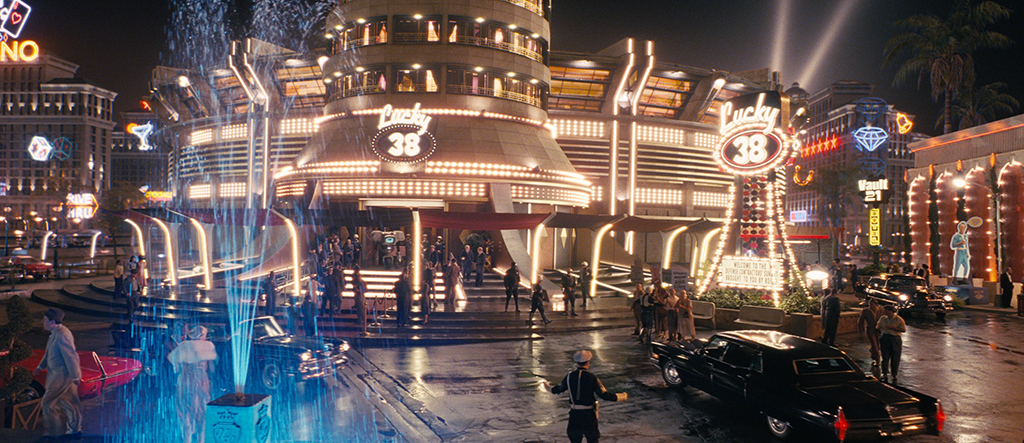
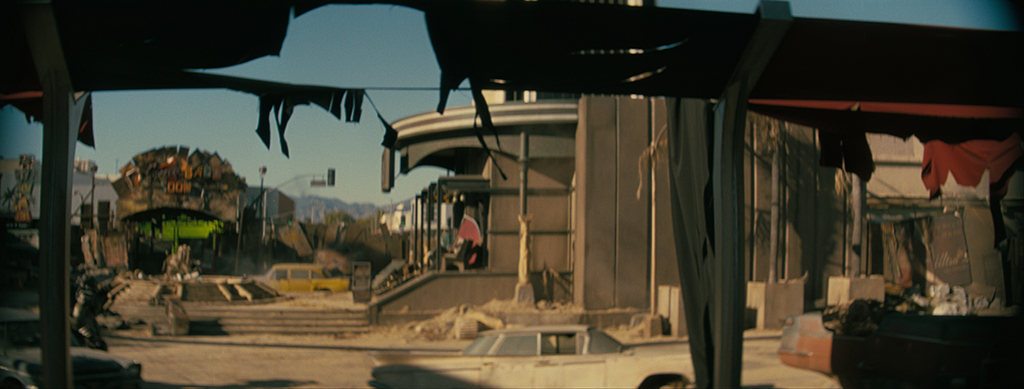
The creation of New Vegas itself presented a significant logistical and creative challenge. Adapting the sprawling game environment to a tangible filming set required a multi-pronged approach. Production Designer Howard Cummings and Location Manager Mandi Dillin located an abandoned mall in North Hollywood, which became the foundation for several key areas. “We built the Southern Gate on one part of it. We also constructed the façade of Tops and Gomorrah and a part of the base of The Lucky 38,” Worth explained. For the Freeside district, the production ingeniously utilized Melody Ranch, a familiar filming location for Worth from his Westworld days. “We were able to rebuild all Freeside on Melody Ranch,” he said. Raynault VFX was tasked with the crucial digital set extensions, building out the comprehensive asset for the grand reveal when Lucy and the Ghoul first enter New Vegas. The team also grappled with fluctuating natural lighting conditions, often requiring extensive digital sky replacements to maintain continuity and the desired atmospheric tone.
Beyond New Vegas, other environments pushed the boundaries of blended practical and digital filmmaking. The New California Republic encampment primarily needed cleanup work, but Caesar’s Legion proved more demanding. Despite physically constructing a large portion of the tents, the scale required digital augmentation. “We had to populate most of those with digital doubles and full set extensions for tents to create that massive set,” Worth revealed. Weather issues, including strong winds that knocked down practical elements, further complicated filming, necessitating pickups and careful digital integration.
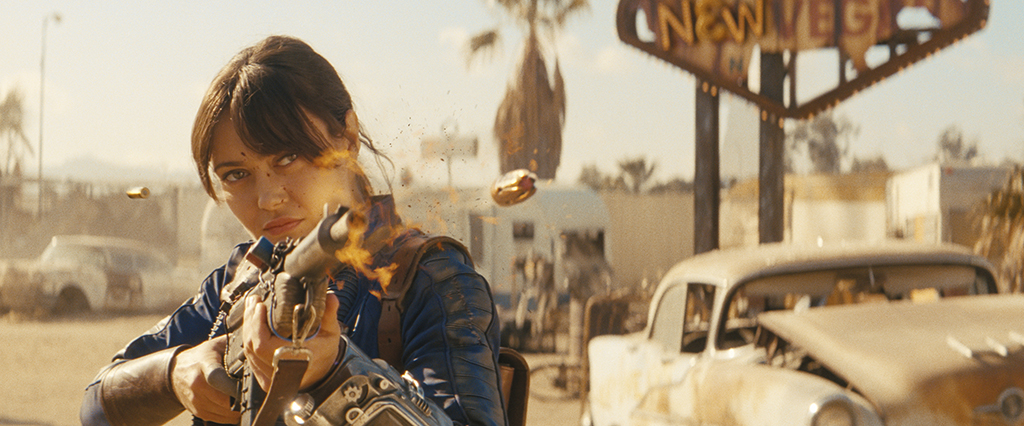
Season 2 also delves into the mysteries of Area 51. The reveal sequence in Dumont Dunes showcased the structure within the vast desert landscape, with digital elements enhancing the scale. The interior of the hangar was filmed at Ontario Airport, leveraging existing dirt mounds outside to blend practical and digital seamlessly. Barracks scenes were shot in an abandoned prison, requiring the addition of dirigibles and sand dunes to complete the alien desert environment.
Bringing the Monsters to Life: Creature Design and Execution
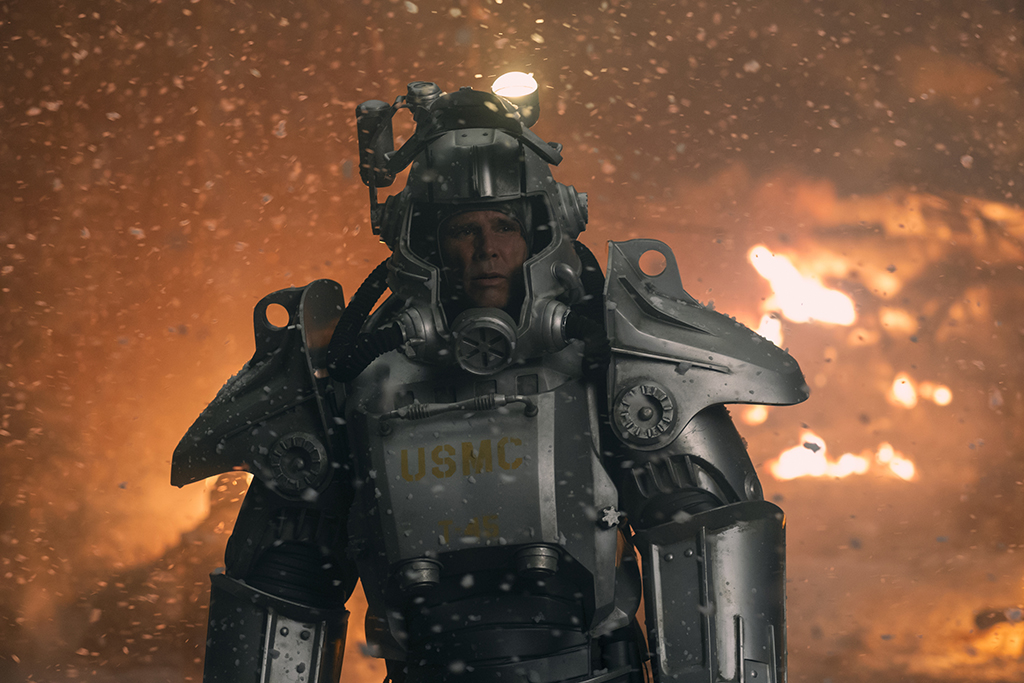
The Fallout universe is defined by its grotesque yet iconic creatures, and Season 2 introduces several fan favorites, demanding a delicate balance between practical effects and seamless digital integration.
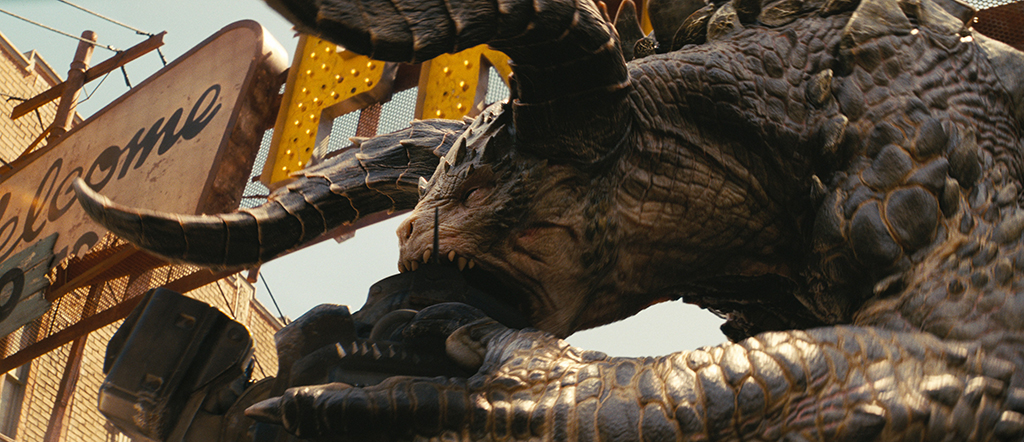
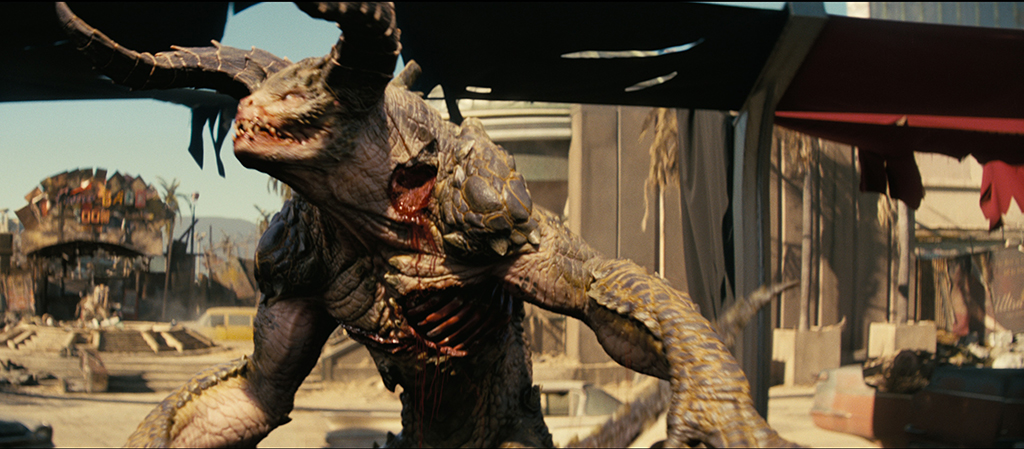
The introduction of the Deathclaw was a major highlight, conceived with the challenging premise: “What if we try to do outside at night in a snowstorm with fire as our primary lighting element when we introduce the Deathclaw for the first time?” Worth recalled. This entire sequence was realized on the volume stage, epitomizing the production’s commitment to intricate, complex visuals. While the team eschewed traditional previs, they relied heavily on stuntvis and storyboards to choreograph the creature’s movements and battles, meticulously matching frame-for-frame beats from the video game.
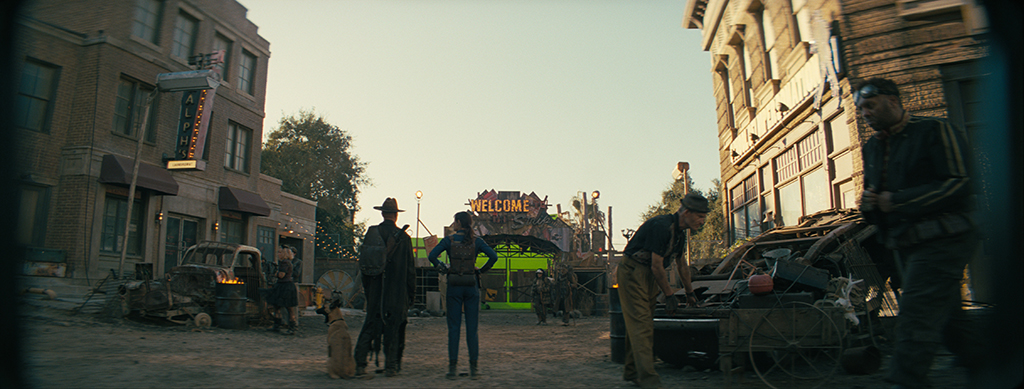
For the Deathclaw, a hybrid approach was employed. Legacy Effects built an incredible practical puppet, particularly for close-up shots of its head and shoulders. “We ended up adding the shoulders and claws, but those were great shots [to begin with]. Where it’s breathing, the nostrils and eye blinks, we did some tweaks for timing and continuity,” Worth explained. This practical grounding provided a tangible reference for actors and cameras, fostering an “organic and tactile” feel. For the full-scale battles in Episodes 207 and 208, ILM took over, building the rest of the creature in CG. This blend ensured that while the creature felt real and impactful in close quarters, its full destructive power could be unleashed in complex digital sequences.
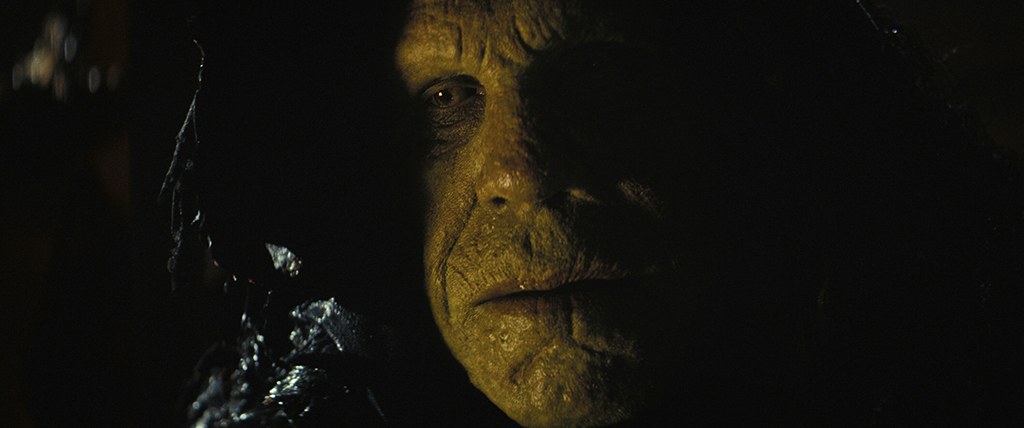
The Super Mutant presented a unique challenge, involving the legendary Ron Perlman, a long-standing voice actor in the Fallout game series. Initially, facial capture was attempted for Perlman, but ultimately, ILP (Important Looking Pirates) executed a full CG replacement for the Super Mutant’s reveal. Worth explained, “We built our Super Mutant more based on the game than on Ron per se, but it has flavors of both, which is fun. It’s a combination of Ron and Marcus from the game.” Prosthetic Makeup Designer Carey Jones, a towering six-foot-eight individual, served as the stunt performer, providing the physical presence and movements for the character, which was then digitally enhanced with Perlman’s performance animated onto the CG head.
Radscorpions, the mutated arachnids, were brought to life through a blend of large-scale practical puppetry and clever digital work. Quantum VFX crafted a huge Radscorpion puppet mounted on a push dolly, creating hilarious on-set moments with actor Walton Goggins. “Half of the takes are Walton with nothing. The other half of the takes have this weird half-head on him,” Worth recounted. For the smaller, baby Radscorpions, the team often used puppets on sticks and wires. ILP in Sweden minimally intervened, often just performing stick removal, allowing the practical movements to shine. Worth fondly recalled a late-night shoot where a baby Radscorpion puppet was flung with monofilament onto Goggins’ face, resulting in a perfectly executed, largely practical shot that required only wire removal.
The infamous Radroaches returned, terrorizing Vault Dwellers with their relentless swarm. Special effects makeup handled the gruesome neck injuries, while puppets were used to create motivated physical interactions. Refuge VFX then took the lead in animating the digital swarms. Worth humorously described the creatures as “dumb bumblebees,” leading to creative choreography where they would crash into obstacles and self-destruct. This allowed for a dynamic and chaotic depiction of the threat, leaving plenty of blood and gore in their wake.
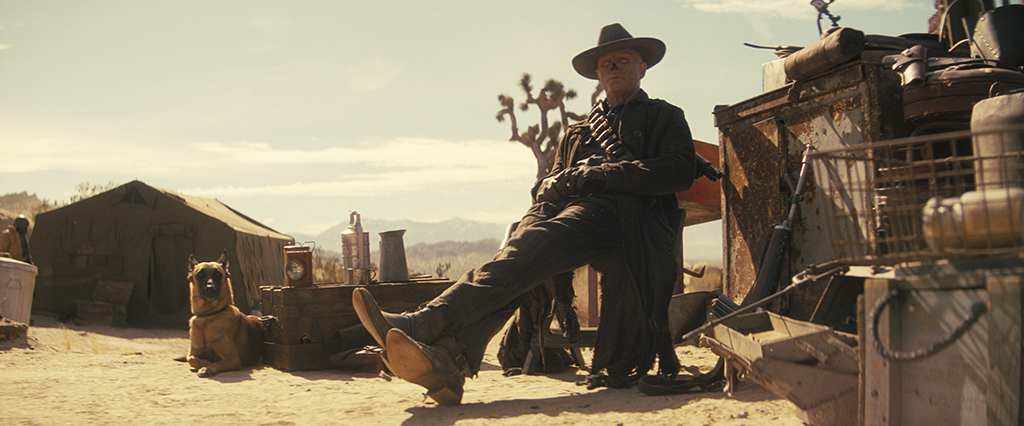
Finally, the Ghoul, portrayed by Walton Goggins, required extensive work on his signature hollow nose. For Season 2, the number of such shots dramatically increased to 800, indicating a heightened focus on the character’s post-transformation appearance and likely more screen time dedicated to his unique physicality.
Signature Spectacles: Explosions and Iconic Moments
Beyond creatures and environments, Fallout Season 2 introduced several signature visual effects that became recurring motifs. A standout was the “mini-nuke” car explosion. This idea originated from creators and executive producers Graham Wagner and Geneva Robertson-Dworet, who wanted car explosions to reflect the game’s unique, over-the-top destructiveness. Refuge VFX brought this concept to life, creating “this incredible mini-nuke explosion for our car, and it ended up being a signature thing we did a couple times throughout the season.”
Another powerful visual, developed by RISE from Season 1, was the nuclear explosion reflected in an eye. This effect was reprised for a poignant moment in Season 2, particularly when Hank tragically drops the nuke on Shady Sands in Episode 202, underscoring the devastating consequences of the wasteland’s history.
The production also managed to infuse a touch of meta-narrative realism by finding the actual Dino Dee-lite Motel that inspired its in-game counterpart. Worth expressed his excitement: “Howard Cummings, our amazing Production Designer, and Mandi Dillin, our Location Manager, found the actual motel that set was based on for the game, and that’s where we got to shoot that sequence. It was really cool!”
Behind the Scenes: Production Workflow and Collaborative Challenges
Across eight episodes, Fallout Season 2 delivered just over 3,202 visual effects shots, a monumental undertaking involving a consortium of leading VFX studios: ILM, RISE, Important Looking Pirates (ILP), Raynault VFX, CoSA FX, FutureWorks, Haymaker VFX, Curated, Quantum VFX, and Refuge VFX. All these shots were meticulously crafted and integrated into footage captured on film with anamorphic lenses, maintaining a consistent cinematic aesthetic.
The production schedule for Season 2 was notably tighter than for its predecessor. However, Worth observed that this constraint paradoxically aided the team: “The schedule was more challenging this year. We had less time than in the past, but it helped us hone in on more specifics of what we were going to be doing.” He contrasted this with Season 1, which was a “blank slate” requiring the foundational development of core assets like Snip Snip, environment work, Vertibird battles, and Cyclops. Season 2 benefited from established visual language: “We know what the Deathclaw, Radscorpion and New Vegas look like.” While this provided a clearer roadmap, the sheer volume and complexity of new creatures, virtual production elements, and diverse environments still presented significant technological hurdles.
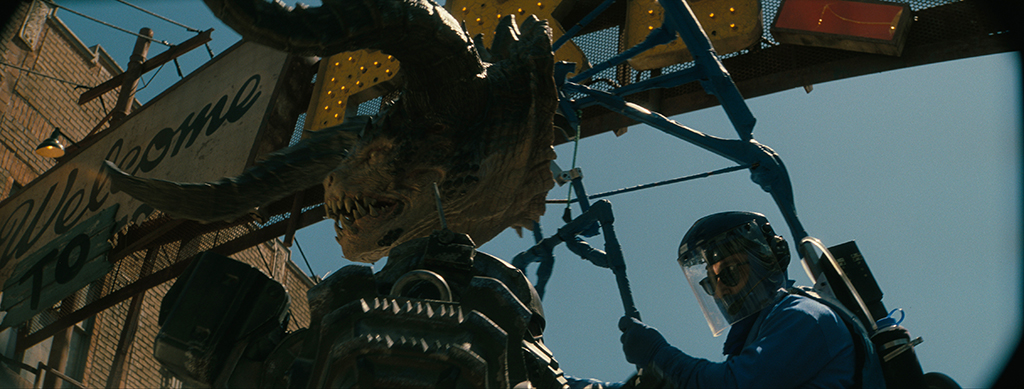
The success of Fallout Season 2’s visual effects is a testament to the seamless collaboration among all departments – from Worth’s VFX team to McCleery’s cinematography, Cummings’ production design, and the creative vision of showrunners Wagner and Robertson-Dworet. The blending of practical effects with digital wizardry, often used interchangeably within the same scene, created a cohesive and believable post-apocalyptic world that feels both expansive and intimately real.
Implications for the Industry: A New Benchmark for Adaptation
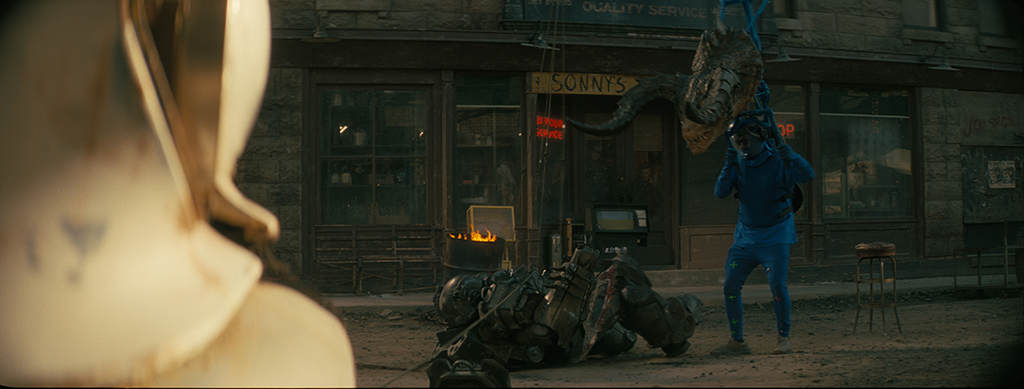
Fallout Season 2 not only delivers a compelling narrative faithful to its source material but also sets a new precedent in visual effects, particularly in its daring integration of film photography with virtual production. This pioneering approach offers a compelling case study for future high-end television and film productions seeking to achieve a distinct cinematic look in digitally enhanced environments. The challenges overcome, from the iterative testing of film on LED volumes to the intricate blending of practical and CG creatures, highlight the evolving capabilities of VFX artistry.
The critical and commercial success of Fallout Season 2, bolstered by its immersive visuals, further solidifies the viability of complex video game adaptations when executed with creative integrity and technical excellence. The commitment to crafting a “tactile” and “organic” feel for its digital elements through hybrid methods underscores a growing trend in the industry to move beyond purely digital solutions, seeking a richer, more grounded aesthetic. As the demand for visually spectacular storytelling continues to rise, Fallout Season 2 stands as a testament to the power of innovation, collaboration, and a willingness to embrace technical challenges in pursuit of artistic vision.
Related posts: