Behind the Mirror: How Sony’s Optical Engineering Masterclass Created Two Distinct Super-Telephotos From a Single Blueprint


The introduction of Sony’s latest additions to its prestigious G Master lineup—the FE 400mm f/4.5 GM OSS and the FE 600mm f/6.3 GM OSS—initially appeared to follow the conventional trajectory of high-end telephoto lens development. Designed to cater to wildlife, sports, and aviation photographers who demand exceptional reach coupled with portability, these lenses seemed on the surface to be distinct products tailored to different focal length preferences. However, a deeper examination of their internal architectures and physical specifications reveals a remarkably efficient feat of optical engineering. Sony has successfully utilized a shared foundational optical formula to deliver two high-performance super-telephoto lenses, challenging traditional assumptions regarding the resource investment required to manufacture specialized camera gear.
Main Facts and Physical Specifications
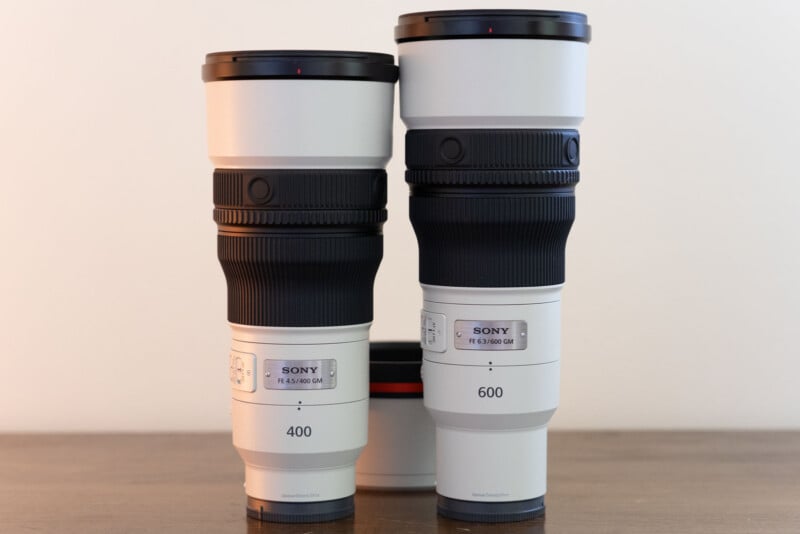
When evaluated side by side, the similarities between the Sony FE 400mm f/4.5 GM OSS and the FE 600mm f/6.3 GM OSS extend far beyond their sleek, white exterior finishes. Most notably, the total weight of the two lenses differs by a mere gram—an equivalent to the weight of a standard paper clip, a single sheet of currency paper, or a negligible pinch of salt. In terms of physical dimensions, the 600mm f/6.3 variant is longer by less than an inch, maintaining a compact profile that defies the traditional bulk historically associated with ultra-telephoto prime lenses.
Beyond their external dimensions and weight distribution, both lenses share identical autofocus drive systems, matching minimum focusing distances, and unified configurations of on-barrel control switches. Furthermore, both models feature robust weather-sealing protocols designed to withstand adverse field conditions. Independent optical evaluations confirm that both lenses deliver exceptional sharpness across the frame, effectively matching one another in overall image rendering capabilities. For the end-user, these shared attributes mean that transitioning between the 400mm and 600mm focal lengths requires zero adaptation in handling, ergonomics, or control familiarity.
Chronology of Modern Super-Telephoto Design
The strategy of maximizing manufacturing efficiency through shared modular or optical platforms is not entirely unprecedented within the camera industry, though its execution varies significantly among manufacturers. In recent years, camera and lens manufacturers have increasingly sought ways to curb escalating research and development (R&D) costs without compromising optical performance.
A notable precedent occurred when Fujifilm developed its Fujinon GF 500mm f/5.6 R LM OIS WR lens for the medium-format GFX system, subsequently adapting the optical and mechanical framework to create the XF 500mm f/5.6 for its APS-C X-Series lineup, thereby generating a 750mm full-frame equivalent field of view using a familiar foundational design. Sony’s approach with the FE 400mm and FE 600mm lenses, however, represents a more integrated concurrent development cycle. Rather than adapting an existing medium-format design for a smaller sensor, Sony engineered these two full-frame E-mount lenses in tandem, ensuring that their optical formulas intersected to a degree rarely seen in commercial lens production.
Inside the Glass: Optical Parallels and Differences

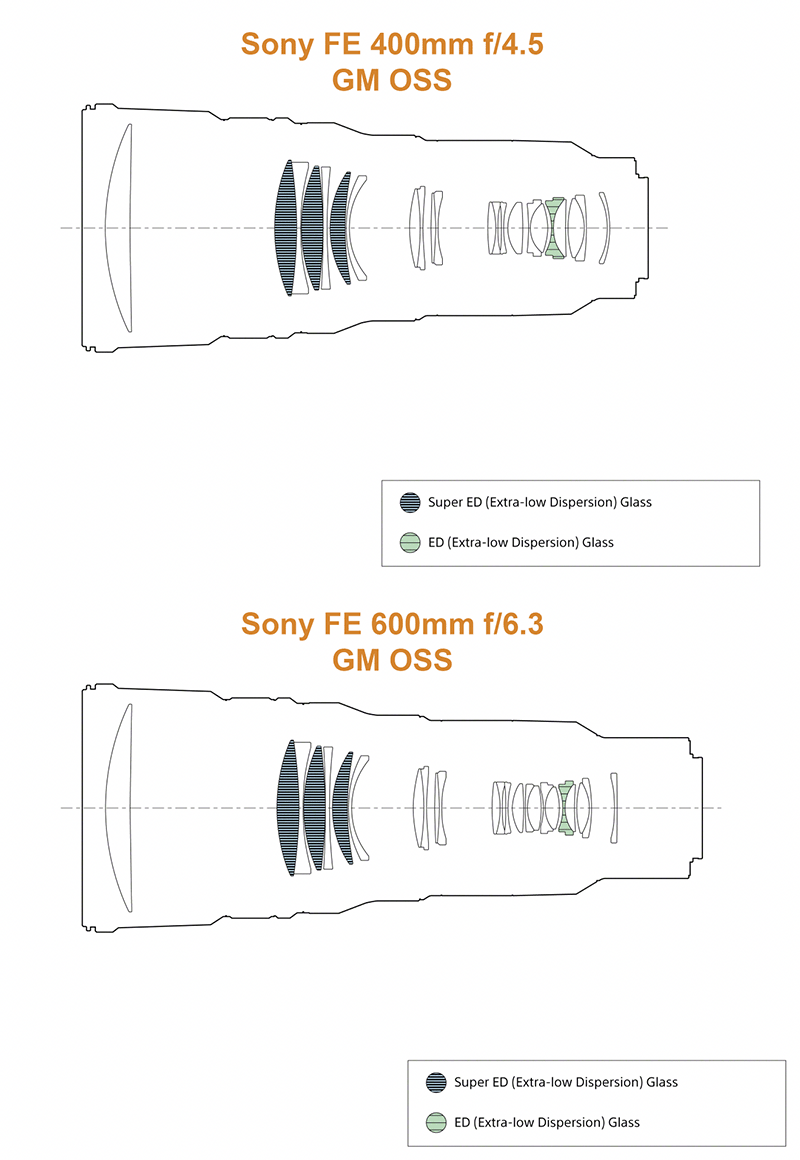
A comprehensive analysis of the internal cross-sections of both lenses reveals that exactly half of the optical design is identical. From the large-diameter front element through the primary focusing group positioned near the center of the barrel, the 400mm f/4.5 and 600mm f/6.3 share identical glass configurations. This shared architecture incorporates Sony’s proprietary Super ED (Extra-low Dispersion) glass elements, which are critical for suppressing chromatic aberrations and maintaining high contrast and resolution at long working distances.
As the light path moves closer to the lens mount, the structural divergence between the two models becomes apparent. To achieve the extended magnification of the 600mm focal length while maintaining manageable aberrations, the FE 600mm f/6.3 incorporates two additional elements grouped into a single supplementary assembly, bringing its total configuration to 24 elements arranged in 17 groups.
The variation in maximum aperture—f/4.5 on the 400mm versus f/6.3 on the 600mm—is a direct mathematical consequence of maintaining a comparable physical entrance pupil size while increasing the focal length. By retaining a similar front element diameter and initial optical stack, Sony avoided the massive weight and dimensional penalties that typically accompany a longer focal length, thereby preserving the handheld usability that defines both products.

Industry Implications and Manufacturing Efficiency
The development and production of specialized super-telephoto lenses historically represent one of the most capital-intensive sectors of the photographic industry. Designing a new optical formula demands thousands of hours of computer-aided optical simulation, precision glass molding, specialized coating development, and rigorous environmental testing. By sharing a substantial portion of the optical prescription and mechanical infrastructure between two distinct commercial products, Sony has demonstrated a high degree of manufacturing efficiency.
This engineering strategy allows the company to amortize R&D expenses across two product lines rather than one, potentially reducing production bottlenecks and streamlining factory tooling. For consumers, the implications are multifaceted. On one hand, photographers gain access to two highly optimized, lightweight super-telephotos that perform at a professional grade. On the other hand, the presence of a shared internal architecture raises questions regarding pricing structures, particularly given that the longer focal length model commands a significantly higher retail price despite utilizing much of the identical underlying glass and componentry. Industry analysts note, however, that pricing within the specialized optics market is dictated by a complex array of factors, including supply chain dynamics, expected sales volumes, and the specific market value of niche focal lengths, rather than raw material costs alone.
User Experience and Market Reception
Initial field testing of both lenses by professional wildlife and sports photographers highlights the practical benefits of Sony’s engineering choices. The ability to carry a 400mm f/4.5 or a 600mm f/6.3 lens that weighs under a kilogram (excluding tripod collars and accessories) has transformed field ergonomics, reducing physical fatigue during extended shoots in natural environments. Wildlife documentation often requires mobility, and the negligible weight difference between the two models ensures that photographers can adapt to changing subjects—such as tracking fast-moving birds with the 600mm or capturing larger mammals in dynamic woodland settings with the 400mm—without altering their physical support equipment or shooting posture.
Ultimately, the release of the Sony FE 400mm f/4.5 GM OSS and FE 600mm f/6.3 GM OSS underscores a shifting paradigm in high-end lens manufacturing. By proving that optical excellence and manufacturing efficiency can coexist through shared foundational designs, Sony has set a new benchmark for how manufacturers may approach the super-telephoto category in the future. Whether photographers choose the versatility of the wider aperture or the extended reach of the longer focal length, the underlying engineering ensures uncompromised optical performance across both tools.