Behind the Scenes of They Will Kill You: How Visual Effects and Practical Gore Brought Kirill Sokolov’s Action Horror-Comedy to Life

Blending the inescapable psychological dread of the Eagles’ classic rock anthem Hotel California with the rural sacrificial cultism of The Wicker Man and the high-octane, blood-soaked ultraviolence popularized by Quentin Tarantino, They Will Kill You stands as one of the most distinctive genre mashups of recent cinematic history. Directed and co-written by visionary filmmaker Kirill Sokolov, the action horror-comedy features a stellar ensemble cast led by Zazie Beetz, who stars as Asia Reaves. In her quest to locate her estranged sister Maria—portrayed by Myha’la—who is employed as a maid at the opulent yet sinister high-rise known as The Virgil, Asia inadvertently walks into a labyrinthine trap operated by an immortal cabal of Satanists disguised as building staff and residents.
As the production rolled in South Africa, translating Sokolov’s wild vision from storyboard to screen required an intricate, painstaking dance between practical special effects, stunt choreography, and cutting-edge computer-generated imagery (CGI). Visual Effects Supervisor Marc Smith recently shed light on the mammoth technical undertaking, detailing how a single primary vendor, Crafty Apes, managed roughly 700 to 800 total shot interventions, culminating in nearly 500 final delivered visual effects sequences.
The Genesis of a Genre-Bending Nightmare
The conceptual roots of They Will Kill You run deep through cinematic history. Filmmaker Kirill Sokolov drew direct inspiration from the absurd slapstick carnage of Monty Python and the Holy Grail alongside the stylized, revenge-driven blade work of Kill Bill. This unique cocktail of tones meant that the production team could never rely on traditional genre boundaries.
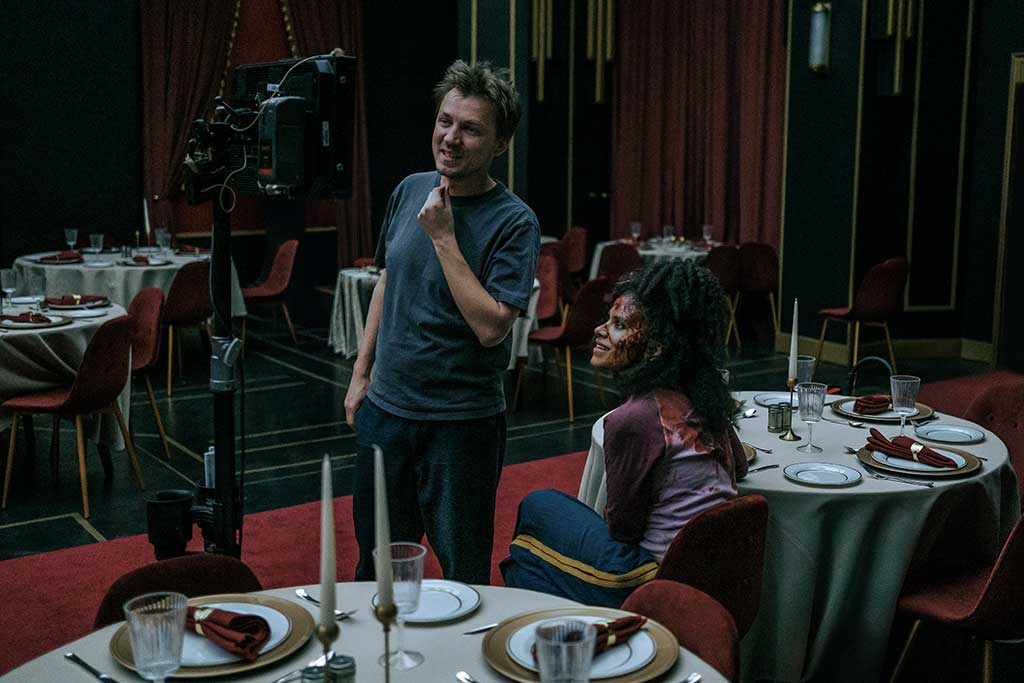
"Kirill Sokolov is excellent at picking the moments where he wants a laugh or shock value," notes Marc Smith. "The whole movie was storyboarded front to back, so we knew ahead of time where these big parts would come in. We discussed quite extensively in prep and before we went to South Africa to shoot this: Is this going to be a stunt? Will this be special effects? Will this be visual effects? Will this be prosthetics? Is it a mix of all of them?"
This collaborative philosophy governed every department on set. Rather than relying entirely on digital wizardry, Sokolov and his crew championed a hybrid approach, prioritizing practical elements wherever physical interaction, lighting reference, or visceral texture demanded it.
Practical Guts and Digital Glue: Executing the Carnage
Nowhere was this hybrid methodology more apparent than in the film’s over-the-top gore sequences. Early in the narrative, Asia finds herself swarmed by henchmen and forced into frantic, brutal close-quarters combat. In one standout sequence involving henchmen "Tall Steve" and "Short Steve," Asia slices her way through adversaries while rolling across a carpeted floor.
"That shot was actually built off of six or seven plates," Smith reveals. "We had a clean plate with the camera move. We had Zazie roll a couple of times to have a different take. We had the prosthetic there, and we shot that a few times clean without the spray of blood. We got the real guy in there to step in and grab it. And then the last take was all the blood effects because we had carpeting in there. The blood was very red and stained quite a bit."
Managing practical blood on set requires rigorous logistical planning, particularly when carpeting and costumes absorb liquid rapidly. Smith explains that the crew carefully sequenced their shooting days around the mess: "There’s a bit of paintwork to paint out the blood spots, and a heal-and-reveal where they came back after the blood was sprayed. But for the most part, it’s all about the planning and the different segments: What’s going to be the most destructive to set? Let’s get the Zazie stuff out of the way. Then she can go break for lunch. Then we can shoot this part. And for the last take, you leave all the blood because that’s going to cause the most issues at the end."
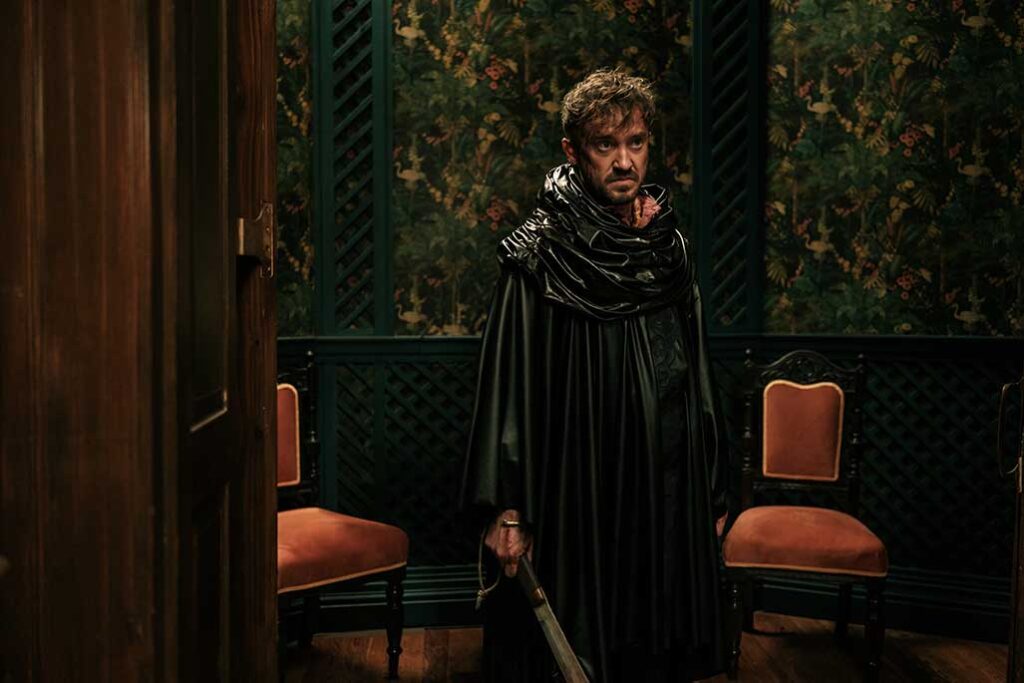
When it came to larger arterial sprays, such as Tom Felton’s character Kevin suffering a dramatic decapitation before his head is comically reattached, Smith pushed back against a purely digital solution. "With the blood effects, we considered using CG, especially where Tom Felton’s head is decapitated, and the fountain is quite over-the-top and fantastic," Smith says. "There was so much interaction and spray with the other characters that I said to Kirill, ‘You best keep this practical, and let’s make a big thing about it.’ Everyone’s covered in blood as well, so it’d be too much to try to reconcile in visual effects."
The Art of the Reverse-Engineered Decapitation
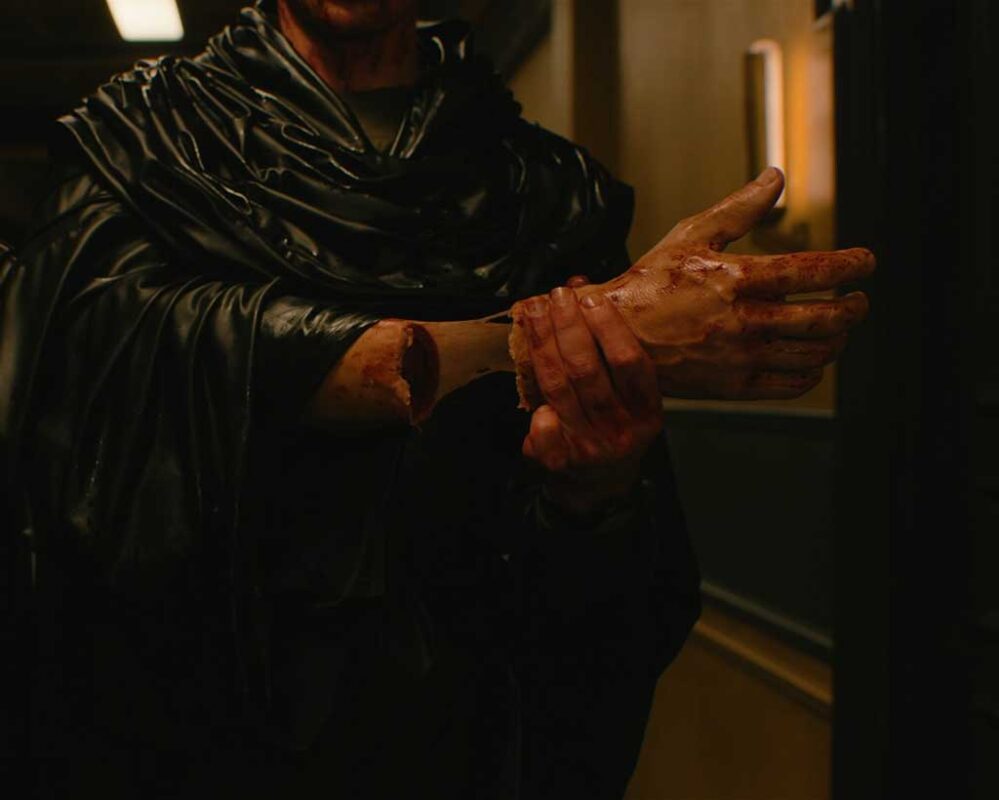
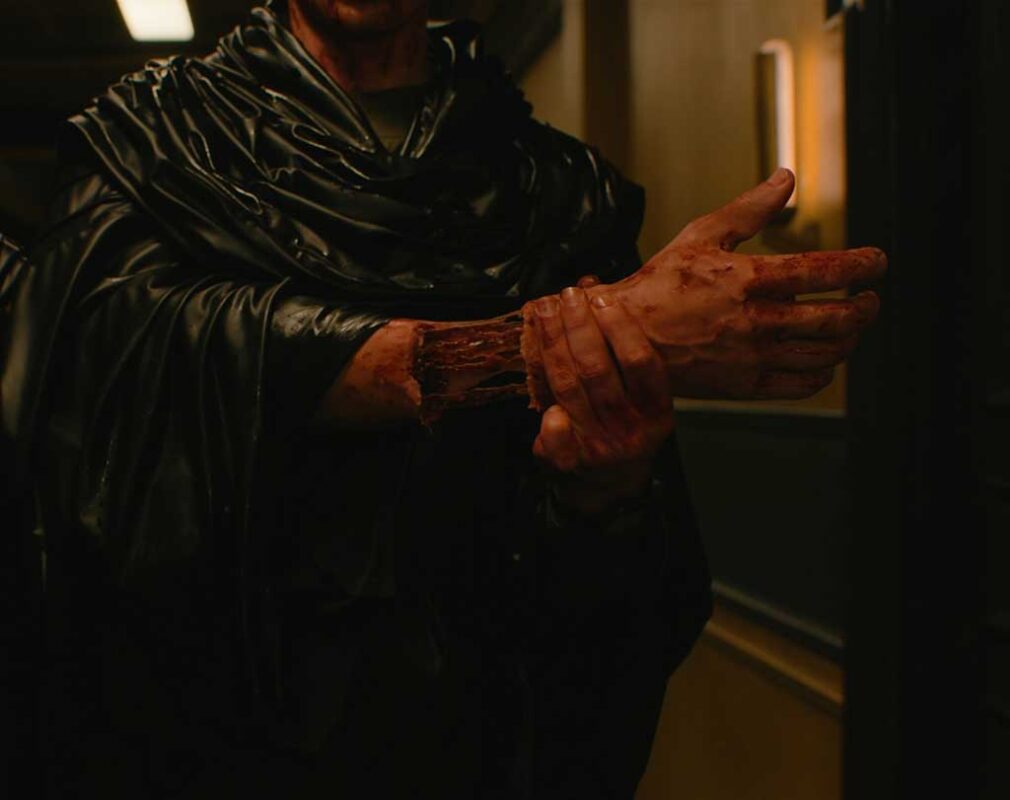
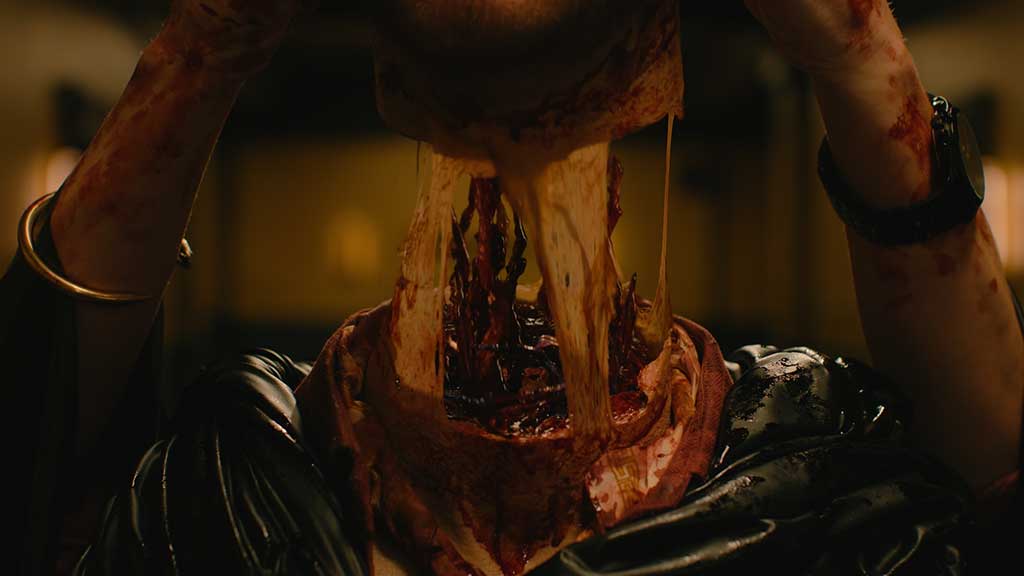
The comedy-horror elements of They Will Kill You truly shine when the villains reveal their terrifying, regenerative immortality. When Tom Felton’s Kevin nonchalantly strolls out carrying his own severed head tucked beneath his arm, the sequence delivers both a visceral shock and a darkly comedic beat.
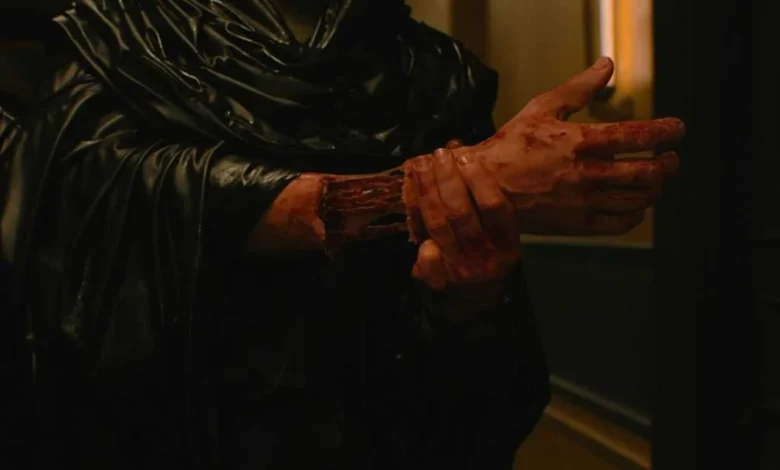
Executing this trick safely and convincingly required close collaboration between the special effects prosthetic team and the visual effects crew. "We got this material from special effects that was like latex, but if we sprayed some kind of solvent on it, it dissolved," Smith explains.
To achieve the reverse-healing effect where the head reattaches and skin knits itself back together, the production utilized high-speed cameras. "We put the neck piece on top of the head prosthetic and had a shoulder prosthetic. We sprayed this skin-like material and pulled the head up, but it was on a metal dowel, so we could keep the head straight while lifting it off. We shot it at 120 frames per second and reversed it so it looked like it was coming back on, with the skin then rejoining."
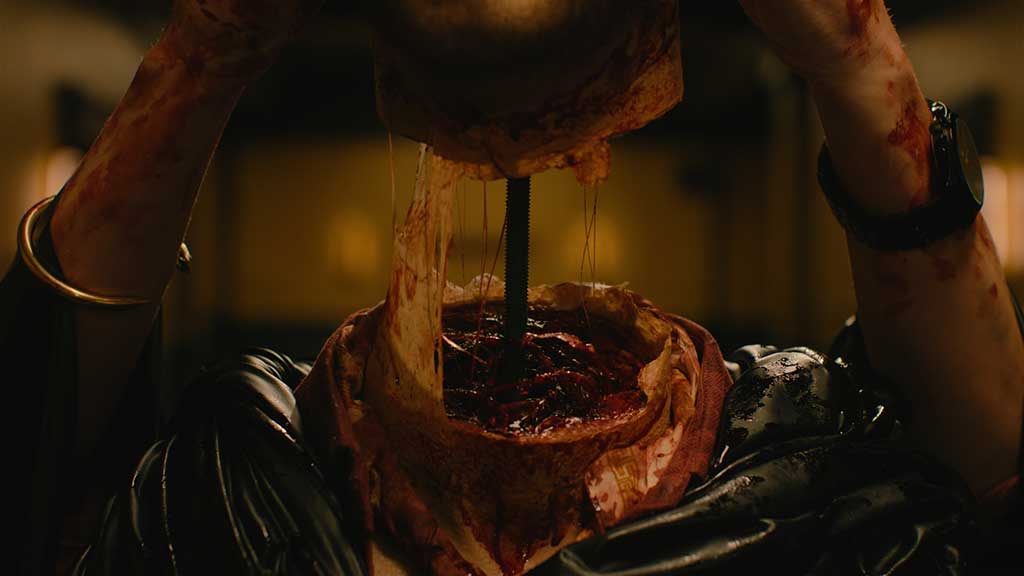
Building this illusion demanded an extra layer of digital craftsmanship. Smith requested approximately 150 independent elements from the prosthetics team—including isolated shots of realistic veins, muscle tissue, and sinew—shot against green screens at various depths. These components were subsequently layered into the composite to create a complex internal anatomy reforming beneath the closing skin.
"It was probably like another six or seven plate comps for our compositors," Smith adds. "Then, to add some nice touches to sell it—because it was a reverse shot, you get a little bit of a weird shake, so it was stabilized. But we added some blood dripping down, so you get the gravity and the dynamics of it closing back up."
Real Fire and the Badassery of Zazie Beetz
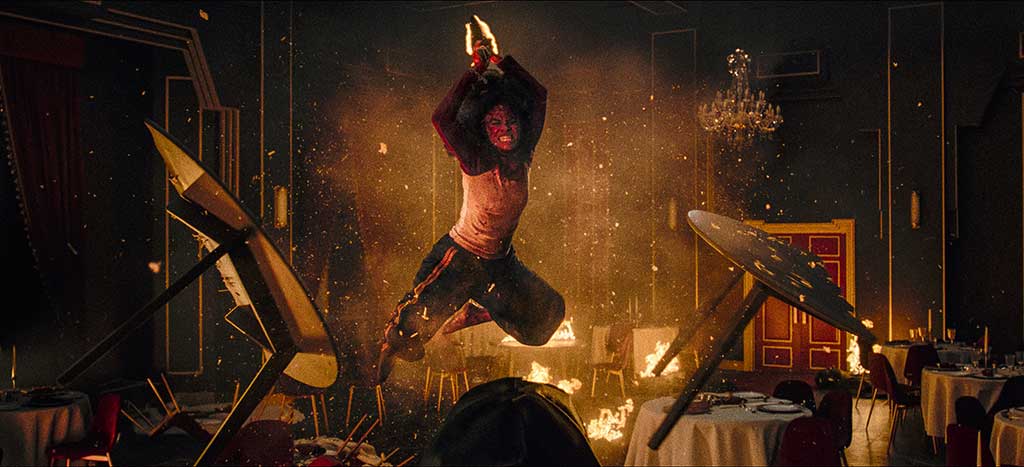
Among the most talked-about sequences by test audiences is a fiery showdown where Zazie Beetz wields a real fire ax against a wave of cultists. Rather than opting for a completely digitized weapon or entirely computer-generated flames, Beetz insisted on executing the heavy choreography practically.
"Originally, we did a bunch of tests in prep where we had the stunt coordinator Kerry Gregg, Zazie’s stunt double Katharyna Araújo, and an ax with LEDs," Smith recalls. "I asked for LEDs because throwing practical lights is always going to be a lot easier than trying to put in firelight afterward. We did a few tests, and it worked great. We did some tests with our CG fire through effect simulations, which Crafty Apes does exceptionally well. But in the end, Zazie, being the badass that she is, wanted to do it practically."
Most of the sequence features Beetz swinging a real fire ax near stunt performers equipped with fire-retardant gear and flame bars fueled by accelerants. Because the set was deliberately designed with low-key lighting, the practical flames served double-duty, casting authentic, dynamic heat values and illumination across the actors’ faces.
"If it was a great take but one or two stunt performers didn’t catch on fire when she hit her with the ax, we added CG fire onto that," Smith notes. "It was fantastic because it was practical fire. The set was so dark, and we had the perfect reference for the heat values or how big the fire should be. We matched it to plate fire, and it was perfect."
The painstaking nature of these continuous takes required intense physical stamina from the cast and stunt teams alike. "There was a section where Zazie hits six guys, and we did that in one take," Smith says. "Stunts had their ropes ready to go and yanked them. We had the flame bars going and had them all doused with accelerant. Zazie leaned into the stunt coordination and choreography for that."
Navigating Tight Spaces: Eyeballs, Spiders, and Architectural Illusions
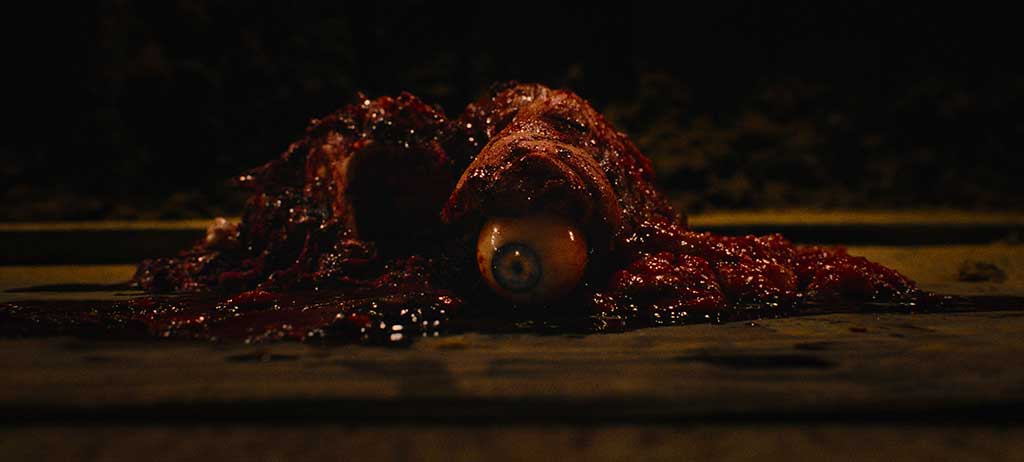
The labyrinthine architecture of The Virgil high-rise offered unique mechanical challenges for the camera crew. In one sequence, a dislodged eyeball belonging to Sharon Vanderbilt—played by Heather Graham—scuttles across the floorboards while pursued by an anxious spider.
Capturing dynamic camera angles inside the cramped crawlspaces beneath the hotel required physical modifications to the set itself. "In that sequence, it was impossible for the camera to make the moves and follow Zazie as she made 90-degree turns," Smith explains. "We took the entire side off the underground area so the camera crane could get in and make several moves. We replaced the entire interior of one of the sides to the point that when we put it in, Kirill said, ‘This is fantastic. This is how you do that camera move.’"
Observing the director’s enthusiastic reaction to practical production solutions validated the extensive prep work undertaken by the visual effects division. "To see that joy and amazement on the director’s face, knowing this is what we did, and he knew that we did it because we told him how we would fix it. That was exceptionally good. It’s one of those things that flies by, and people don’t even realize it, which is the whole point of visual effects. You’re not supposed to see it as a visual effect."
The Digital Metamorphosis of a Talking Pig
Perhaps the most surreal and technically demanding character in They Will Kill You is Satan himself, who manifests and communicates through the severed, talking head of a pig. Far from a static prop, the porcine avatar serves as a pivotal character driving the dark comedic narrative forward.
"The pig is a character in itself," Smith emphasizes. "There was a point where the pig was funny; however, it didn’t play well. It became more sinister and then sarcastic and sullen. Every time the dialogue changed, we talked to Kirill and asked, ‘Is the pig annoyed? Is he angry? Is he nonchalant? Is he sarcastic?’ We would get great feedback from Kirill on the pig’s exact demeanor."
Translating human vocal performances onto an animal’s anatomy required a sophisticated pipeline involving motion capture, automated dialogue replacement (ADR) footage, and MetaHuman face-tracking software. However, capturing the facial data digitally only solved roughly 65 percent of the problem.
Because the structural proportions of a human face and a pig’s head are fundamentally incompatible, the animation team—comprising artists Roane, J. Griffin, and Paul Zeke—had to meticulously hand-animate micro-movements to sell the illusion of life.
"There’s never a still frame on-set where there was a pause in the vocabulary," Smith explains. "The ear twitches. The devil is in the details. You need to add these subtle nuances to sell the idea that this pig is alive. When he’s not having this big dialogue moment, he’s in the background and is alive back there. The pig is always doing something. He’s not just sitting there as a pig on a stick that’s dead."
This attention to behavioral nuance culminated in the film’s climax: a protracted confrontation between Patricia Arquette’s cult leader Lily Woodhouse and the digital pig character. According to Smith, the Lily-Pig fight sequence represented the largest single workload handled by Crafty Apes, combining a practical prop head mounted on a rig with a fully digital head replacement during intense emotional beats.
Constructing The Virgil in Cape Town
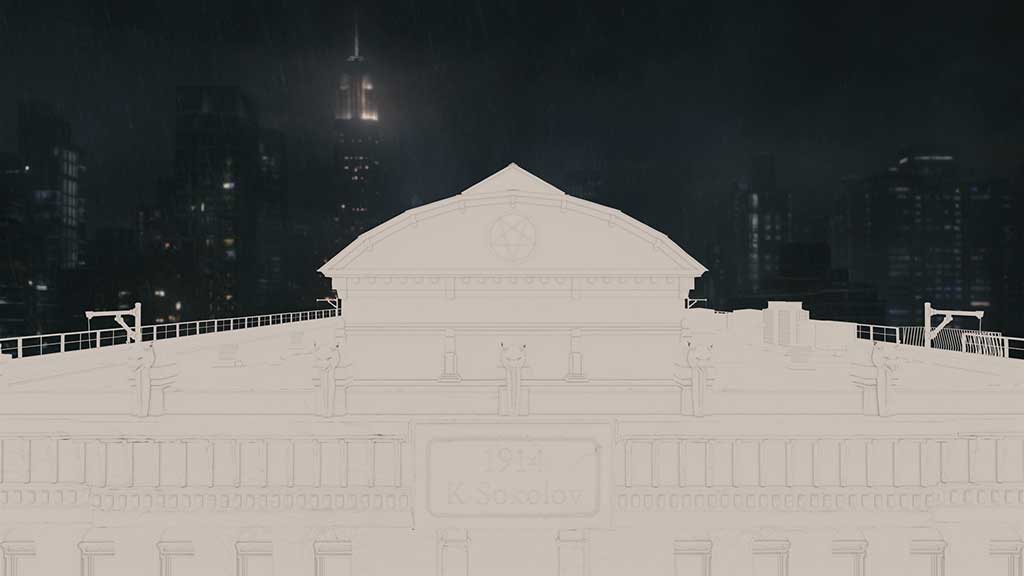
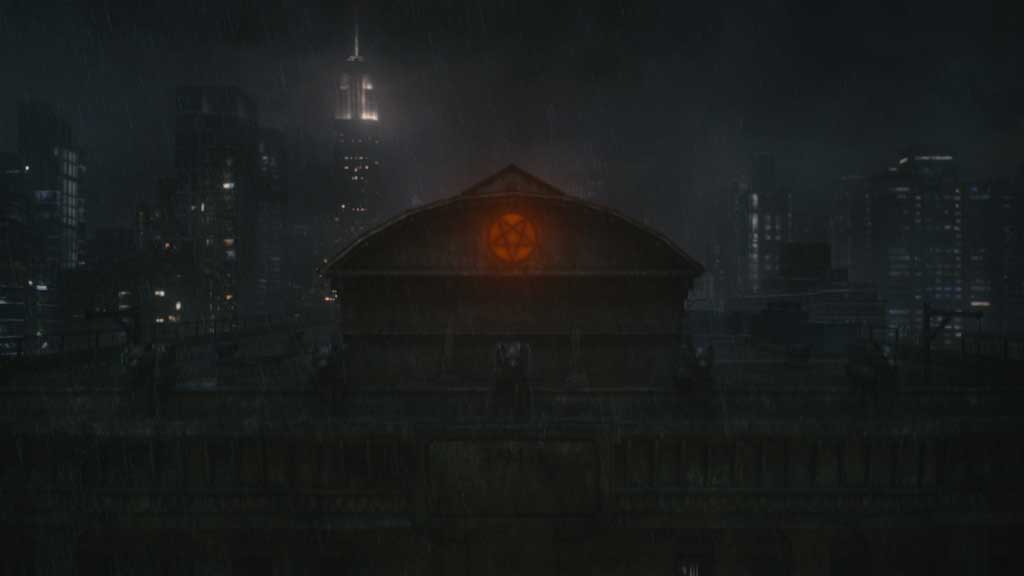
While the narrative of They Will Kill You is rooted in the concrete-and-steel expanse of a fictional New York City high-rise, principal photography took place on location in Cape Town, South Africa. Transforming a South African urban environment into an exclusive Manhattan architectural masterpiece required extensive digital environment extensions.
"When Zazie arrives at The Virgil, that’s on location," Smith shares. "We built a façade, which was the first two windows and the main door, and everything above that is a CG extension from us. We had to do a lot of environment work to make it look like high-end New York. The Virgil was designed by the art department, and we got some of the looks and things that Kirill liked. There are these little things you might not notice when you look at it for the first time, like little pig gargoyles on the top of the roof."
These subtle visual motifs—including the recurring pig iconography woven into the architecture, masks, and manifestations—tie the film’s thematic elements together under a cohesive design umbrella.
Reflecting on the sheer volume of work executed by Crafty Apes throughout production, post-production, and countless rounds of test screening-driven reshoots, Smith acknowledges the relentless pace required to cross the finish line.
"I’ve got pages and pages of shots on ShotGrid of things that we were 85% to 90% there, then it got cut, changed and swapped out," Smith concludes. "It was close to 500 delivered shots, and a lot of those were CG pigs at the end… But from start to finish, we touched a lot of shots, even if it’s just a bit of clean-up here and there, which we don’t necessarily call a visual effects shot. But we did a lot of work on that movie."
Through meticulous pre-planning, practical stunts, and a symbiotic relationship between physical makeup effects and digital augmentation, They Will Kill You establishes a high benchmark for modern genre-blending cinema, proving that unhinged comedy and visceral horror can successfully coexist when backed by rigorous technical execution.
Related posts: