The market for electronic rhythm production hardware has long transcended the standard 16-step grid and analog drum emulation popularized by vintage Roland and Linn units. While conventional beat boxes remain studio staples for producers worldwide, hardware manufacturers continue to push the boundaries of human-computer interaction, ergonomics, and signal routing. Following previous comprehensive roundups of budget and premium beat-making machines, this analysis explores the most eccentric, unorthodox, and boundary-pushing drum machines available to musicians and sound designers. Ranging from all-passive acoustic units to stompbox sequencers and retro-chip synthesizers, these rhythm instruments redefine how beats are generated and performed.

Stylophone Beat: Bringing the Iconic Stylus to Percussion
The Stylophone concept, originally introduced in the 1960s, carved out a unique niche in music history by allowing users to play melodic notes by running a metal stylus across a resistive keyboard. Decades later, the manufacturer has translated this tactile methodology from monophonic melodies to rhythm generation with the Stylophone Beat. Priced at the absolute entry-level of the hardware market, the device functions as an ultra-portable, lo-fi groovebox designed for rapid, hands-on beat sketching.

The Beat provides users with four distinct sample banks categorized as Rok, Techno, Hiphop, and Beatbox, alongside four dedicated bass tones. Operation is straightforward: players tap or drag the stylus across a circular metal contact plate to trigger sounds in real time. Despite its toy-like aesthetic, the unit includes pattern recording functionality, tempo adjustment, and an integrated onboard speaker. Producers seeking extra grit often route the audio through an external microphone, though the inclusion of a standard stereo line-out ensures clean tracking into a recording setup.
Korg Volca Kick: The Single-Voice Resonance Engine

While Korg’s Volca series includes multiple rhythm-focused devices—such as the digital Volca Drum—the Volca Kick occupies a uniquely specialized category. Rather than offering a full polyphonic or multi-channel drum kit, the Volca Kick functions as a dedicated analog kick drum designer and sequencer, echoing the philosophy of software plugins like the D16 Group Punchbox translated into physical hardware.
The instrument centers around the analog filter resonator circuit originally found in Korg’s legendary MS-20 synthesizer. Users can sculpt subterranean 808-style sub-basses, industrial thuds, and click-heavy transients using parameters including tone, bend, envelope, and drive. Because it focuses entirely on low-frequency percussion, producers frequently utilize the Volca Kick as a dedicated sub-layer beneath other rhythm machines or sample its output directly into a digital audio workstation (DAW) for custom sample library creation.

Dato Drum: Multi-User Rhythms for All Ages
Following the success of the Dato Duo, a dual-sided synthesizer aimed at collaborative play and younger musicians, the company expanded its philosophy to percussion with the Dato Drum. Marketed toward creators ranging from children to seasoned producers, the drum machine adopts a circular form factor designed to make the cyclical nature of musical time signatures immediately intuitive.

The instrument features a circular sequencer interface that encourages multiple hands-on participants simultaneously. Sound generation relies on four sample-based drum voices, with users able to load custom samples, manipulate filters, apply bitcrushing, and inject random or repeat parameters into the pattern. While the sequencer resolution is deliberately limited to eight steps to maintain accessibility for younger users, the inclusion of MIDI and hardware sync inputs and outputs allows the Dato Drum to integrate seamlessly into complex studio setups and live electronic jams.
Musical Beings Tembo: Tactile Wood and Magnetic Sequencing

Merging modern electronic sampling with physical board-game mechanics, Musical Beings has created one of the most visually striking rhythm boxes in recent years with the Tembo. Originally launched via a successful crowdfunding campaign on Kickstarter, the instrument abandons traditional plastic buttons and rubber pads in favor of an interface resembling a heavy-duty wooden chessboard.
At its core, the Tembo is a 16-step sequencer and sampler, but user input is handled by arranging magnetic pucks across an eight-step wooden grid. Users can alter note divisions simply by stacking magnetic pieces vertically to introduce sixteenth-note subdivisions. Complete with an onboard looper, signal processing effects, and USB MIDI connectivity, the Tembo bridges the gap between sculptural art objects and functional music production gear, appealing to producers seeking a completely tactile departure from screen-based editing.

Polyend Step: Stomping Out Beats on the Floor
Polyend has established a formidable reputation in the high-end electronic instrument market with sophisticated rhythm workstations like Polyend Drums. However, the company also addressed the instrumental needs of guitarists, bassists, and floor-bound performers with the Polyend Step, a drum machine housed entirely inside a rugged guitar stompbox chassis.

The Step shifts the physical interface entirely to the floor, allowing performers to trigger patterns and manipulate arrangements using three heavy-duty footswitches. The unit comes pre-loaded with 350 preset rhythms and 200 kits built from a library of 2,000 acoustic and electronic samples. Although configured primarily as a four-track rhythm machine, it supports custom pattern creation, per-step parameter automation, polyrhythms, and stomp-in performance effects. By harnessing the feet—a natural anatomical tool for percussionists and drummers—the Step offers a compelling hybrid solution for instrumentalists looking to anchor their live performances with solid rhythmic foundations.
Twisted Electrons BlastBeats: 16-Bit FM Nostalgia

While boutique hardware manufacturers frequently focus on analog subtractive synthesis, Twisted Electrons has carved out a distinct identity by harnessing vintage frequency modulation (FM) chips, famously utilizing Sega Genesis sound architecture in products like the MEGAfm. With the BlastBeats drum machine, the company shifted its focus to early 1990s personal computing technology.
BlastBeats is built around the Yamaha YMF262 OPL3 sound chip, the very silicon that powered Sound Blaster cards in MS-DOS computers during the early nineties. The machine offers six FM drum voices alongside four distinct synth instruments, paired with a 64-step sequencer. Loaded with hands-on faders, deep automation capabilities, multiple audio outputs, and a browser-based software editor for fine-tuning sound design parameters, BlastBeats delivers a gritty, crunchy 16-bit sonic signature that stands apart from standard PCM sample playback and pure analog synthesis.

Moog DFAM: The Semi-Modular Percussion Powerhouse
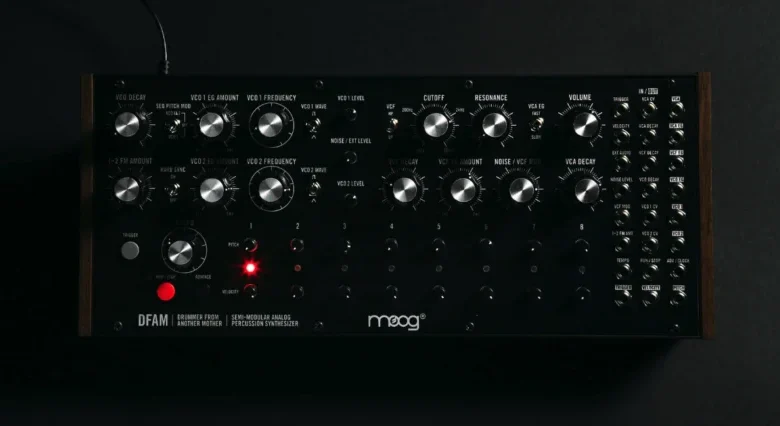
Though Moog Music has historically specialized in monophonic and polyphonic synthesizers rather than dedicated drum machines, the Drummer From Another Mother (DFAM) has become an industry standard for electronic percussion since its introduction. Part of the semi-modular ecosystem sharing dimensions with the Mother-32, the DFAM is technically a two-voice percussion synthesizer paired with an integrated analog sequencer.

Signal generation relies on two wide-range analog oscillators and a dedicated white noise generator, capable of producing everything from thunderous kicks and snapping snares to metallic bells and aggressive basslines. Tonality is shaped via Moog’s signature ladder filter, which features switchable lowpass and highpass modes. Rhythms are programmed using an onboard eight-step sequencer equipped with dedicated tuning and decay controls per step. Enhanced by three LFOs and an extensive patch bay for Eurorack integration, the DFAM remains a cornerstone for producers crafting industrial, techno, and cold wave music.
Landscape Noon: The Physics of Passive Sound Generation

Perhaps the most conceptually radical device on the market is Noon, manufactured by Landscape. Challenging the foundational premise that electronic musical instruments require an active internal power source, Noon is completely passive. It operates entirely without batteries or wall power, generating audio signals purely from the trigger voltage and gate signals received from an external sequencer.
Noon features eight distinct channels, each engineered to react differently to incoming electrical currents. Some channels produce organic, insect-like clicks and chirps, while others generate harsh noise textures suited for experimental sound art and industrial compositions. Capacitive touch plates allow users to manually alter pitch and texture, while natural circuit loading introduces organic swing, groove, and variable gate lengths. For producers looking to scale down, Landscape also offers Moon, a four-channel derivative of the same underlying passive technology.

Vermona drumDING: The Analog Sampling Hybrid
Vermona’s DRM1 MKIV analog percussion synthesizer has long been praised by producers for its pure, hands-on analog tone-generation circuits. However, the instrument has historically lacked an onboard sequencer, requiring users to rely on external MIDI controllers or DAW sequencing. Vermona addressed this limitation with the drumDING, though it introduces a fascinating and unorthodox operational workflow.

The drumDING houses a single multi-purpose analog drum voice derived from the DRM1 architecture, utilizing oscillators, noise generators, and impulse circuits to craft kicks, snares, and hi-hats. Because it features only one active voice channel at a time, users must sculpt an analog sound, sample it into the internal memory, and then sequence the recorded sample across a six-track sequencer layout. Supporting parameter locks, polymeters, trigger ratchets, and external audio sampling, the drumDING forces a deliberate, iterative production process that bridges traditional analog synthesis with modern groovebox sequencing.
Soma Pulsar-23: The Organismic Modular Drum Machine

Designed by Vlad Kreimer of Soma Laboratory—the visionary minds behind the drone synthesizer Lyra-8—the Pulsar-23 represents a maximalist approach to electronic percussion. Marketed as an "organismic drum machine," the Pulsar-23 is a semi-modular powerhouse containing 23 interconnected modules.
The architecture includes four dedicated drum channels covering kick, snare, hi-hats, and bass/percussion, supported by four envelope generators, four loop recorders, clock dividers, LFOs, and built-in effects. Users patch signals together using either traditional alligator clip cables or standard pin connections, facilitating a high degree of circuit-bending experimentation. Particularly favored by producers working within dark ambient and techno genres, the Pulsar-23 rewards deep exploration, offering an expansive sonic palette capable of generating rhythmic textures that defy traditional categorization.