Democratizing Robot Learning: A Verifiable Guide to OpenVLA Fine-Tuning with LoRA in Colab

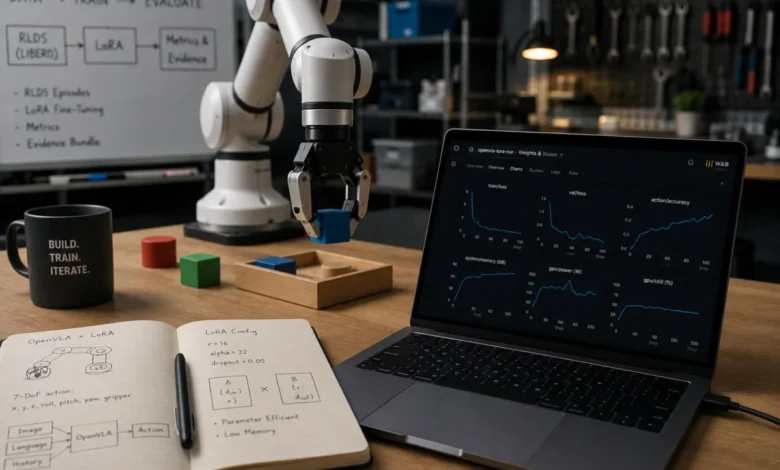
The burgeoning field of robot learning, driven by large-scale vision-language-action (VLA) models, presents both immense promise and significant practical challenges. Among these, the sheer computational cost, complexity of setup, and difficulty in verifying initial experiments often deter researchers and developers from engaging with these cutting-edge technologies. A recent initiative tackles this head-on, offering a concise, reproducible, and verifiable pathway to fine-tune the powerful OpenVLA model using Low-Rank Adaptation (LoRA) within the accessible environment of Google Colab. This approach aims to demystify the initial stages of VLA model adaptation, providing a crucial "smoke test" before committing to extensive, resource-intensive robot experiments.
The core motivation behind this reproducible experiment is to address the common apprehension that large models—such as the 7-billion-parameter OpenVLA—are inherently expensive, fragile, and opaque in their operation. By demonstrating a real LoRA fine-tuning run in Colab, complete with dataset loading verification, GPU activity confirmation, and inspectable evidence, the project offers a tangible starting point. For those seeking to understand the practicalities of OpenVLA fine-tuning, this article outlines the methodology, unpacks the technical components, and highlights the verifiable outcomes, establishing a solid foundation for more ambitious robotic endeavors.
OpenVLA: A Landmark in Vision-Language-Action Models

Introduced in the OpenVLA paper (arXiv:2406.09246), OpenVLA stands as a significant open-source contribution to the field of robot learning. It is a 7-billion-parameter vision-language-action model trained on an impressive corpus of 970,000 real-world robot demonstrations. This scale positions OpenVLA as a foundational model for robot control, capable of interpreting diverse human instructions and visual cues to orchestrate robot movements. The model’s primary function is to receive two critical inputs: a camera image capturing the robot’s workspace and a natural-language instruction (e.g., "put the cup on the plate"). From these inputs, OpenVLA predicts the most appropriate next action for the robot to execute, effectively bridging the gap between human intent and robotic manipulation.
The very scale of OpenVLA, while enabling powerful generalization, also underscores the necessity for accessible and verifiable initial experiments. A model trained on nearly a million demonstrations is designed to be versatile, but real-world deployment invariably requires adaptation to specific robot hardware, task environments, and operational nuances. This is where fine-tuning becomes indispensable.
The Imperative of Fine-Tuning: Adapting Foundation Models to Specific Tasks
Fine-tuning refers to the process of taking a pre-trained model and continuing its training on a more specific, often smaller, dataset. In the context of OpenVLA, this involves exposing the model to additional robot demonstrations tailored to a particular task family or robot configuration. Each demonstration within such a dataset captures the robot’s visual observations, the corresponding language instruction it was following, and the precise action it undertook. The overarching goal of fine-tuning is to refine the model’s predictive capabilities, enabling it to more accurately forecast the desired actions for tasks relevant to its intended application.

A prevalent challenge in robotics, often termed "embodiment shift," highlights the need for fine-tuning. This phenomenon occurs when a pre-trained robot policy, however robust, encounters discrepancies between its training environment and its deployment environment. Such discrepancies can manifest in various forms: a new camera angle, a different type of gripper, a modified action scale for joint movements, novel objects in the workspace, or task language that was not adequately represented in the original training data. When these changes occur, the pre-trained policy, while conceptually sound, may no longer precisely align with the new physical setup. Fine-tuning offers a systematic method to bridge this gap, adapting the model’s internal representations to the specific characteristics of the target embodiment without having to retrain the entire model from scratch.
During the fine-tuning process, OpenVLA learns to adjust its internal parameters to better predict discrete "action tokens." These tokens are essentially vocabulary entries that represent specific robot control values. For the released OpenVLA, these tokens translate into normalized seven-degrees-of-freedom (7-DoF) end-effector commands, encompassing x, y, z coordinates, roll, pitch, yaw orientations, and gripper state. A crucial step for any robot system is to then convert these normalized values back to the specific action scale and joint space of its own hardware before execution.
LoRA: A Strategic Approach to Efficient Adaptation
Given the immense parameter count of models like OpenVLA, full fine-tuning—where every parameter of the model is updated—can be prohibitively expensive in terms of computational resources (GPU memory, processing time) and storage for the resulting checkpoints. This is where Low-Rank Adaptation (LoRA) emerges as a highly practical and efficient alternative. LoRA operates by freezing the vast majority of the pre-trained model’s weights and instead introduces a small set of new, trainable adapter weights. These adapters are typically low-rank matrices injected into the model’s existing layers. By training only these much smaller matrices, LoRA significantly reduces the number of updated parameters.

The benefits of LoRA are multi-fold: it drastically lowers GPU memory consumption, accelerates the training process, and results in much smaller checkpoint files for the adapted model. This makes LoRA an ideal candidate for initial experiments and for deployments in resource-constrained environments. Critically, the OpenVLA project itself reports that LoRA can match the performance of full fine-tuning in its parameter-efficient fine-tuning experiments, achieving comparable results while updating only 1.4 percent of the total parameters. This strong empirical backing reinforces LoRA as the method of choice for this verifiable first run, demonstrating that efficiency does not necessarily compromise effectiveness for adaptation tasks.
The Colab Blueprint: A Reproducible Fine-Tuning Workflow
To ensure accessibility and reproducibility, the entire fine-tuning demonstration is encapsulated within a Google Colab notebook (available at: https://colab.research.google.com/drive/1AiiJuFvNUTyQ-eksm9Mj7wAGtvH_V4zQ). This choice makes the powerful A100 GPU hardware, crucial for handling large models, available without requiring local setup. The specified runtime configuration—Python 3, A100 GPU, and High-RAM enabled—is vital for the successful execution of the experiment.
The demonstration leverages the libero_spatial_no_noops split from the modified LIBERO RLDS (Robot Learning Dataset Standard) dataset, hosted on Hugging Face. LIBERO is a well-established benchmark designed for language-conditioned robot manipulation tasks. The "spatial" subset specifically focuses on scenarios where the robot must understand and act upon spatial relationships between objects (e.g., "place the red block on the blue mat"). The "no_noops" suffix indicates that "no-operation" actions, where the robot remains static, have been removed from the dataset. This ensures that the training data is concentrated on meaningful state-changing actions, optimizing learning efficiency.

RLDS provides a standardized format for storing robot demonstrations as episodes, each comprising a sequence of timesteps. Every timestep records essential information: camera observations (images), natural-language instructions, the 7-DoF robot actions taken, and associated metadata. This structured format facilitates seamless integration with robot learning pipelines like OpenVLA. The Colab notebook automates the download and staging of this dataset, ensuring that the data_root_dir and dataset_name parameters correctly link the training script to the data.
Deconstructing the Training Process: Commands and Hyperparameters
The core of the fine-tuning process is executed via the official OpenVLA LoRA entry point, vla-scripts/finetune.py. The torchrun command orchestrates the training, specifying a standalone process on a single node with one process per node. Key parameters passed to the script include:
--vla_path openvla/openvla-7b: Identifies the pre-trained OpenVLA 7-billion-parameter checkpoint to be loaded.--data_root_dir /content/data/rlds/modified_libero_rlds: Points to the local directory where the LIBERO dataset is stored.--dataset_name libero_spatial_no_noops: Selects the specific dataset split for training.--lora_rank 32: Defines the rank of the low-rank matrices used in LoRA. A higher rank allows for more expressivity but increases parameter count; 32 is a common and effective choice.--batch_size 2: Sets the number of samples processed per GPU iteration. This small batch size is chosen to keep GPU memory usage manageable on the A100.--grad_accumulation_steps 8: Instructs the trainer to accumulate gradients over 8 mini-batches before performing a single optimizer update. This technique effectively simulates a larger batch size (2 8 1 = 16 in this single-process setup) without incurring the full memory cost of a large physical batch.--learning_rate 0.0005: Specifies the step size for the optimizer. This value is conservatively chosen, following common practices for LoRA fine-tuning.--image_aug True: Enables image augmentation techniques. This is a crucial setting, as the official OpenVLA LoRA recipe utilizes augmentation to enhance robustness to visual variations and improve generalization.--wandb_project openvla-lora-finetuneand--wandb_entity "$WANDB_ENTITY": Configure Weights & Biases (W&B) for experiment tracking, ensuring metrics and system telemetry are logged.--max_steps 100: Limits the training run to 100 steps. This duration is sufficient to verify the entire pipeline functionality—dataset loading, adapter training, metric logging, and W&B synchronization—without requiring extensive computational time.
Verifying the Learning Signal: Metrics and System Telemetry

The 100-step run, though brief, generated clear evidence of a learning signal, confirming that the fine-tuning process was indeed active and effective. Three primary metrics, tracked through Weights & Biases, provide insight into the model’s adaptation:
train_loss: This metric quantifies the supervised training error. A decrease intrain_losssignifies that the model is improving its ability to predict the demonstrated actions based on the input observations and instructions. The run showed a sharp initial drop from approximately 11 to 3.6 within the first ten steps, stabilizing around 3.2–3.6, and concluding at 3.42928. This rapid decline is a strong indicator of active learning.l1_loss: This measures the absolute error between the model’s predicted continuous action values and the ground-truth demonstrated action values. A lowerl1_lossindicates that the predicted robot movements are becoming more accurate. The L1 loss decreased from an initial value near 0.46, fluctuating between 0.18 and 0.29, and ultimately settling at 0.2222, further corroborating the learning process.action_accuracy: This metric gauges how often the model’s predicted action tokens precisely match the demonstrated action tokens. An increase inaction_accuracyimplies that the model is learning to generate the correct discrete action commands. The accuracy rose from approximately 0.09 at the beginning to a peak near 0.35, finishing at 0.28571. While not indicative of task success, this upward trend confirms the adapter’s ability to learn from the demonstration data.
Beyond these learning metrics, system telemetry is critical for verifying that real computational work was performed. W&B logs for host memory usage, process GPU power consumption (in watts), and process GPU power utilization (as a percentage) provide this evidence. The A100 GPU demonstrated sustained activity, with process GPU power fluctuating between 165 and 195 watts and utilization around 40-48% throughout the training window. This telemetry definitively confirms that the Colab environment and the A100 GPU were actively engaged in the fine-tuning computations, dispelling any concerns about a "dummy" run.
The Role of Experiment Tracking: Weights & Biases as an Audit Trail
For any scientific or engineering endeavor, particularly in machine learning, transparent and reproducible results are paramount. Experiment trackers like Weights & Biases (W&B) serve as an indispensable audit trail, providing a centralized repository for all aspects of a training run. In this OpenVLA fine-tuning demonstration, W&B was used to log metrics, system telemetry, and configuration details. The Colab notebook’s unique approach involves training offline first within the OpenVLA-specific Python environment and then, upon completion, creating a separate, updated W&B sync environment to upload the entire run history. This offline-then-sync strategy enhances resilience against dependency conflicts while ensuring that a dynamic, inspectable W&B page is generated.

The resulting W&B run page (e.g., https://wandb.ai/wb-authors/openvla-lora-finetune/runs/zwo162re) serves as the definitive record. It allows anyone to inspect the configuration parameters, review the trends of loss and accuracy metrics, analyze GPU utilization charts, and even access the generated artifact files and environmental metadata. This commitment to inspectability ensures that the claims made about the training run are not merely assertions but are backed by verifiable, public evidence.
Broader Implications: Accelerating Robotics Research and Deployment
The successful demonstration of a reproducible, verifiable OpenVLA LoRA fine-tuning run in Colab carries significant implications for the broader robotics community. Firstly, it democratizes access to advanced robot learning techniques. By lowering the barrier to entry—both in terms of computational resources and setup complexity—it enables a wider range of researchers, students, and smaller development teams to experiment with and adapt state-of-the-art VLA models. This accessibility is crucial for fostering innovation and accelerating the pace of research in robot manipulation.
Secondly, this approach addresses a critical need for preliminary validation. Before investing substantial time and resources into longer training cycles, complex simulation rollouts, or expensive real-robot evaluations, developers can use this blueprint to confirm that their chosen pipeline, dataset, and model configurations are fundamentally sound. This early-stage verification mitigates risks and optimizes resource allocation in subsequent, larger-scale experiments.

Finally, the emphasis on inspectability through experiment tracking establishes a best practice for reproducibility in robot learning. In a field where physical experiments can be difficult to replicate, ensuring that the computational aspects of model training are transparent and auditable is vital. This verifiable foundation paves the way for more robust research, faster iteration cycles, and ultimately, the more reliable deployment of intelligent robotic systems.
Reproducing the Experiment: A Step-by-Step Guide for Developers
To replicate this demonstration, users can access the companion Colab notebook directly via the provided URL: https://colab.research.google.com/drive/1AiiJuFvNUTyQ-eksm9Mj7wAGtvH_V4zQ.
The steps are straightforward:

- Set Runtime: Configure the Colab runtime to "A100 GPU" with "High-RAM" enabled.
- W&B API Key: Add your Weights & Biases API key to Colab Secrets, named
WANDB_API_KEY. - Run All Cells: Execute all cells in the notebook by selecting
Runtime -> Run all.
The notebook will then automatically proceed through the full sequence: installing dependencies, cloning the OpenVLA repository, staging the modified LIBERO RLDS dataset, configuring the OpenVLA Python 3.10 environment, executing the LoRA fine-tuning process, synchronizing the offline W&B run, verifying the W&B run URL, and archiving the evidence files. Upon completion, the printed W&B link will direct users to the comprehensive record of their run, allowing for thorough inspection of all logged data.
Conclusion: Beyond the Notebook – The Value of Verifiable Foundations
While a 100-step LoRA run is not sufficient to evaluate the deployment readiness of a robot policy, its practical value lies in confirming the integrity of the training pipeline. It unequivocally demonstrates that the correct dataset can be loaded, the official OpenVLA script can be executed, the LoRA adapter successfully receives updates, the GPU performs real computational work, and all critical metrics are reliably captured and stored outside the ephemeral notebook environment.
This verifiable baseline is invaluable. Before scaling to longer training schedules, conducting extensive simulation evaluations, or engaging in costly real-robot testing, developers now have a compact, reproducible, and inspectable foundation. This pattern extends beyond OpenVLA: for any large-model fine-tuning tutorial, the crucial question transcends mere notebook completion. It asks whether enough evidence remains for another individual to meticulously inspect the data, the commands, the metrics, the hardware activity, and the final artifacts. This commitment to provable and measurable training runs is the bedrock upon which the next generation of intelligent robotic systems will be built.

Sources
- OpenVLA Paper: https://arxiv.org/abs/2406.09246
- OpenVLA Project: https://github.com/openvla/openvla
- LIBERO Project: https://github.com/Lifelong-Robot-Learning/LIBERO (Liu et al., 2023)
- Modified LIBERO RLDS Dataset (Hugging Face): https://huggingface.co/datasets/openvla/modified_libero_rlds
- LIBERO Dataset License: https://creativecommons.org/licenses/by/4.0/
- Colab Notebook: https://colab.research.google.com/drive/1AiiJuFvNUTyQ-eksm9Mj7wAGtvH_V4zQ
- W&B Run: https://wandb.ai/wb-authors/openvla-lora-finetune/runs/zwo162re
Related posts: