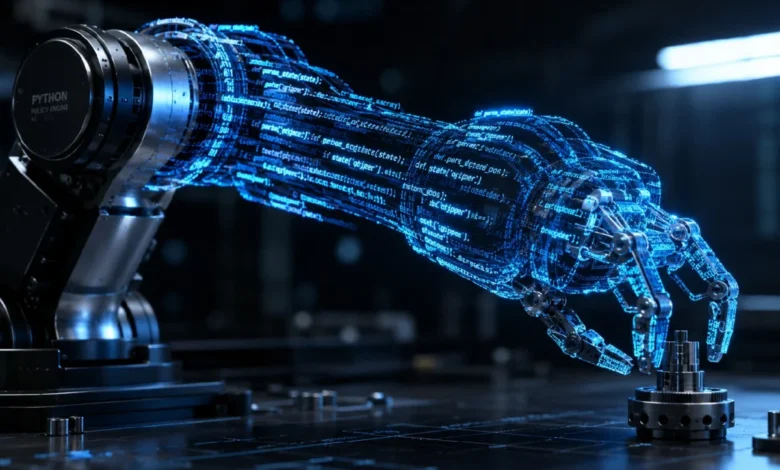
Traditional robotic systems have long been constrained by rigid programming paradigms, struggling to adapt gracefully to the unpredictable complexities of physical dynamics, diverse environmental configurations, and inevitable operational failures. This fundamental limitation has hindered the widespread deployment of robots beyond highly controlled industrial settings. However, a groundbreaking new framework, ASPIRE (Agentic Skill Programming through Iterative Robot Exploration), developed by Nvidia in collaboration with researchers from multiple universities, is poised to revolutionize this landscape. ASPIRE introduces a continual learning approach, empowering artificial intelligence systems to autonomously write, execute, and refine robot control programs, thereby fostering a new generation of self-improving robotic agents.
The core innovation of ASPIRE lies in its ability to diagnose its own errors and subsequently distil successful repairs into a reusable skill library. This mechanism aligns perfectly with the burgeoning industry trend of leveraging advanced reasoning models to enable AI agents to enhance their own operational scaffolding. For real-world AI applications, this technique represents a significant leap forward, drastically reducing the extensive programming, computational token usage, and debugging efforts traditionally required for physical robots. Crucially, ASPIRE demonstrates this efficacy across varying hardware embodiments and application programming interfaces (APIs), signaling a profound shift toward agentic systems that accumulate transferable knowledge, accelerating the adaptation and deployment of robotic systems in complex, open-world environments.
The Enduring Challenges of Robotic Coding Agents
The journey towards truly autonomous and adaptable robots has been fraught with challenges. Historically, robot programming has relied on meticulously crafted, explicit instructions, often hardcoded for specific tasks and environments. Any deviation from these predefined conditions, be it a slight change in object placement, unexpected lighting, or minor mechanical wear, could lead to system failure. This rigidity necessitated extensive human intervention for reprogramming, calibration, and debugging, making large-scale, flexible robotic deployment economically prohibitive for many applications.
Recent advancements in AI coding agents, particularly those leveraging large language models (LLMs), have offered a glimmer of hope. These sophisticated models have demonstrated an impressive capacity to review execution traces, identify errors, and iteratively refine code. In the realm of robotics, this progress has catalyzed the "code-as-policy" paradigm. This innovative approach translates complex robot behaviors into executable programs, typically Python scripts, that seamlessly integrate perception tools, APIs, and low-level control actions. Instead of directly outputting raw motor torques, the AI generates human-readable code that directly commands the hardware. The advantage is clear: because a robot’s actions are articulated as code, these programs can be inspected, debugged, and incrementally improved through continuous interaction feedback, much like traditional software development.
However, even these advanced robotic coding agents have faced substantial hurdles. A primary limitation has been their operation within comparatively naive environments, which typically provide only coarse, task-level feedback. Debugging a complex robot program is inherently difficult due to the intricate interplay of numerous components, including multimodal perception (e.g., vision, depth sensing), contact dynamics (how the robot interacts physically with objects), grasp generation (determining how to pick up an object), and motion planning (calculating collision-free paths). For instance, if a robot fails to complete an execution rollout, a simple "failure" signal offers little insight. It doesn’t clarify whether the root cause was a faulty camera perception, an unstable physical grasp, an unexpected object collision, or an error within the motion planner’s algorithms. Without fine-grained diagnostic traces to precisely pinpoint what went wrong, agents struggle to determine what evidence to inspect, localize the exact point of failure, or formulate an effective repair strategy.

Furthermore, a critical deficiency in many existing systems is their inability to accumulate experience. When these agents successfully resolve a problem, they typically do not retain the fixes, recovery strategies, or newfound insights for future tasks. Consequently, an AI agent attempting its hundredth task remains effectively no more experienced or efficient than an agent attempting its very first task. This lack of institutional memory represents a significant bottleneck to scalability and long-term autonomy.
This contrasts starkly with how human robotics engineers approach problem-solving. When a robot program fails, a human engineer methodically replays the execution, analyzes perception outputs, scrutinizes motion trajectories, isolates the failing subsystem, and then meticulously rewrites the problematic code. Crucially, human engineers internalize these solutions, compounding their debugging experience into transferable knowledge that generalizes across a wide array of tasks. They might develop specific grasp recovery heuristics, reusable perception prompting recipes, or procedural navigation strategies – for example, explicitly commanding the robot to sample alternative approach angles if a target object is positioned too close to a table’s collision boundary. By continually accumulating this reusable knowledge, human programmers become progressively more proficient and efficient over time. ASPIRE seeks to imbue robotic AI with this fundamental human capability.
ASPIRE: An Agentic Framework for Continual Learning
To overcome these significant limitations, the Nvidia research team introduced ASPIRE, which embodies the concept of an AI framework that functions much like a seasoned robotics engineer. Instead of treating every new task as an isolated, novel challenge, ASPIRE operates as a true continual learning system for robotics. The more problems it encounters and solves, the more capable and efficient it becomes, mirroring human expertise development.
ASPIRE achieves this unprecedented level of autonomy by independently writing and refining robot control programs. In essence, the AI acts as a sophisticated software developer, crafting the underlying Python code that governs the robot’s perception and motion, and then autonomously debugging that code when the robot encounters a failure. This cycle is completed by recording newly acquired experience, which is then stored and made available for application to future tasks.
Historically, robots have been confined to a rigid "perception-plan-execute" pipeline. The camera captures an image, the software calculates a path, and the robotic arm executes the movement. If an unexpected variable or perturbation interrupts this fixed sequence, the entire system often grinds to a halt, awaiting human intervention. ASPIRE dramatically departs from this static approach, embracing an open-ended learning loop. In this dynamic model, the agent independently determines how to investigate a failure, inspects multimodal execution traces, diagnoses the root cause, generates a software patch, validates the new behavior through execution, and finally consolidates this new information into its long-term memory.
Diving Deeper: The Three Pillars of ASPIRE’s Self-Improvement

The framework achieves this robust self-improving loop through the seamless integration of three distinct yet interconnected components:
-
The Closed-Loop Robot Execution Engine: This component serves as ASPIRE’s sophisticated debugging environment. Unlike traditional systems that merely report a task failure, this engine provides rich, multimodal traces of the robot’s operation. It functions akin to an airplane’s "black box" recorder, meticulously logging what the robot "saw" (perception data), what the generated code outputted, where the motion planner encountered an error, and critical visual keyframes immediately preceding and following the failure event. This wealth of fine-grained diagnostic data is paramount, allowing the agent to precisely pinpoint which specific line of code, sensor reading, or physical interaction went awry. For example, it can differentiate between a perception system misidentifying an object and a motion planner failing due to an unforeseen obstacle.
-
The Skill Library: This component acts as ASPIRE’s compounding brain, its repository of accumulated knowledge. Whenever the agent successfully validates a repair or discovers an effective recovery strategy, a central coordinator meticulously distills this learned experience into a reusable rule or heuristic, which is then permanently stored in the skill library. This library can catalog a diverse range of knowledge, from subtle localization tricks and complex grasping constraints to optimized debugging workflows and generalizable error recovery routines. Future agents, when faced with new tasks or similar challenges, can then retrieve these pre-learned skills as in-context guidance. This dramatically provides a "head start" on complex assignments, reducing exploratory time and improving efficiency. The skills are abstracted enough to be broadly applicable, not just task-specific.
-
The Evolutionary Search Procedure: A common pitfall in machine learning is for an agent to become trapped in a "local minimum," perpetually tweaking the same flawed logic without making substantive progress towards a solution. To circumvent this, ASPIRE incorporates an evolutionary search procedure. This mechanism generates a diverse population of alternative control programs and task strategies. By testing multiple code mutations and behavioral variations in parallel, the system is encouraged to explore fundamentally different ways to solve a problem, rather than becoming stuck in an iterative refinement of a single, failed trajectory. This broader exploration capability is vital for robust problem-solving in open-ended, real-world scenarios.
Real-World Application and a Detailed Debugging Example
To illustrate ASPIRE’s practical efficacy, consider a hypothetical scenario: an enterprise deploys a mobile manipulator robot with the task of picking up a specific red radio from a crowded workbench. The robot successfully identifies the radio but then inexplicably refuses to approach it, reporting a failure.
To diagnose this issue, ASPIRE’s robot execution engine automatically retrieves and analyzes the extensive logs. The agent, powered by an underlying LLM (such as Claude Opus 4.6, as used in the research), reviews the diagnostic trace. It quickly discerns that the perception system functioned flawlessly, accurately locating the red radio. However, the logs repeatedly show that the motion planner component generated a planning error. Further inspection reveals the root cause: the intended navigation target for the robot’s end-effector was mathematically too close to the workbench’s physical edge. This proximity inadvertently triggered a pre-programmed, hidden collision-avoidance safety buffer within the motion planning software, preventing the robot from moving to the perceived target.

Using its evolutionary search procedure, the agent proposes multiple diverse solutions. Instead of fruitlessly attempting to tweak the perception prompt (which was not the issue), it intelligently generates a software patch. This patch modifies the robot’s approach strategy, instructing it to sample alternative approach directions—checking 45-degree, 90-degree, and 180-degree angles relative to the target object. The goal is to find a valid path that completely avoids the problematic safety buffer. The execution engine then deploys and tests this new code. Upon successful execution, the robot smoothly navigates to and grasps the radio. ASPIRE then extracts this multi-angle approach routine, generalizing it into a reusable rule, and permanently saves it to the skill library, making it available for future navigation challenges involving table edges or similar obstacles.
Bridging the Gap: Sim-to-Real Transfer and Its Economic Impact
The true transformative value of this self-improving system extends far beyond simulation. ASPIRE provides compelling initial evidence of effective "sim-to-real" transfer—a notoriously difficult challenge in robotics. Because the system learns fundamental physical heuristics, robust debugging strategies, and generalized problem-solving patterns rather than merely memorizing task-specific code within a simulated environment, the skills discovered in a high-speed simulation can be directly imported and applied to real, physical robots. This is a critical breakthrough. Even if the target factory robot possesses a different mechanical design, varied sensor suites, or utilizes entirely distinct application programming interfaces (APIs), retrieving these pre-learned, generalized skills dramatically reduces the time, computational token cost, and intensive engineering effort traditionally required to program robots for real-world enterprise environments. This capability fundamentally democratizes advanced robotics, making sophisticated automation accessible to a broader range of industries and applications.
Unprecedented Performance: Quantitative Results and Benchmarking
To rigorously evaluate ASPIRE, the researchers utilized Claude Opus 4.6 as the core coding agent and tested the framework across three simulated benchmark families. These benchmarks were designed to assess models on diverse robotic navigation and manipulation tasks, spanning short and long operational horizons, and under various environmental conditions, including object perturbations. To further validate real-world transfer capabilities, they employed OpenAI Codex with GPT-5.5 to control a physical bimanual robot, which featured a completely different physical embodiment and programming interface than the simulator used for initial skill acquisition.
ASPIRE’s performance was benchmarked against leading state-of-the-art baselines. These included other sophisticated coding agents, such as CaP-Agent0, which relies solely on test-time retries without accumulating experience, thereby demonstrating the direct impact of ASPIRE’s continual learning. The framework was also compared against advanced end-to-end vision-language-action models like OpenVLA, pi0, and pi0.5, and remarkably, even against programs manually written by human experts.
The quantitative results were nothing short of impressive, demonstrating massive improvements across the board. On the challenging LIBERO-Pro benchmark, ASPIRE significantly outperformed all baselines, boosting success rates by an astounding 77 percentage points on tasks involving object perturbations, where slight shifts in object position can typically derail traditional systems. On the Robosuite benchmark, ASPIRE transformed a complex bimanual handover task from a meager 20% success rate to an impressive 92%, showcasing its ability to master intricate coordination. For long-horizon BEHAVIOR-1K tasks, which involve extended sequences of actions, ASPIRE surpassed both the strongest AI baseline and even human experts in navigation and overall task execution. Furthermore, when applying its accumulated skill library to previously unseen long-horizon tasks, the system achieved a remarkable 31% zero-shot success rate, drastically outperforming prior methods that typically saturated at a mere 4%, underscoring the power of transferable knowledge.

Efficiency and Cost Reduction: The Token Economy of Robotics
Beyond raw success rates, one of the most compelling takeaways from ASPIRE’s evaluation for real-world applications is its profound impact on operational efficiency and the drastic reduction in computational costs. This is particularly relevant in the era of large language models, where "token" usage directly correlates with computational expense and processing time. Because ASPIRE extracts generalized repair logic and robust heuristics rather than simply memorizing specific simulator code, the skills discovered in simulation can serve as highly effective in-context guidance for entirely different physical robots.
A perfect illustration of this efficiency gain was observed in the real-world deployment experiments. When a physical robot was tasked with the relatively common action of lifting a soda can, feeding the agent a previously learned simulation skill reduced the total reasoning tokens required for debugging by nearly an order of magnitude. The token count plummeted from approximately 61.94 million tokens to just 6.58 million, while simultaneously boosting the final success rate from 13 out of 20 attempts to an impressive 19 out of 20.
The impact was even more dramatic on a complex drawer manipulation task. Without the benefit of a transferred skill, the agent consumed a massive budget of nearly 335 million tokens without achieving a single successful outcome. However, with the application of the transferred skill, it achieved an 11 out of 20 success rate using only a fraction of the computational budget, totaling 81.67 million tokens. These figures highlight not just improved performance, but a fundamental shift in the economic viability of deploying and maintaining advanced robotic systems. Reduced token usage translates directly into lower cloud computing costs and faster iteration cycles, making sophisticated robotics more accessible and sustainable for enterprises.
Broader Implications and the Future of Robotics
The development of ASPIRE marks a critical inflection point in the field of robotics and artificial intelligence. Its self-improving, continual learning capabilities have profound implications across numerous sectors:
- Manufacturing and Logistics: Factories and warehouses can deploy robots that learn and adapt on the fly to changing product lines, facility layouts, and unexpected obstacles, reducing downtime and the need for constant human supervision or reprogramming. This could unlock unprecedented levels of automation flexibility.
- Healthcare and Service Industries: Robots assisting in hospitals or elder care facilities could learn to navigate dynamic environments, handle diverse objects, and respond to unpredictable human interactions with greater dexterity and reliability.
- Space Exploration and Hazardous Environments: Autonomous robots operating in remote or dangerous locations could learn from their mistakes and improve their operational resilience without direct human intervention, extending mission capabilities.
- Economic Impact: The reduction in programming effort and computational costs promises to accelerate the adoption of robotics, driving productivity gains across industries. This could also foster the creation of new roles focused on robot supervision, skill library curation, and advanced system design, shifting the nature of work rather than simply replacing it.
- Ethical Considerations: As robots become more autonomous and self-improving, discussions around safety, accountability, and the nature of robotic "intelligence" will intensify. Frameworks like ASPIRE, by providing transparent code-based policies, could offer better traceability and debugging pathways compared to opaque end-to-end neural networks.
The researchers have announced plans to open-source the code for ASPIRE, inviting developers and researchers worldwide to explore, build upon, and contribute to this transformative self-improving robotic framework. This collaborative approach is expected to accelerate innovation, fostering a vibrant ecosystem around agentic AI for physical systems. With large language models and other AI components consistently improving in their reasoning capabilities, frameworks like ASPIRE are not just an incremental improvement; they represent a critical step toward an era where robotic fleets learn, adapt, and refine their own programming seamlessly in the background, ushering in a future where intelligent machines are truly capable of continuous self-enhancement. The "loop engineering" paradigm, where AI agents actively participate in their own development and improvement, is no longer a futuristic concept but a burgeoning reality.
Related posts: