Morphoice Releases EightyTen Free Beta Combining Dual Vintage Roland Synthesis with Modern Effects Processing

The software instrument developer Morphoice has officially announced the release of EightyTen, a comprehensive virtual analog synthesizer that emulates two of the most iconic entries in the Roland JX series. Currently available as a free beta, the plugin serves as a dual-engine recreation of the Roland JX-8P and the SuperJX-10, including its rack-mount counterpart, the MKS-70. This release marks a significant expansion of the Morphoice catalog, which has rapidly grown over the past two years to include high-fidelity emulations of legendary hardware such as the Yamaha CS-80 and the Roland Jupiter-8. By integrating the architectures of these mid-1980s classics into a single digital interface, Morphoice aims to provide music producers with a versatile tool that bridges the gap between vintage analog warmth and modern digital flexibility.
Historical Context: The Evolution of the Roland JX Series
To understand the significance of EightyTen, one must look at the hardware landscape of the mid-1980s. When the Roland JX-8P was released in 1985, the synthesizer industry was undergoing a seismic shift. The rise of the Yamaha DX7 and FM synthesis had made the traditional, knob-laden interfaces of the 1970s appear dated. Roland responded by producing the JX-8P, a six-voice polyphonic synthesizer that utilized Digitally Controlled Oscillators (DCOs) for improved tuning stability while maintaining an entirely analog signal path for its filters and amplifiers.
While the JX-8P was lauded for its lush, "glossy" sound—distinct from the more aggressive tones of the earlier Juno and Jupiter series—its lack of dedicated physical controls made programming a challenge. Users were forced to navigate menus using a single data entry slider unless they purchased the optional PG-800 programmer. In 1986, Roland expanded the concept with the SuperJX-10 (and the MKS-70 rack version), which essentially housed two JX-8P engines in one chassis. This allowed for 12-voice polyphony and the ability to layer two different patches, creating the massive, cinematic textures that defined film scores and pop hits of the era. EightyTen recreates this specific evolutionary line, offering the simplicity of the JX-8P alongside the layered power of the SuperJX-10.
Technical Architecture and Synthesis Engine
The core of EightyTen is built upon a faithful recreation of the DCO architecture. Unlike Voltage Controlled Oscillators (VCOs), which are prone to pitch drift due to temperature changes, DCOs are clocked digitally, ensuring perfect tuning while retaining the harmonic richness of analog waveshapes. EightyTen features two oscillators per voice, offering standard saw, pulse, and square waves.
A defining characteristic of the JX series included in this emulation is the Cross Modulation (X-Mod) capability. This feature allows one DCO to modulate the frequency of the other, enabling the creation of complex, metallic, and bell-like timbres usually associated with FM synthesis. This specific technical quirk was famously used to create the lead sounds in Chaka Khan’s "I Feel For You," proving that analog hardware could compete with the digital FM sounds of the time.
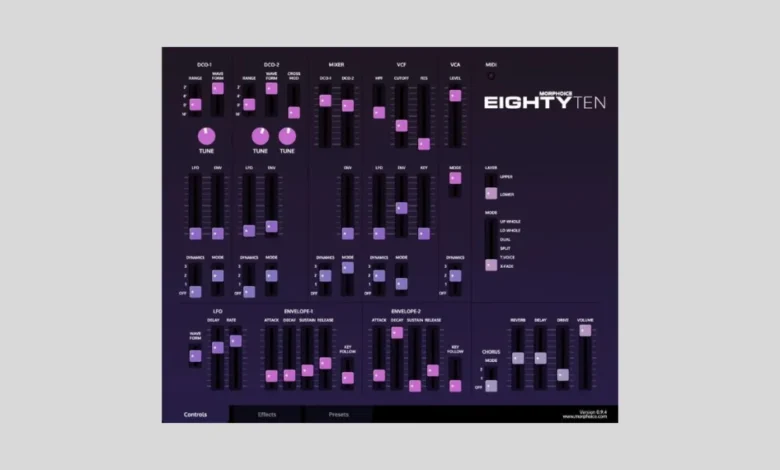
The filter section of EightyTen utilizes a 24 dB/octave resonant low-pass filter, modeled after the classic Roland IR3109/IR3R01 chips. This is complemented by a non-resonant high-pass filter, providing producers with the tools to sculpt the low-end frequency response precisely. For modulation, the plugin provides two ADSR envelope generators per voice, which can be routed to the filter cutoff, pitch, or amplifier. This dual-envelope setup was a step up from the single-envelope design of the Juno series, allowing for more intricate sound design where the tonal evolution of a note is independent of its volume decay.
Modern Enhancements and Integrated Effects
While EightyTen remains grounded in 1980s hardware architecture, Morphoice has implemented several contemporary features to satisfy the demands of modern production environments. The plugin includes an expanded effects suite that goes far beyond the original hardware’s capabilities.
Chief among these is the DarkStar Reverb, an algorithmic processor inspired by the expansive, atmospheric textures of the Strymon BigSky. This allows users to place the vintage synth tones into massive virtual spaces, suitable for ambient, cinematic, and synthwave genres. Additionally, the plugin features a dedicated lo-fi tape delay module, which introduces subtle pitch instability and saturation, emulating the character of vintage hardware tape loops.
For users seeking more aggressive textures, Morphoice has included the "HeatBurn" drive and distortion circuit. This module can range from subtle harmonic warming to heavy saturation, providing a tonal edge that the original, more "polite" JX-8P hardware lacked. Furthermore, the unmistakable Roland-style stereo chorus is present, featuring the classic "I" and "II" settings that define the wide, shimmering stereo image associated with 80s analog synthesis.
User Interface and Expressive Control
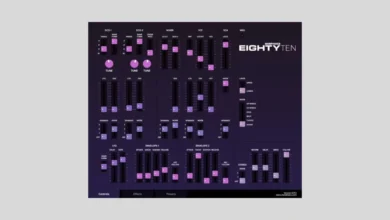
One of the primary advantages of the EightyTen software version over the original hardware is the user interface. Morphoice has opted for a "PG-800-style" layout, meaning all parameters are accessible via dedicated knobs and sliders on a single screen. This removes the "menu-diving" frustration that hampered the original JX-8P and SuperJX-10, making sound design an intuitive, real-time process.
The plugin also fully supports modern MIDI implementation, including velocity sensitivity and aftertouch. In the original hardware, these features were revolutionary, allowing for expressive performances where the brightness or volume of a sound would change based on the player’s touch. EightyTen maintains this legacy, ensuring that the virtual instrument feels as "playable" as a physical keyboard.
Development Roadmap and Distribution Model
The release of EightyTen follows a specific development pattern established by Morphoice with their previous releases, such as "Unstable" (a CS-80 emulation), "EightySix" (a Juno-6 emulation), and "EightyEight" (a Jupiter-8 emulation). The developer typically releases these instruments in an "early beta" phase, allowing the community to test for bugs and provide feedback on the DSP (Digital Signal Processing) quality.
Currently, EightyTen is available as a free download via the Gumroad platform. However, the developer has indicated that this free status is tied to the beta phase. To incentivize early adoption and support ongoing development, Morphoice offers a "lifetime license" for a contribution of $10 or more. This license ensures that users will retain access to the plugin and all future updates even if the software eventually transitions to a paid-only model.
Compatibility is a high priority for the developer. EightyTen is available in AU, VST, and VST3 formats. Notably, Morphoice provides native support for Windows, macOS, and Linux. The inclusion of Linux support is particularly significant, as the professional audio landscape on Linux continues to grow, yet often lacks the high-quality vintage emulations available on other operating systems.
Comparative Analysis and Industry Impact
The release of EightyTen enters a competitive market for Roland emulations. While Roland’s own "Roland Cloud" offers official versions of these instruments, Morphoice’s approach focuses on a streamlined, "boutique" experience that emphasizes CPU efficiency and a specific aesthetic workflow.
Industry analysts note that the JX-8P and SuperJX-10 have often been overshadowed by the more famous Juno and Jupiter series in the virtual instrument world. By focusing on these "underrated" classics, Morphoice is filling a niche for producers who desire the specific mid-80s "hi-fi" analog sound that defined the transition into the digital era. The ability to stack patches—a hallmark of the SuperJX-10—provides a level of sonic density that single-oscillator or single-engine emulations cannot easily replicate.
The "pay-what-you-want" beta model also reflects a broader trend in independent software development. By lowering the barrier to entry, Morphoice is able to build a large user base quickly, gathering diverse data on system performance across various DAWs (Digital Audio Workstations) and operating systems.
Summary of Key Features
- Dual-Engine Architecture: Emulates both the six-voice JX-8P and the twelve-voice SuperJX-10/MKS-70.
- Oscillator Sync and Cross-Mod: Enables FM-style timbres and complex harmonic textures.
- Classic Filter Design: 24 dB/octave low-pass filter combined with a high-pass filter for precise tonal shaping.
- Onboard Effects: Includes DarkStar Reverb, Lo-fi Tape Delay, HeatBurn Distortion, and the classic Roland Stereo Chorus.
- Expressivity: Full support for velocity and aftertouch, mimicking the high-end expressive capabilities of the original hardware.
- Cross-Platform: Available for macOS, Windows, and Linux in VST, VST3, and AU formats.
- Licensing: Free beta access with a $10 optional donation for a lifetime license.
As the music production community continues to embrace the "hybrid" workflow—combining the convenience of digital plugins with the character of vintage analog gear—tools like EightyTen become essential. By preserving the soul of the JX series while adding the benefits of modern processing and an accessible interface, Morphoice has provided a significant contribution to the current landscape of virtual synthesis. Whether used for recreating nostalgic 80s pop or crafting modern cinematic soundscapes, EightyTen stands as a testament to the enduring appeal of Roland’s analog legacy.