Phantom Sounds Launches Intermod Free Self-Intermodulation Audio Plugin for Creative Sound Design

The digital audio workstation landscape has seen a significant influx of specialized processing tools designed to push the boundaries of traditional sound manipulation, and the latest entry from developer Phantom Sounds, titled Intermod, represents a sophisticated evolution in this sector. Intermod is a dedicated self-intermodulation audio plugin that functions by identifying and multiplying the strongest frequency components within an incoming audio signal against one another. This process generates what the developers term "phantom frequencies"—new harmonic and inharmonic content that is mathematically derived from the source material. By utilizing the inherent characteristics of the input signal to drive the modulation process, the plugin ensures that the resulting sonic profile remains unique to the specific audio being processed, offering a departure from standardized saturation or distortion effects that apply a uniform character regardless of the source.
The release of Intermod follows the successful launch of the developer’s previous offerings, Orbit and 56K, which focused on spatial reverberation and digital bit-crushing/decay, respectively. With Intermod, Phantom Sounds continues its trajectory of developing unconventional tools that prioritize experimental sound design over traditional utility. The plugin is currently available as a free download, requiring only an email registration, positioning it as an accessible entry point for producers looking to explore advanced modulation techniques without the financial barrier often associated with high-end signal processing software.
Technical Architecture and Modulation Logic
At the core of Intermod’s operation is the principle of intermodulation, a phenomenon typically associated with unintended distortion in radio and telecommunications. In a traditional electrical engineering context, intermodulation occurs when two or more signals of different frequencies are processed through a non-linear device, resulting in the creation of additional signals at frequencies that are the sums and differences of the original frequencies. Phantom Sounds has repurposed this technical concept for creative applications, allowing users to intentionally induce these interactions within a controlled digital environment.
The plugin’s architecture is built around a "self-intermodulation" engine. Unlike standard frequency modulation (FM) or ring modulation, which usually require a separate carrier and modulator signal, Intermod treats the input signal as both. By isolating the most prominent spectral peaks in the audio and using them to modulate the rest of the signal, the plugin creates a dense web of sidebands and harmonic artifacts. This results in a "phantom" layer of sound that moves in perfect synchronization with the original audio’s transients and tonal shifts. Because the modulation is reactive, the effect feels more integrated into the source material than an external layer of noise or an independent oscillator would.
Operational Modes and Sound Character
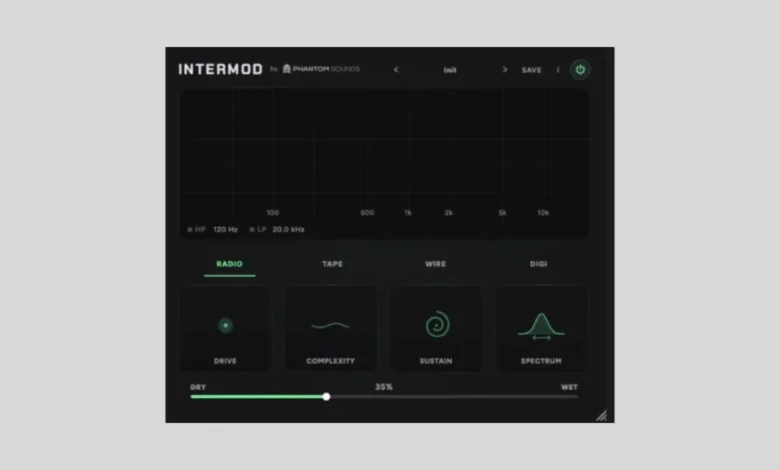
To provide a wide range of sonic textures, Intermod features four distinct source modes: Radio, Tape, Wire, and Digital. Each mode utilizes a different underlying algorithm to dictate how the intermodulation is calculated and how the resulting phantom frequencies are shaped.
The Radio mode is designed to emulate the unpredictable nature of electromagnetic interference and signal drift. When the Drive and Sustain parameters are increased, this mode produces textures reminiscent of shortwave radio transmissions, complete with the chirping and whistling artifacts common in atmospheric interference. The Tape mode focuses on the non-linearities of magnetic storage, providing a warmer, more saturated response that emphasizes lower-order harmonics and adds a subtle sense of physical movement to the sound.
The Wire mode offers a more industrial and lo-fi aesthetic, simulating the characteristics of early telegraphy or long-distance copper-wire transmissions. This mode often produces more metallic and dissonant phantom frequencies, making it particularly effective for percussive sounds or experimental textures. Finally, the Digital mode addresses the artifacts of the modern era, focusing on quantization errors, aliasing, and the harsh, cold textures associated with low-bitrate digital processing. This mode is particularly useful for creating modern glitch effects or adding "grit" to clean digital synthesizers.
Parameter Control and User Interface
Intermod provides a streamlined interface that belies the complexity of its internal processing. The user is presented with four primary adjustable parameters: Drive, Complexity, Sustain, and Spectrum. These controls allow for precise tailoring of the intermodulation effect, ranging from subtle harmonic enhancement to total sonic deconstruction.
The Drive parameter controls the input gain into the modulation engine, determining the intensity of the intermodulation. Higher settings push the signal deeper into the non-linear processing stage, resulting in more aggressive phantom frequencies. The Complexity control is perhaps the most critical for sound design; it dictates the density of the sidebands generated. At low settings, the movement remains stable and focused, while higher settings introduce a chaotic, unpredictable character that is ideal for evolving soundscapes.
Sustain functions similarly to an envelope control, extending the life of the generated phantom frequencies. In practice, this allows a producer to take a short, staccato sound—such as a drum hit—and create a lingering, pulsing tail that follows the rhythm of the original hit. The Spectrum control acts as a frequency focus tool, allowing the user to determine which part of the audio spectrum is most heavily affected by the intermodulation process.
In addition to these primary controls, the plugin includes a real-time frequency display that provides visual feedback of the spectral changes occurring. Below the display, users can access high-pass (HP) and low-pass (LP) filter settings, which are essential for cleaning up the extreme low-end or high-end energy that can sometimes be generated by aggressive intermodulation. A Dry/Wet slider completes the interface, allowing for parallel processing—a technique often used to maintain the clarity of the original signal while blending in the "phantom" textures.
Developer Context and Product Chronology
Phantom Sounds has established a reputation for releasing plugins that challenge the standard conventions of the VST/AU market. Their product timeline shows a clear focus on "niche" processing. Earlier in 2026, the company released Orbit, a spatial reverb plugin that moved away from traditional room modeling in favor of a more abstract, celestial approach to space and time. Prior to that, the release of 56K highlighted the developer’s interest in "digital decay," offering a specialized tool for emulating the sound of failing hardware and low-bandwidth connections.
The release of Intermod represents a continuation of this design philosophy. By focusing on a specific, often misunderstood physical phenomenon like intermodulation, Phantom Sounds provides producers with a tool that does not overlap significantly with standard "essential" plugin bundles. This strategy has allowed the developer to carve out a space in the highly competitive boutique plugin market, appealing to sound designers, cinematic composers, and experimental electronic musicians.
Market Analysis and Creative Implications
The availability of Intermod as a free tool is a significant move within the music technology industry. In recent years, many developers have moved toward a "freemium" or "lead-magnet" model, where high-quality, specialized tools are offered for free to build brand loyalty and an active mailing list. For the user, this provides access to professional-grade sound design tools that would have cost hundreds of dollars a decade ago.
From a creative standpoint, Intermod addresses a growing trend in modern music production: the desire for "organic" digital textures. As high-fidelity digital recording has become the standard, many producers seek ways to introduce character, instability, and "vibe" back into their tracks. Intermod excels in this area by providing a way to generate noise and artifacts that are mathematically tied to the music itself, rather than being layered on top as a static sample.
In professional sound design—particularly for film and video games—the ability to create "otherworldly" sounds that still feel grounded in a physical reality is highly valued. Intermod’s Wire and Radio modes are particularly well-suited for creating sci-fi atmospheres, ghostly whispers, or the sound of malfunctioning technology. The inclusion of a robust preset library, categorized by instrument types such as bass, synths, drums, and vocals, further increases its utility by providing starting points that demonstrate how the intermodulation engine reacts to different frequency ranges.
Broader Industry Impact
The launch of Intermod signals a broader shift toward "intelligent" audio processing. While the plugin is easy to use, the underlying logic—using the signal’s own strongest components to self-modulate—is a sophisticated approach to signal chain design. This mirrors trends in the industry where artificial intelligence and complex mathematical modeling are being used to create tools that are more reactive and "aware" of the audio they are processing.
As of April 2026, the plugin remains a notable example of how boutique developers can influence the market by offering specialized, high-concept tools for free. For the electronic music community, Intermod offers a new method for achieving the "saturated yet controlled" sound that is currently popular in genres ranging from industrial techno to experimental ambient.
In conclusion, Intermod by Phantom Sounds is more than a simple distortion or modulation effect. It is a calculated tool for spectral manipulation that leverages the physics of intermodulation to provide a unique sonic palette. By combining a streamlined user interface with a complex internal engine, Phantom Sounds has provided the music production community with a versatile instrument for modern sound design. Its release reinforces the trend of high-quality free software being used as a catalyst for innovation in the digital audio space. Those interested in exploring the boundaries of their audio signals can download the plugin via the Phantom Sounds website, where it serves as a testament to the creative possibilities of modern DSP (Digital Signal Processing) engineering.