Breaking the Silos: Paul Boag and Smashing Magazine Announce New Community for In-House UX Professionals

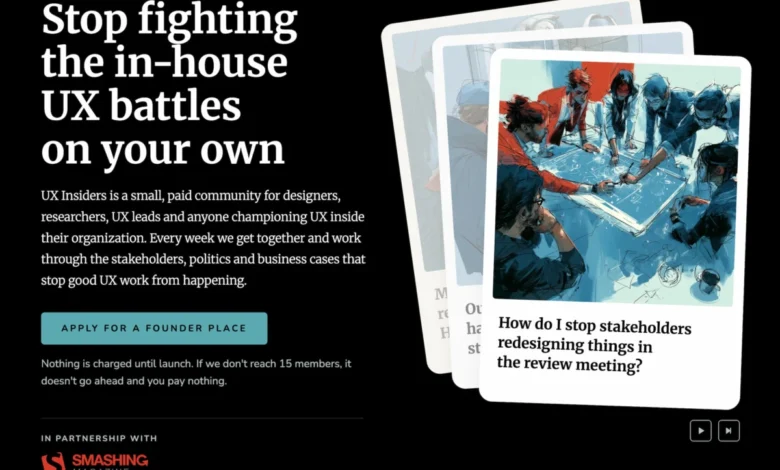
The landscape of professional user experience (UX) design is undergoing a significant shift, moving away from solitary troubleshooting toward collaborative, peer-led problem solving. Paul Boag, a veteran of the digital design industry, an advisory board member for Smashing Magazine, and the author of numerous influential texts on web strategy, has announced the launch of UX Insiders. Scheduled to officially commence on January 5, 2027, this initiative represents a strategic partnership between Boag and the Smashing Magazine editorial team, designed specifically to address the unique professional challenges faced by UX practitioners working within larger organizations.
The core motivation behind the creation of this community stems from an ongoing industry trend: the isolation of in-house UX professionals. While the broader design community is saturated with general-purpose forums and social media groups, Boag identified a critical gap in professional support structures for those navigating the complexities of corporate environments. According to recent industry surveys regarding job satisfaction and professional development, a significant majority of in-house UX designers cite "stakeholder management" and "navigating organizational bureaucracy" as more taxing than the technical execution of their design duties.
The Context of Corporate UX Isolation
Professional isolation in the workplace is not a new phenomenon, but its impact on the UX field has been magnified by the rapid adoption of artificial intelligence and shifting project management methodologies. In-house practitioners often find themselves as "teams of one," tasked with advocating for user-centric principles against competing priorities from senior management, engineering teams, and marketing departments.

Data indicates that the complexity of these internal dynamics has increased as organizations attempt to integrate AI into their research workflows. Many practitioners report that senior management often expects immediate, high-fidelity research results from AI tools, failing to account for the nuances of human-centered design. This "expectation gap" often leaves the individual practitioner without an internal peer group capable of providing actionable, battle-tested solutions. The UX Insiders project is positioned as an "outside view," offering a repository of shared business cases, research plans, and templated workflows that have been validated by peers in similar environments.
Chronology and Launch Logistics
The development of the UX Insiders community follows a structured timeline designed to ensure sustainability and member value.
- November 2026: Initial outreach and opening of applications for "Founder Members." The application process is designed to vet candidates, ensuring that only in-house practitioners gain access, thereby maintaining the integrity of the community’s focus.
- December 11, 2026: A critical milestone date. Should the community fail to reach a minimum threshold of 15 confirmed members by this date, the initiative will be canceled to ensure that the community has the necessary critical mass to function effectively.
- January 5, 2027: The official launch date for the community. On this date, the first cohort of members will gain access to the shared library and the inaugural weekly video conferencing sessions.
The model for this community is heavily influenced by the success of Boag’s previous endeavor, the Agency Academy, which has served freelancers and agency owners since July 2024. By applying the lessons learned from the agency-focused group—specifically the value of a moderated, peer-to-peer exchange—Boag aims to replicate a high-trust environment where members can share sensitive internal strategies without the risk of external exposure or solicitation.
Financial Structure and Professional Development
The economic model for UX Insiders is built on a subscription basis, emphasizing "Founder Pricing" for early adopters. The rate is set at £49 per month for annual billing or £59 per month for a rolling monthly subscription. A key aspect of this pricing strategy is that it is locked in for the duration of the member’s tenure, a move intended to provide financial predictability for practitioners seeking to expense the membership through their corporate training budgets.
For independent professionals or agency owners, the current landscape also includes the concurrent offering of the Agency Academy. As part of a promotional effort with Smashing Magazine, agency-focused professionals have access to a discounted rate until the end of November 2026. This dual-track approach reflects a broader trend in the professional development sector: the move toward niche-specific micro-communities over mass-market educational platforms.
Industry Implications and Future Analysis
The establishment of such a community suggests a maturing of the UX profession. In the early 2010s, the primary focus of the industry was on the dissemination of technical skills and design systems. As the discipline has become a standard feature of modern corporate structures, the focus has shifted toward "soft" skills: communication, persuasion, organizational psychology, and strategic alignment.
The implication for employers is significant. Organizations that support the professional development of their UX staff through these types of external communities may see an increase in retention and productivity. The availability of a peer-vetted "playbook" for common internal conflicts—such as redesign meetings or stakeholder disagreements—could potentially reduce the cycle time for project approvals and minimize the attrition caused by burnout.
From a pedagogical perspective, the move toward community-led learning represents a departure from traditional, top-down knowledge transfer. In the UX Insiders model, the expertise is crowdsourced from the membership. Paul Boag’s role is that of a facilitator and moderator rather than a lecturer. This reflects a shift in the digital economy where experience-based knowledge—often called "tribal knowledge"—is increasingly seen as more valuable than theoretical instruction.
The Role of External Oversight
By vetting applicants to ensure they are strictly "in-house," the community creates a secure space for the candid discussion of organizational challenges. This is particularly relevant in an era where trade secrets and internal processes are highly guarded. The exclusion of agencies and freelancers is a deliberate safeguard, preventing the community from becoming a lead-generation funnel for outside contractors.
This "closed" environment may be the most attractive feature for participants. The ability to discuss a specific, failing project with someone who has no vested interest in selling services, but rather in solving a common professional hurdle, provides a level of objectivity that is difficult to find within a standard corporate hierarchy.
As the industry approaches the January 2027 launch date, the success of UX Insiders will serve as a bellwether for the demand for specialized, practitioner-led support networks. For the UX community at large, it marks a transition toward a more resilient, network-based form of professional development that prioritizes the realities of organizational life over the idealized workflows often presented in design literature. Whether this model scales remains to be seen, but the initial response from the Smashing Magazine readership suggests a strong appetite for a more nuanced, community-centric approach to digital design leadership.
Related posts: