The Evolution of the Digital Audio Workstation
The modern DAW market is dominated by legacy giants—Ableton Live, Logic Pro, and FL Studio—each of which carries a steep learning curve that can often stifle the creative momentum of a novice producer. Historically, these tools were built for engineers with an understanding of complex routing, gain staging, and signal chains. However, as the barrier to entry for music production has lowered, a new generation of creators has emerged: those who prioritize speed, workflow, and the removal of technical friction.
Splice’s entry into the DAW market arrives at a critical juncture. According to recent market analysis from industry research firms like MIDiA Research, the global creator economy, particularly within music production, has seen a compound annual growth rate exceeding 15% since 2020. This influx of new users has created a demand for software that functions more like a creative partner than a rigid technical utility. Splice Create is designed specifically to address the "creative block" phenomenon, where the technical complexity of traditional DAWs hinders the artistic process.
Chronology of a Digital Transformation
Splice began its journey in 2013, primarily focused on cloud-based collaboration tools for musicians. By 2015, the platform had pivoted heavily into the sample marketplace, fundamentally changing how producers sourced sounds. By licensing content directly from artists and sound designers, Splice effectively killed the "pirated loop" culture that had plagued music production for decades.
The trajectory of the company has been marked by strategic expansions:
- 2013-2015: Introduction of the Splice cloud-sync engine and the launch of the royalty-free sample store.
- 2018-2020: The introduction of the Splice desktop app and the integration of "Rent-to-Own" models for high-end plugins, allowing users to pay monthly for software that would otherwise be cost-prohibitive.
- 2022-2024: Development of advanced AI-driven search algorithms (such as "Similar Sounds") to help users navigate their massive library of millions of samples.
- November 5, 2026: The official public beta launch of Splice Create, marking the company’s first foray into a proprietary, full-featured DAW environment.
Technical Architecture and Innovative Features
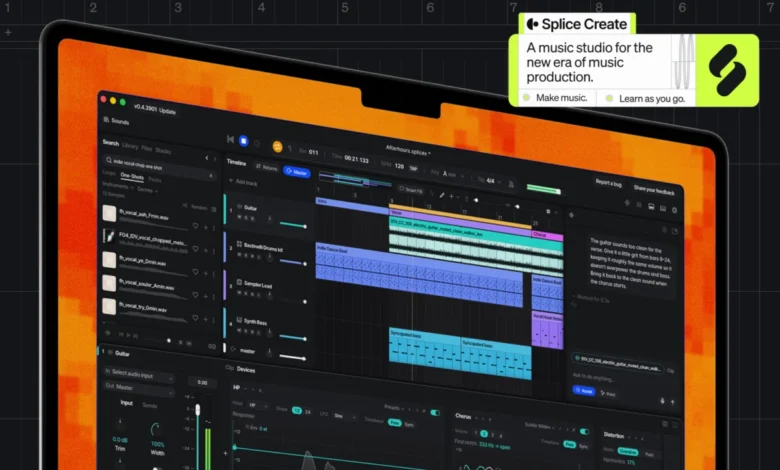
What distinguishes Splice Create from its predecessors is its emphasis on natural language processing and instructional design. Unlike traditional software that requires the user to memorize keyboard shortcuts and complex menus, Splice Create incorporates voice and text-based command structures. This allows a producer to ask the software to perform specific tasks—such as "group these drums" or "apply a saturation effect"—using natural conversational language.
Furthermore, the software introduces a feature termed "Point Mode." This is an interactive overlay that guides users through the production process in real-time. By providing step-by-step contextual advice, it serves as a self-teaching tool for beginners. This pedagogical approach is a significant departure from the standard manuals or external YouTube tutorials that producers typically rely on to master their craft.
The integration of Splice INSTRUMENT and native VST support ensures that while the software is designed for accessibility, it does not sacrifice professional-grade output. The ability to export projects for use in other industry-standard DAWs ensures that users are not locked into the Splice ecosystem, a feature that has historically been a point of contention with proprietary software suites.
Industry Perspectives and Expert Reception
The announcement has drawn attention from both emerging producers and established industry professionals. Skepta, the GRAMMY-nominated MC and producer, has been among the first to publicly endorse the platform, highlighting the necessity of removing technical barriers during the creative process. Skepta noted that the ability to instantly drag and drop high-quality breakbeats into a project—even in mobile or travel-restricted environments—significantly lowers the threshold for producing viable, high-quality music on the fly.
From an industry standpoint, the implications are profound. If Splice Create successfully captures a significant market share, it could force legacy DAW developers to reconsider their user experience strategies. For years, the industry has operated on a model of "complexity equals power." Splice is challenging this assumption, suggesting that power is best realized when it is harnessed through an intuitive, friction-less interface.
Economic Implications for Creators
The shift toward a $9.99/month Pro subscription model for full functionality signals a broader trend in the software industry: the move toward "Software as a Service" (SaaS) and utility-based pricing. By lowering the upfront cost of entry, Splice is effectively democratizing the tools of production.
The economic model is twofold:
- Accessibility: By providing a free tier for the beta, the company allows for widespread testing and user adoption without the barrier of a heavy purchase price.
- Scalability: The Pro subscription, priced at $9.99/month, offers an affordable path for creators to graduate from casual hobbyists to professional producers without the need for a multi-thousand-dollar studio investment.
This pricing structure is particularly attractive to the burgeoning demographic of "bedroom producers" who rely on modular equipment and laptop-based setups. Analysts suggest that if the subscription base scales as anticipated, it could solidify Splice’s position as a dominant infrastructure provider for the next decade of music.
Addressing the Creative Bottleneck
A frequent criticism of modern music technology is that it has become too automated, with "AI-generated" music often criticized for lacking human soul. Splice has sought to distance itself from this narrative by positioning Create as a "human-made" tool. The emphasis is not on the software creating the song for the user, but rather on the software facilitating the user’s intent.
The software functions as an assistant rather than a composer. It handles the mundane, repetitive tasks—such as file organization, sample browsing, and basic signal routing—so that the user can focus on the creative decisions that define a song’s character. This distinction is vital for maintaining the authenticity that is central to the Splice brand identity.
Broader Impact and Future Outlook
As of early November 2026, the Splice Create beta is available exclusively for macOS, with Windows and web-based versions currently in the development pipeline. The decision to prioritize Mac is a common industry practice due to the platform’s high saturation among audio engineers, though the company has stated that cross-platform parity is a high-priority goal for the 2027 roadmap.
The impact of this launch will likely be felt in the coming 12 to 18 months. As users begin to integrate Splice Create into their workflows, the industry will be watching to see if the "all-in-one" approach leads to a decline in the use of disparate plugins and third-party tools. If Splice can successfully maintain the quality of its library while providing a stable, reliable DAW environment, it could potentially disrupt the market hierarchy of the top three DAWs.
In conclusion, Splice Create represents more than just a new piece of software; it represents a fundamental change in the philosophy of music production. By centering the human creator and leveraging modern advancements in voice control and AI-assisted workflow, Splice is betting on a future where the technical barriers to music production are minimized, allowing creativity to flourish unencumbered by the complexity of the past. Whether this will fully displace legacy software remains to be seen, but the initial response suggests that the market is ready for a more intuitive, user-centric approach to digital music composition.