The Scientific Methodology of AI Search Optimization Proving Causation Through Split Testing and Data Analytics

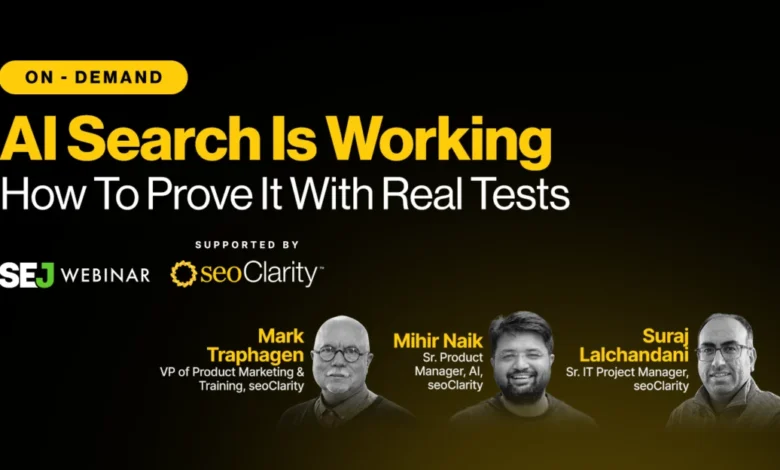
The digital marketing landscape is currently undergoing a fundamental transformation as artificial intelligence search engines and generative AI overlays redefine how users discover information online. In a recent high-level industry briefing hosted by Search Engine Journal, experts from seoClarity—including Mark Traphagen, Vice President of Product Marketing and Training; Mihir Naik, Senior Product Manager of AI; and Suraj Lalchandani, Senior IT Project Manager—unveiled a rigorous scientific framework for measuring and influencing visibility within these new AI environments. The central revelation of the session was the successful demonstration of a causal link between specific on-page optimizations and the frequency of AI citations, a feat that has largely eluded search engine optimization (SEO) teams until now. By implementing a "reversion" testing model, the team proved that adding FAQ sections to high-value pages significantly increased their appearance in AI-generated answers, while removing those same sections caused citations to drop back to baseline levels. This methodology marks a departure from the industry’s reliance on correlation and signals a new era of data-driven Answer Engine Optimization (AEO).
The Evolution of Measurement in the Age of AI Overviews
For much of the past year, digital marketers have operated in a vacuum regarding AI search performance. Unlike traditional search, which offers robust analytics through platforms like Google Search Console, AI search visibility has been notoriously difficult to quantify. Most organizations have relied on manual sampling or third-party scraping tools, which often provide an incomplete or "noisy" picture of how Large Language Models (LLMs) interact with brand content. This changed significantly on June 3, when Google officially launched dedicated Search Console reports for AI Overviews and AI Mode. This update provides first-party, page-level data on how often URLs appear within Google’s AI-driven search features.
According to Suraj Lalchandani, this development represents the most significant measurement upgrade since the inception of AI search. The availability of first-party data allows for a level of trust that third-party tools cannot replicate. However, the seoClarity team was careful to note that while Google’s new reports are a breakthrough, they only cover a fraction of the total AI search ecosystem. Platforms such as ChatGPT, Claude, Perplexity, and Gemini still require structured third-party tracking and custom-built monitoring solutions to gauge performance accurately. The current challenge for enterprise-level brands is integrating these disparate data sources into a cohesive testing program that can identify which content changes actually drive results.
Establishing Causation Through Reversion Testing
The core of the seoClarity presentation focused on the distinction between visibility scores and actual performance. While visibility scores indicate whether a brand appeared in a search result, they do not explain why. To move beyond guesswork, the team utilized a split testing methodology across a variety of AI surfaces. The most compelling evidence came from a large-scale test involving approximately 1,000 prompts. By adding structured FAQ sections to a set of test pages, the team observed a measurable lift in citations compared to a control group.
To confirm that this lift was not merely a result of a model update or seasonal fluctuation, the team employed a reversion strategy: they removed the FAQ sections after the initial lift was recorded. When the citations subsequently dropped back to their original levels, the team had what Lalchandani described as "the second half of proof." This ability to turn a result "on and off" is the gold standard of scientific proof in digital marketing. It demonstrates that the LLM is specifically identifying and valuing the FAQ content as a source for its generated answers. This finding has immediate implications for content strategy, suggesting that structured, question-and-answer formatted content is a primary driver for AI "findability."
The "Golden Prompt Set" and Tiered Strategy
A critical component of any AI search testing program is the selection of prompts. The seoClarity methodology involves building a "golden set" of prompts that span the entire marketing funnel—from initial awareness to customer retention. These prompts are not chosen at random but are meticulously tagged by funnel stage and then sorted into tiers based on the brand’s current standing in AI responses.
Tier 1 prompts are identified as "easy wins." These are queries where the brand is already relevant to the topic, but the AI has not yet been provided with a specific URL that it deems worthy of a citation. In these instances, the goal is to provide the AI with a "linkable asset"—a clear, concise piece of information that fits the LLM’s requirements for a source. Tier 2 prompts represent a "heavier lift," where the brand may not yet be perceived as an authority or where the competition for the citation is more intense. Interestingly, the team revealed that they often drop certain prompts from testing entirely if the gap between the brand’s content and the AI’s requirements is too vast to bridge in the short term. This sequencing is strategic: by securing early wins in Tier 1, marketing teams can build the internal "political capital" and budget necessary to pursue more complex, long-term optimizations.
Engineering a Control Group for Non-Deterministic Models
One of the primary hurdles in testing AI search is that LLMs are non-deterministic; they can provide different answers to the same prompt at different times, and they do not allow for traditional A/B testing where traffic is split 50-50. To solve this, the seoClarity team utilizes a "correlated control group" methodology. This involves selecting a set of pages that historically perform similarly to the test pages and using them as a noise filter.
This methodology requires a high degree of discipline regarding timing. A specific baseline period is established before any changes are made, followed by a minimum test window after the changes go live. Because AI search engines do not always crawl and update their models overnight, cutting a test window short can lead to "reading noise" rather than actual results. The team categorized test outcomes into three distinct types: a positive lift, a neutral result, or a negative impact. Each outcome provides valuable data for refining the brand’s AI hypothesis. Even a negative or neutral result is considered a "win" in this framework because it provides empirical evidence that prevents the organization from wasting resources on ineffective tactics.
Analyzing the ROI of the "Zero-Click" Citation
A common concern among digital marketers is the value of an AI citation that does not result in a direct click to the website. If the AI provides the answer directly in the search interface, the user may never visit the source URL. However, Mihir Naik argued that the ROI of a citation goes far beyond referral traffic. When a brand is cited, it gains the ability to "control the narrative" inside the AI’s answer.
This is particularly crucial in comparison queries—for example, when a user asks an AI to compare two competing software products. If a brand is cited, the AI is more likely to use that brand’s specific unique selling propositions (USPs) and accurate data points. Without a citation, the AI may rely on outdated or third-party information that misrepresents the brand. Furthermore, Lalchandani shared an example of a restaurant client where the AI’s inability to reach or verify certain content led to inaccuracies in the generated response. Being cited ensures that the AI’s "representation" of the brand is accurate, which is vital for brand equity and long-term customer trust.
The Role of Technical Foundation and AI Authority
Despite the focus on new AI-specific tactics, the webinar emphasized that traditional SEO remains the foundation of AI search performance. Mark Traphagen noted that seoClarity’s clients with the most technically healthy sites and well-optimized content are consistently the best performers in AI search. AI optimization is viewed not as a replacement for SEO, but as an "extra layer" on top of a solid technical foundation.
The concept of "AI Authority" was also addressed. While there is no single metric for AI authority, the team identified four "stackable signals" that indicate how much an LLM trusts a source. These include citation share on top prompts and consistency across different AI engines. When a brand is consistently cited as a source for a specific category of questions across ChatGPT, Google, and Perplexity, it becomes the de facto authoritative source for that topic. This cross-platform consistency is a powerful signal of brand authority that transcends traditional backlink profiles.
Implications for the Future of Search Marketing
The findings presented by the seoClarity team suggest that the future of search marketing will be defined by a more rigorous, scientific approach to content creation. The success of the FAQ test, contrasted with less predictable results from tests on meta descriptions and listicle formatting, highlights the need for continuous experimentation. As AI models continue to evolve, what works today may not work six months from now.
Organizations must move away from "best practices" and toward a model of continuous testing and validation. By building a robust testing infrastructure—including golden prompt sets, correlated control groups, and reversion testing—brands can navigate the volatility of the AI search landscape with confidence. The transition from guesswork to evidence-based optimization is no longer a luxury but a necessity for any brand seeking to maintain its visibility in an increasingly AI-driven digital world. The ability to prove causation, as demonstrated in the FAQ case study, provides a roadmap for how enterprises can systematically improve their findability and protect their brand narrative in the age of the Answer Engine.
Related posts: