Sailing in Serenity: How Viking Transformed Modern Cruise Ship Design Through Scandinavian Principles

The contemporary cruise industry has long been defined by excess: soaring multi-story atriums flashing with neon, ornate carpeting, glitzy casinos, and a maximalist aesthetic intended to dazzle mass-market travelers. Against this backdrop of theatrical scale, a quieter revolution has been unfolding across the seas. Cruise lines are increasingly abandoning sensory overload in favor of restraint, light, and understated luxury. At the forefront of this movement is Viking, a company that has systematically rewritten the spatial and visual vocabulary of modern cruising by anchoring its fleet-wide architecture in the tenets of Scandinavian design.
Translating the core pillars of Nordic design—light-filled spaces, pale woods, clean lines, and an overarching sense of calm—onto a floating vessel presents a monumental spatial challenge. Unlike a land-based boutique hotel, a cruise ship must contend with strict maritime safety regulations, variable weather systems, dynamic light changes at sea, and the sheer logistical hurdles of accommodating thousands of passengers within a confined footprint. Yet, through a rigorous collaboration with Rottet Studio, Viking has managed to bypass the conventional tropes of cruise ship interiors, crafting ocean, river, and expedition vessels that feel less like commercial liners and more like thoughtfully curated, high-end residential homes.
The Evolution of New Nordic Design at Sea
At the helm of this design philosophy is Richard Riveire, founding principal of Rottet Studio, who has overseen the interior architecture for Viking’s extensive fleet. Riveire and his team approach Scandinavian design not as a static, historical visual style, but as a living framework that evolves alongside modern travel habits. While industry observers often refer to this contemporary interpretation as "New Nordic," Riveire points out that the terminology itself is secondary to the practical application of age-old Scandinavian principles adapted for the 21st century.

"Although ‘new Nordic’ is not terminology we use formally, traditional Scandinavian principles have evolved and are being interpreted for how people live and travel today," Riveire explains. "There’s still a strong sense of restraint, but it’s balanced by a feeling of being lived in. These days, Scandinavian design is less about minimalism and more about creating spaces that feel welcoming, thoughtful, and enduring."
Rather than treating interior design as decoration applied after construction, Rottet Studio established a foundational design framework built upon five pillars: residential modernism, nature, craft, heritage, and exploration. This framework ensures that architectural elements—such as pale oak flooring, stone finishes, and neutral wall panels—remain structurally restrained, allowing tactile details like woven leather, wool blankets, and sculptural woodwork to introduce warmth.

A Chronology of Restraint: The Strategic Shift in Cruise Architecture
The transition toward minimalist, residential-style cruising did not happen overnight. Over the past two decades, demographic shifts among travelers have driven a demand for experiential, wellness-oriented, and culturally immersive travel. Mass-market cruise lines initially responded by building larger mega-ships outfitted with roller coasters and waterparks to capture multi-generational families. Conversely, Viking carved out a distinct market niche targeting travelers who preferred cultural enrichment, intellectual stimulation, and architectural tranquility.
When Viking launched its first ocean ship, the Viking Star, in 2015, it signaled a definitive departure from the industry standard. The interior spaces were intentionally designed to scale down the cavernous feel typical of cruise liners. Over subsequent years, as the fleet expanded to include dozens of ocean and river vessels, as well as specialized expedition ships designed for polar regions, the design language matured. The introduction of spaces like the Wintergarden—featuring a geometric wood lattice ceiling beneath expansive glass roofing—and the Explorers’ Lounge cemented a visual identity that married maritime exploration with Nordic domesticity.

Tapping Into Nordic Heritage, Craft, and Biophilic Design
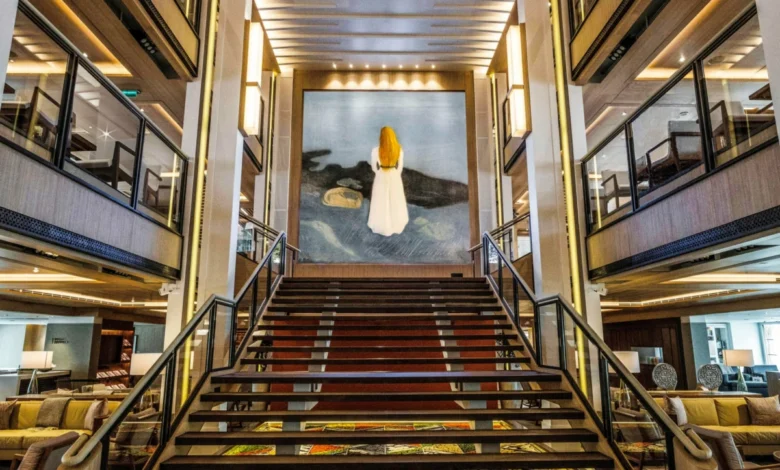
A critical component of Viking’s spatial strategy involves bridging the gap between the vessel’s physical environment and its cultural roots. This is achieved through carefully curated regional artwork and historic references. Throughout the fleet, passengers encounter original pieces by celebrated Norwegian painter Edvard Munch, anchoring major circulation arteries like the atrium stairwells in Scandinavian art history.
Textiles and decorative elements further ground the experience. Staterooms feature traditional Norwegian Marius blankets, utilizing a familiar geometric knitting pattern that dates back decades, while public spaces showcase fabrics by Dutch designer Hella Jongerius and tabletop accessories by iconic Finnish architect Alvar Aalto.

"That heritage connects the design to Norwegian culture and folklore, while exploration reminds us that this is a ship designed for people who are curious about exploring the world," says Riveire. "So maps, globes, libraries, constellations, and other references to exploration play a meaningful role in our designs."
Furthermore, biophilic design plays a functional role in mitigating the artificial nature of being at sea. References to birch trees, lichen, moss, and driftwood are woven into the physical fabric of the ships. In public restrooms, guests are greeted by the subtle, ambient sound of birds chirping. In the onboard spas—which feature traditional Nordic amenities like snow grottos, cold plunges, and thalassotherapy pools—natural stone, slate, and expansive glass reinforce a minimalist palette designed to lower cortisol levels and promote restorative wellness.

Mastering Light, Color, and Spatial Scale at Sea
Designing for maritime environments requires addressing unique lighting challenges that do not exist in land-based architecture. On land, architects can easily map the predictable path of the sun across a building’s orientation. At sea, however, solar exposure is wildly variable.
"At sea, the sun is far more variable—not only in direction, but also in duration," notes Riveire. "During Arctic summers, for example, it may never set."

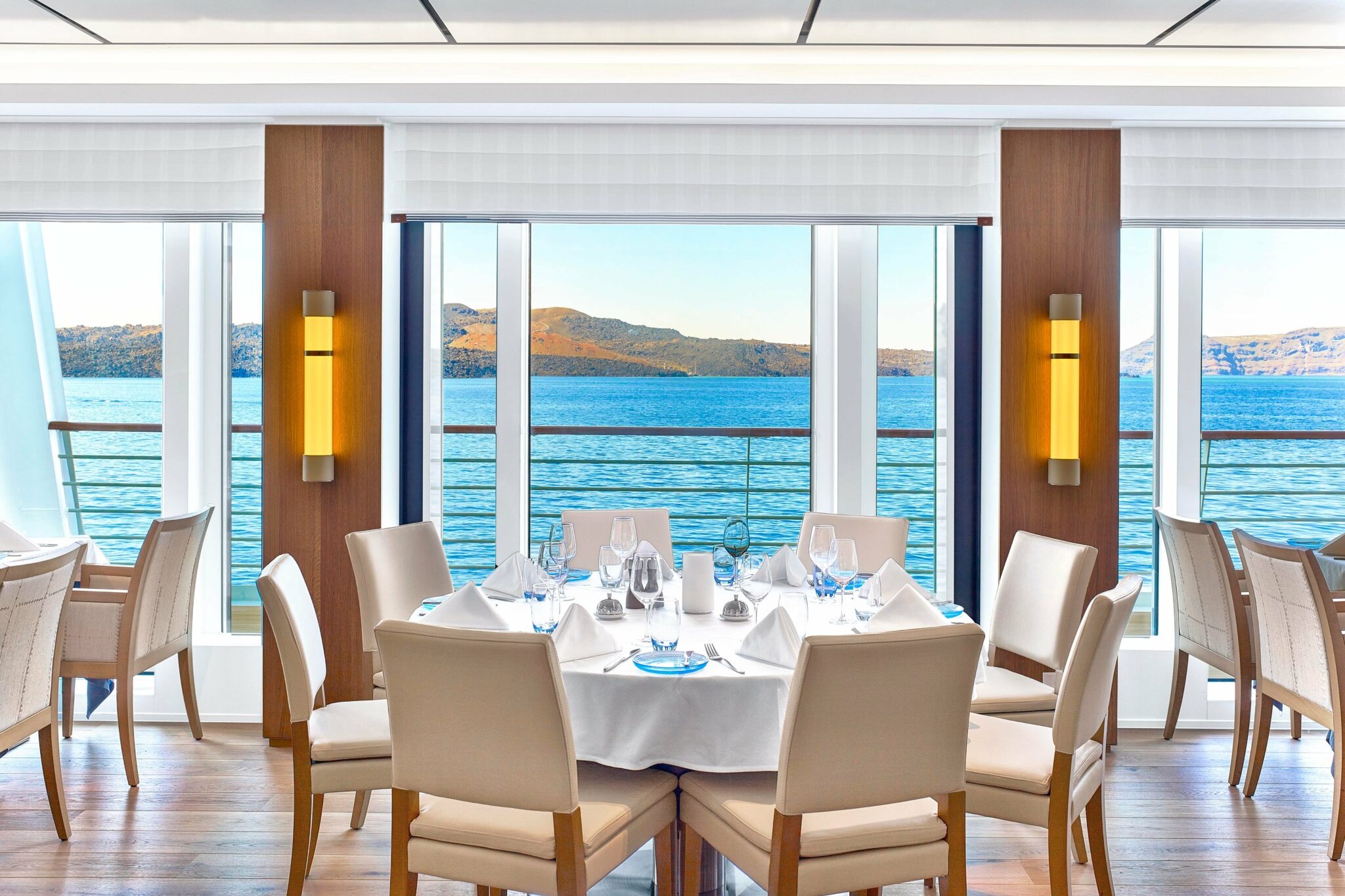
To counteract this, the fleet’s interior architecture incorporates flexible shading systems, architectural openings, and strategic glass placement. Floor-to-ceiling windows do not merely illuminate the rooms; they frame passing landscapes—whether a steep Norwegian fjord, a winding European river, or an icy Antarctic coastline—turning the external environment into an ever-shifting piece of art.
Color is deployed with equal discipline. Eschewing the stark, clinical whites associated with early modernism, the design palette relies on warm creams, sandy tans, and earthy neutrals. Measured doses of color are introduced selectively: navy and slate blue stripes on stateroom headboards, translucent aqua glassware in the dining rooms, and rust-orange accents in throw pillows and carpets.

To counteract the cavernous scale of multi-level atriums and sprawling public lounges, Rottet Studio implemented what Riveire terms the "cocoon principle"—a house-within-a-house concept. By breaking large rooms down into intimate seating nooks, pairing low-slung armchairs with built-in bookshelves, and arranging furniture to mirror domestic living rooms, the ships successfully create psychological shelter and privacy for guests.
Engineering Comfort: Acoustics and Discretionary Technology
A truly residential atmosphere requires careful attention to invisible sensory factors, notably acoustics and technology. Cruise ships are inherently noisy environments, propelled by massive diesel-electric engines and populated by hundreds of walking passengers.

To maintain a sense of hygge—the Danish and Norwegian concept of coziness and comfortable conviviality—Viking’s interiors utilize advanced acoustic engineering. Sound-absorbing textile wall panels, acoustic carpet underlays, and heavily upholstered furniture absorb ambient noise in public corridors and dining rooms.
Simultaneously, modern technology is strictly subordinated to the aesthetic vision. In stateroom bathrooms, underfloor heating warms the stone tiles unobtrusively, while climate control and lighting management systems are integrated directly into custom wood joinery.

"In the Scandinavian tradition, design serves human comfort without demanding attention," Riveire concludes. "Technology and acoustics are integrated so subtly that you don’t notice how the space functions—only how calm it makes you feel."
Broader Industry Implications and Market Impact
The commercial success of Viking’s design ethos has sent ripples across the broader cruise and hospitality industries. As luxury travelers increasingly prioritize mental wellness, quiet luxury, and architectural authenticity over superficial flashiness, other cruise operators are being forced to rethink their interior strategies.

By proving that high-density passenger vessels can successfully adopt the intimate, human-centric scaling of residential architecture, Viking has helped redefine contemporary maritime design. The shift demonstrates that modern luxury travel no longer requires visual opulence to convey value; instead, true sophistication at sea is increasingly measured by the quality of light, the honesty of materials, and the profound, restorative quiet of the space around you.